

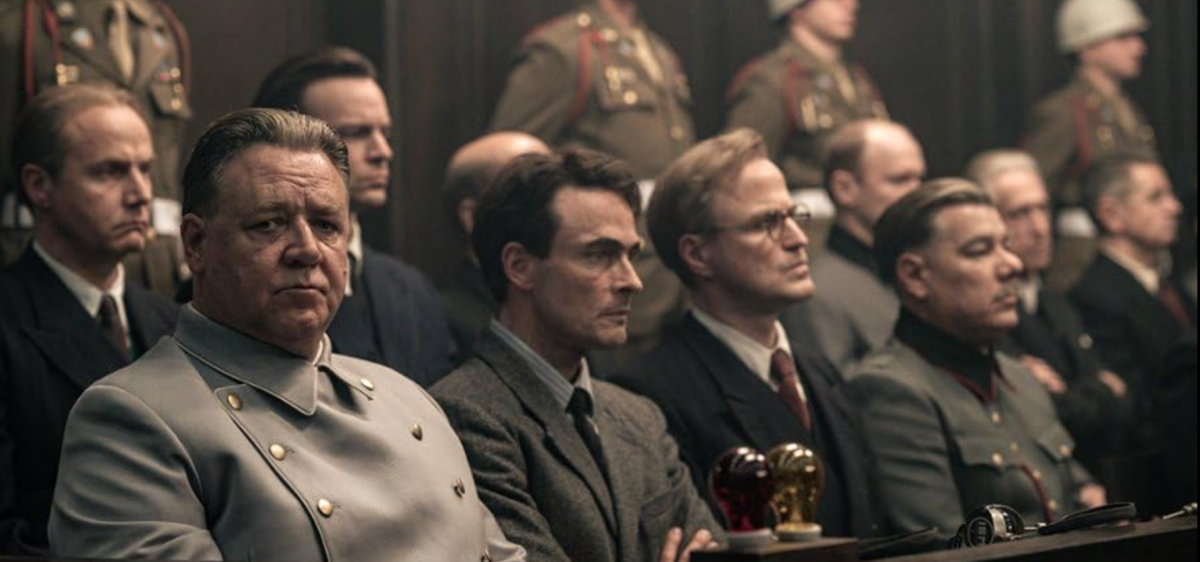


To comprehend the mentality of Germans who followed Hitler, whose Nazi Party by 1933 had become Germany’s most popular, we need to understand what Germany went through from 1919 to the end of 1932.
This is not the first mention of the film “Nurenberg” (2025) on this website. In December 2025, Donna Park wrote that she went to see the film “to revisit the issue of how a court of law can be used to convict those guilty of war crimes. As a result, several parts of the film left me uneasy and looking for a better way to govern our world.” She goes on to indicate that Hermann “Goering [Russell Crowe] suggested that if the Germans won the war, the Americans could have been brought to trial for dropping two nuclear bombs on Japan in August 1945.” She also stated that “his suggestion that the war’s victors were also responsible for war crimes has a disturbing element of truth to it.” The rest of her article is devoted not to the movie, but mainly to the question of “how can we move forward to creating a world in which international law and its obligations receive proper respect?”
Noble though Park’s purpose is, my intention in the present article is different. It follows up from a question a U. S. Army psychiatrist, Douglas Kelley (Rami Malek), assigned to talk to an incarcerated Goring before his trial, about the leading German war criminals. What, he asks, “if we could dissect evil? What sets these men apart from all others? What enabled them to commit the crimes that they did?” He goes on to suggest that if “we could psychologically define evil,” we could ensure that “something like this never happens again.” (Film quotes are taken from the filmscript.)
Thus, in addition to briefly summarizing the film--which is well acted and directed-- this essay will examine the problem of evil and what, as Kelley indicates, made some Germans willing to kill some six million non-combatant Jews, as well as millions of others. Also it will relay some insights provided by Eddie Jaku’s book The Happiest Man on Earth: The Beautiful Life of an Auschwitz Survivor (2021).
The Army psychiatrist, Douglas Kelley, referred to above was the dual subject of Jack El-Hai’s 2013 book, The Nazi and the Psychiatrist: Hermann Göring, Dr. Douglas M. Kelley, and a Fatal Meeting of Minds at the End of WWII. And the film being reviewed here is partly based on it.

To comprehend the mentality of Germans who followed Hitler, whose Nazi Party by 1933 had become Germany’s most popular, we need to understand what Germany went through from 1919 to the end of 1932. There are several Internet sites that help lead us to this understanding.
First, there is the National WWII Museum in New Orleans, which has posted an article entitled “How Did Adolf Hitler Happen?” It points out that the Allies’ post-WWI treaty, “the Treaty of Versailles, . . . compelled the new German government, the Weimar Republic, to accept” it. And along with it, an obligation to pay $33 billion in war reparations.Germany also had to give up its prized overseas colonies and surrender valued parcels of home territory to France and Poland. The German army was radically downsized and the nation forbidden to have submarines or an air force.”
The article then goes on to indicate that “paying the crushing reparations destabilized the economy, producing ruinous, runaway inflation. By September 1923, four billion German marks had the equal value of one American dollar.” During the first five post-WWI years, “Hitler blamed the Weimar Republic’s weakness on the influence of Germany’s Jewish and communist minorities, who he claimed were trying to take over the country.”
The museum piece also notes that Hitler was an “ideologue,” a point we shall return to later. But if it had not been for the Great Depression, which hit Germany worse than in the USA, Hitler might not have come to power in January 1933, as he did. “The worldwide economic depression and the rising power of labor unions and communists convinced increasing numbers of Germans to turn to the Nazi Party. The Nazis fed on bank failures and unemployment—proof, Hitler said, of the ineffectiveness of democratic government.”

As I pointed out in a text almost two decades ago, there was “a natural tendency of people in times of great stress and frustration to blame their problems on others, on scapegoats, and Hitler’s provision of a convenient list of them, especially the Allies, Communists, Jews, and most Weimar politicans,” aided his rise to power.
A central question in the debate about the evils of the Holocaust is whether a different nation than that of Germany would have been capable of perpetrating such an atrocity as the Holocaust. Some say that, given similar conditions to those faced by the Germans, “yes,” it’s likely that other nations might have perpetrated their own Holocausts. Others, however, think it unlikely that the people of most other nations would have acted like the Germans did.
But one famous 1960s experiment by a Yale professor on U. S. subjects revealed “the extreme willingness of adults to go to almost any lengths on the command of an authority....Ordinary people, simply doing their jobs, and without any particular hostility on their part, can become agents in a terrible destructive process. Moreover, even when the destructive effects of their work become patently clear, and they are asked to carry out actions incompatible with fundamental standards of morality, relatively few people have the resources needed to resist authority.”
Such a conclusion is scary indeed and suggests--to answer Army psychiatrist Kelley’s question, “What enabled them to commit the crimes that they did?”--that given similar circumstances, the people of many nations might have acted as the Germans did.
I have often written before that it all comes down to people’s values. As U.S. neuropsychologist and Nobel laureate Roger Sperry stated, “Human value priorities…stand out as the most strategically powerful causal control now shaping world events. More than any other causal system with which science now concerns itself, it is variables in human value systems that will determine the future.”
The main problem is that most people are not taught good values. Many conservatives were, or are, taught the wrong ones, and many progressives do not emphasize them enough. In his book Culture Wars (1991), James Davison Hunter summed up the clash over values that had come to characterize U. S. politics. On one side of this “war” were conservatives who believed in God, on the other side were progressives, who relied more on reason, their inner selves, and contemporary conditions in deciding right from wrong.

Several years later, Values Matter Most (1995) appeared. Its author was Ben J. Wattenberg, who for many years had been a Democrat, but became a “Reagan Democrat” in the 1980s, partly because Reagan supported more of the values in which Wattenberg believed. Among the 44 value issues he listed in his book were abortion, pornography, illegitimacy, infidelity, homosexuality, movies and television, and various issues related to what occurred in public schools, for example, sex education, dispensing condoms, and prayer. About curriculum issues like teaching evolution or having students read books that some parents found offensive, he has little to say, but these were also school issues contested in the cultural war.
It was not until Barack Obama’s The Audacity of Hope (2006) proclaimed “that Democrats are wrong to run away from a debate about values” that we heard a prominet progresive welcome a values debate. He stated that empathy “is at the heart of my moral code, and it is how I understand the Golden Rule—not simply as a call to sympathy or charity, but as something more demanding, a call to stand in somebody else's shoes and see through their eyes.” However, he also stressed other values such as tolerance, diversity, rationality, kindness, self-reliance, self-discipline, mutual responsibility, temperance, and optimism.
Decades before Obama wrote about values, a European socialist, E. F. Schuamacher, who later became a Catholic, wrotethat “education which fails to clarify our central convictions is mere training or indulgence. For it is our central convictions that are in disorder, and, as long as the present anti-metaphysical temper persists, the disorder will grow worse. Education, far from ranking as man's greatest resource, will then be an agent of destruction.”
One person who tried to address Schumacher’s concern was Yale psychologist Robert Sternberg in his “It's Not What You Know, but How You Use It: Teaching for Wisdom” (2002). He mentioned that at Yale University's Center for the Psychology of Abilities, Competencies, and Expertise, he and colleagues “are seeking a solution—teaching students from roughly age 10 or so to think wisely. Underlying this program is the view that we need to teach students not only knowledge but also how to use that knowledge well.”

Sternberg goes on to state that “people are wise to the extent that they use their intelligence to seek a common good. They do so by balancing, in their courses of action, their own interests with those of others and those of larger entities, like their school, their community, their country, even God. And they balance these interests over the long and the short terms. . . . Our goal is not to teach values but to help children develop positive values of their own that promote social welfare.”
The problem with the Germans, both before and after Hitler came to power, was that they did not help Germans develop values that promoted the social welfare of society, not all of society, not the Jews and other minorities, like the gypsies. Sternberg believed that many otherwise smart people who lacked wisdom did so because they “are particularly susceptible to four fallacies,” which are tied up with too big an ego, with overestimating their own importance and powers, with a lack of humility.
At one point in “Nurenberg” psychiatrist Kelley tells Goring, you’re “a narcissist. . . . With a strong ambition and drive to subjugate the world as you find it. To your own pattern of thinking.” Although Goring tries to deny or downplay his responsibility for the Holocaust, he knew more about it than he admits, and he could have objected to it. But he did not. Like so many Germans, he lacked the wisdom to do so.
I have written often about the importance of wisdom and the values that accompany it, e.g., love, empathy, humility, etc. But many people--and not just in Nazi Germany--were (or are) not wise. Instead they emphasize egotistic or ideological needs, like making money, gaining fame, or privileging “pure Germans” (or white people).
The favoring of “pure Germans” is connected with Hitler’s ideology. In a 2013 sermon Pope Francis warned against being ruled by any ideology: “When a Christian becomes a disciple of the ideology, he has lost the faith...But it is a serious illness, this of ideological Christians...His attitude is: be rigid, moralistic, ethical, but without kindness.” He urged Christians “to remain humble, and so not to become closed.”
The pope’s mention of kindness reminds me of a book I mentioned earlier--The Happiest Man on Earth: The Beautiful Life of an Auschwitz Survivor. In it, its author (Eddie Jaku) wrote, “Kindness is the greatest wealth of all. Small acts of kindness last longer than a lifetime.” Jaku added that the main psychological factor that explained Nazi behavior was hate. “Hate is the beginning of a disease, like cancer. It may kill your enemy, but it will destroy you in the process.”
Perhaps a prominent U. S. politician who recently said, “I hate my opponent and I don't want the best for them” should heed these words.
