

“The Burial”

Amazon’s Entertaining Courtroom Drama Features Two First-Rate Actors Versus a Powerful Corporation
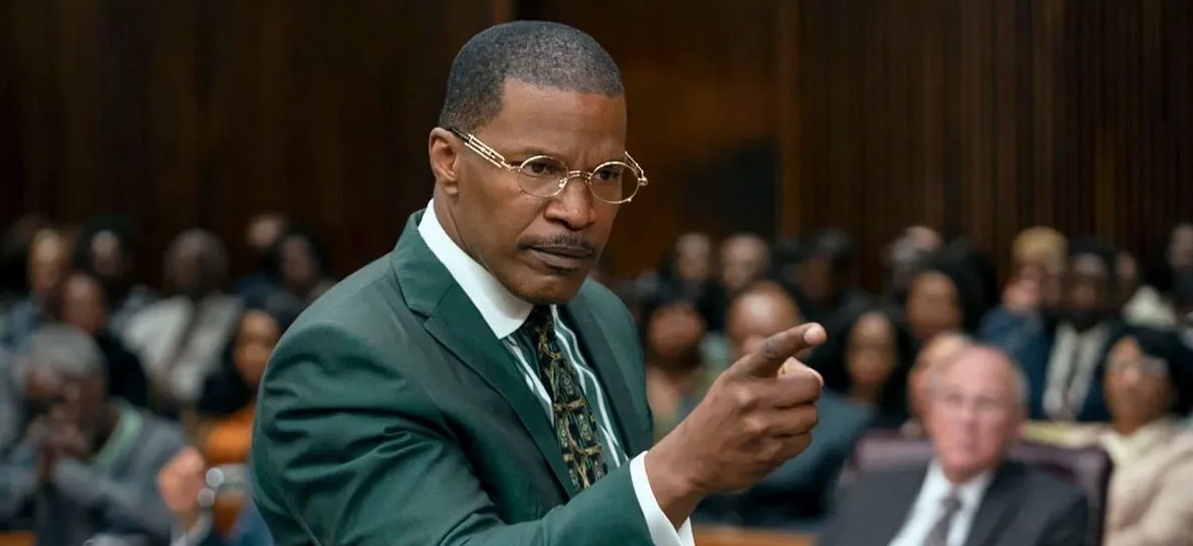
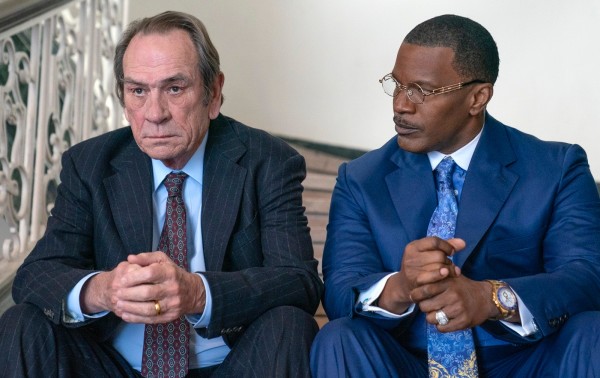
The two actors mentioned in my title? Jamie Foxx and Tommie Lee Jones. And yes, flamboyant Foxx (playing attorney Willie Gary) and the more muted Jones (funeral-home owner Jeremiah “Jerry” O’Keefe) are, as always, excellent. The film starts with the charismatic Gary speaking to a congregation in a Black Baptist church in Indiantown, Florida (just northwest of Palm Beach). He’s no minister, but his brother “preaches here,” and asked him to say a few words. And say them he does.
And right away, the Black spirit of “The Burial” emanates from Willie Gary and the congregation—the film’s director, Maggie Betts, is a Black woman who previously directed 2017’s “Novitiate.” The Black spirit shines forth because Willie asks, “Where do we want to be?” And the churchgoers respond, “Home.” Willie says, “Home is where the heart is. Amen.” And the congregants answer, “Amen.” He says, “Hallelujah.” And they answer back, “Hallelujah.” (All movie quotes are taken from the filmscript.)
One of the first things a White speaker notes when talking to a Black audience is the wonderful feedback one receives while speaking. And in an interview director Betts admits that although she based her film on a true story about lawyer Gary and his client O’Keefe, she also wanted to emphasize the racial angle.
Thus, what we have here is a movie that does that—more on that topic later—but which also leaves us with a feel-good feeling because it deals with the growing friendship of a Black guy (Gary) and a White guy (O’Keefe). And this a dream that many of us have, that we share with Martin Luther King, Jr. (MLK)— “I have a dream that one day down in Alabama . . . little black boys and black girls will be able to join hands with little white boys and white girls as sisters and brothers.”
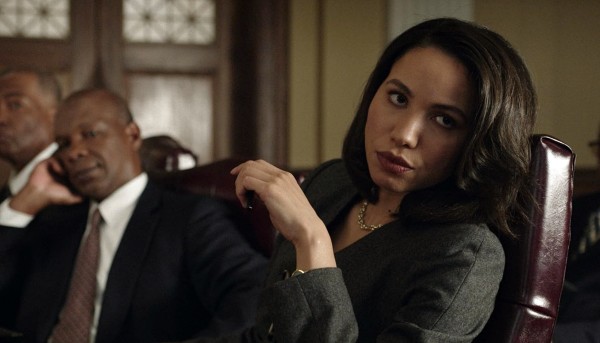
Moreover, the “dream,” the American Dream, is relevant to Betts’ film. At one point, Willie is talking to an opposing lawyer, Mame Downes (Jurnee Smollett), and she tells him, “we’re both living our own little version of the American dream,” and a little later she says, “the Black American dream is quite different than the white American dream.”
Her words remind us of a poem (“Let America Be America Again”) by Langston Hughes, perhaps the most eminent poet of the “Harlem Renaissance.”
Let America be America again.
Let it be the dream it used to be
….……………………………………………..
[and the repeated refrain:]
(America never was America to me.)
….……………………………………………
I am the poor white, fooled and pushed apart,
I am the Negro bearing slavery's scars.
I am the red man driven from the land,
I am the immigrant clutching the hope I seek—
And finding only the same old stupid plan.
Of dog eat dog, of mighty crush the weak.
I am the young man, full of strength and hope,
Tangled in that ancient endless chain
Of profit, power, gain, of grab the land!
Of grab the gold! Of grab the ways of satisfying need!
Of work the men! Of take the pay!
Of owning everything for one's own greed!
….…………………………………………..
Although Hughes poems was written in 1935, the discrepancy between the American Dream and the reality of the Black experience was still felt in 1995 when the trial that is at the center of “The Burial” occurred. “Profit,” “gain,” “greed” sum up the being of Canada’s Loewen Group, a corporation that in the words of Mike (Alan Ruck), O’Keefe’s longtime lawyer, has “been been on a pretty significant acquisition spree. Going all across the country [USA], buying up every independently owned funeral chain they can get their hands on. These guys, they’re really big players.” Later on it’s revealed that the Loewen Group owns “1,115 funeral homes, 427 cemeteries, 354 insurance companies.” (See here for the tendency of such corporations as Purdue Pharma, Boeing, Pacific Gas & Electric, and Facebook to put profits before people.)
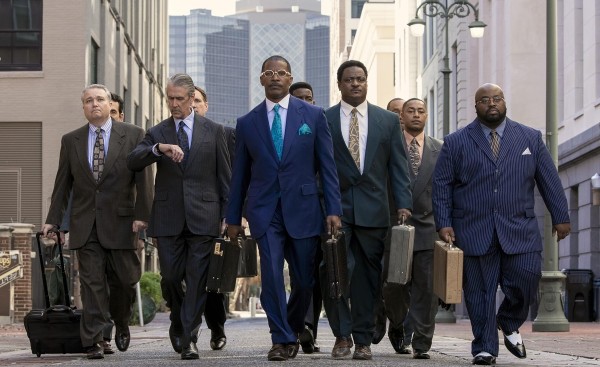
Because of financial trouble, Jerry O’Keefe flies to Vancouver and agrees to sell three of his eight funeral homes to Loewen. With him are lawyers Mike and Hal (Mamoudou Athie), a young Black man who is a friend of one of Jerry’s children (he and his wife have 13 kids). On his boat, Ray Loewen (Bill Camp), President and CEO of the the Loewen corporation, tells Jerry that he’ll get his “lawyers to draw up the contracts so we can get it done immediately.”
But about four months pass and still no contracts. Hal convinces Jerry that Loewen is deliberately stalling. “The longer he stalls, the worse you’re screwed. First, the insurance commission takes your license, effectively destroying your livelihood, until, sooner or later, you have no choice but to file for bankruptcy. Now not only does Loewen get the three homes, he can actually buy your entire business out from under you at yard-sale prices.” Thus Jerry decides to sue the Loewen’s company, which he does in “Jeremiah J. O’Keefe Sr. v. The Loewen Group LLC.”
Hal also convinces Jerry to hire Willie Gary as his attorney. This occurs after Jerry watches a tape (It’s the mid 1990s) that Hal brought to his house. It’s an episode about Gary on Robin Leach’s “Lifestyles of the Rich and Famous.” It relates that Gary is “a man who refused to accept a life sentence of poverty because he believed in the American dream. Born to a family of migrant sharecroppers working the sugarcane fields of Florida. . . . now Willie regularly wins multimillion-dollar cases. . . . He not only owns his own private 737 jet, called Wings of Justice, he also lives the high life in a 50-room mansion along the luxurious Florida coast.”
But perhaps more than Leach’s words, it is Hal’s additional statement that convinces Jerry to hire Willie. “The case was filed down in Hinds County [Mississippi]. That’s a three-to-one Black/white ratio. That means there’s a 70% chance we’ll get a Black judge, and if we do go to trial, likely a Black jury as well.” [Hal’s prediction proves correct; the judge is Black and so are most of the jurors.]
Besides the “American Dream,” the film also touches on values. (See here on the centrality of values in people’s lives.) During the trial Willie states, “Jerry, you an eight-time decorated hero. You got the Air Medal, the Navy Medal. . . . You got the Flying Cross. And you did all of that in the sacrifice for your country [during WW2]. . . . You came back to your county, you took over the family business. . . . You ran for mayor in your home town in Biloxi” [and “served two terms as mayor, from 1974 until 1982”]. Under questioning, Jerry also relates that he denied the Ku Klux Klan a permit to demonstrate in Biloxi. Willie adds, “Now, flying warplanes is one thing, but to tell the Klan ‘no’ at that time, that’s a different type of bravery.” With Jerry still testifying, Willie inquires, “I just want to ask you, what are your values? What is important to you?”
Although this courtroom scene cuts away without Jerry answering, he did reveal what he valued earlier. Willie had asked him why he wanted to sue Loewen, and he answered, “Cause he tried to mess with the one thing that means the most to me in life: being able to leave something behind for my children and my grandchildren when I go. They have a legacy, Willie. And I do mean to pass it on to ’em.”
Willie’s values are more murky. Pursuing the American Dream can mean different things to different people. (See my “Two American Dreams,” where I contrast Donald Trump’s with that of MLK and John Lewis—creating a “Beloved Community” based on love for all humans and putting “away our willingness to profit from the exploitation of others.”) Making money, and lots of it, is certainly part of Willie’s dream. But lest we think that Willie has succumbed completely and exclusively to the American goal of rising from poverty to wealth—which that old White writer Wendell Berry believed was a “dream” African Americans should not prioritize—Willie reveals other sides to his character.
He tells Jerry that he decided to go to law school and later to file his first law suit against a complex called Raintree Apartments for discriminatory practices after they refused to rent to him and his family. (See here for a 1973 Justice Department law suit filed against Trump Management, with Donald as its president, for similarly discriminating against Blacks).
And part of his motivation for so doggedly pursuing Jerry’s case is his genuine affection for him and for average people in general who take on big corporations like the Loewen Group. During the trial Willie asks a testifying Loewen, “While you were sitting there sunning on that $25 million boat . . . did it ever bother you that it was all being paid for by all the poor people and destitute people that your company was systematically taking advantage of and profiting from every single day? . . . Not only that, they were taking advantage of ’em at their worst time, when they’re downtrodden, when they lost somebody, when they’re mourning somebody. And now, who has to pay for it? The small businessman like Jeremiah O’Keefe. The small businessman in this country, who worked so hard to pay for everything.”
Shortly before these courtroom words, Willie had heard from some of the poor Mississippi Blacks that had dealt with the Loewen Group, which had struck a deal with the National Baptist Convention (NBC), “one of the largest single branches of the Black church.They represent over 33,000 churches and more than eight million members.” The deal was that if the NBC could convince its members to accept the “Loewen Group as their death care provider of choice, then they’d turn some of its members into [commissioned] salesmen. . . . teach ’em how to sell everything from graves to crypts to headstones and . . . burial insurance straight to their own people.”
The corporation figured it would make $1.2 billion on the deal, but it only contributed about $200,000 to NBC. One NBC member concluded, the deal “never did much for anybody. Except the Loewen Group, of course.” And another churchgoer concluded, “they was just trying to find another way to exploit Black folks in their most vulnerable moments.” Still another was told that the fee she paid for her husband’s burial “didn’t cover the cost of embalming or moving the body.” And a man who intended to buy the “least expensive” coffin he could for his mother found out that the one the group sold him “was three times more than average.”
While all of this is being revealed, there is plenty of drama. This 1995 case goes to court with more than an hour remaining in the film. And the Loewen Group brings in a Black woman, Mame Downes, to defend itself—as one of Willie’s assistants says, “We done got out-Blacked and out-womaned, all in one go.” Because of her striking “when you least expect it” during cross examination, she has earned the nickname “python.”
As the trial develops, it first seems that one side will win and then another. Before it ends the Loewen Group offers a settlement. But rather than spoil things by revealing the ending, I’ll let potential viewers discover that for themselves. Also, however, don’t fail to read the final words on the screen. They tell us more about the characters of Jerry and Willie, and the final fate of the Loewen Group.
