

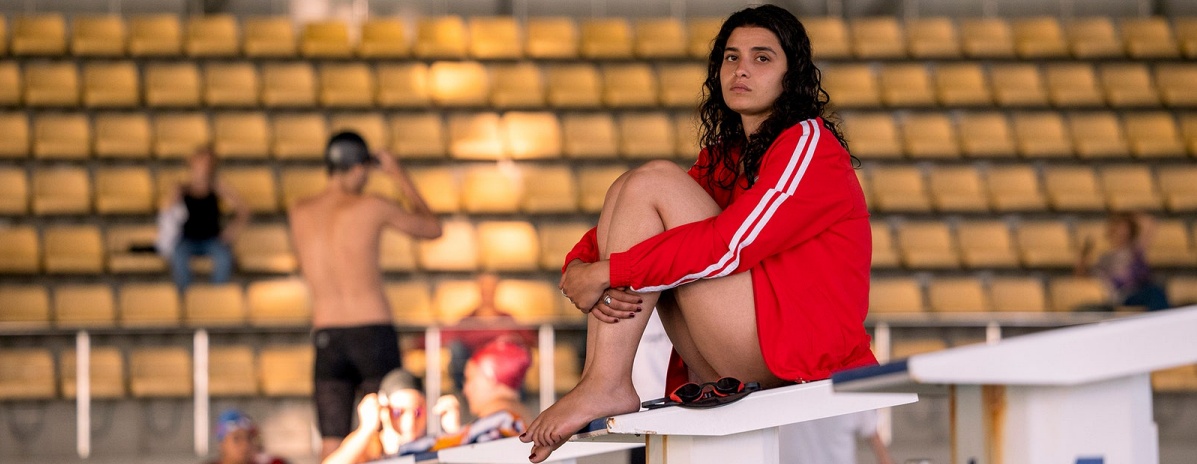


“The Swimmers” not only displays the virtues of empathy and compassion, but they come primarily from young people, the sisters Mardini.
The 2022 film “The Swimmers,” now available on Netflix, is based on the real-life adventures of two young sisters, Sarah and Yusra Mardini, who fled the Syrian Civil War, becoming refugees in Germany. For many reasons, the film is enjoyable, uplifting, and thought-provoking. To begin with, it offers one more reminder—and we need such mental jolts as often as possible—of the terrible toll of wars.
In his novel Black Dogs, British novelist Ian McEwan wrote about one of his characters: “He was struck by the recently concluded war [World War II] not as a historical, geopolitical fact but as a multiplicity, a near-infinity of private sorrows, as a boundless grief minutely subdivided without diminishment among individuals who covered the continent like dust...For the first time he sensed the scale of the catastrophe in terms of feeling; all those unique and solitary deaths, all that consequent sorrow, unique and solitary too, which had no place in conferences, headlines, history, and which had quietly retired to houses, kitchens, unshared beds, and anguished memories.”
Although it has not killed as many people as WWII, the Syrian Civil War has continued for about a dozen years since its beginnings in 2011. According to one reliable source, more than a half million Syrians have lost their lives in it, and by the end of 2022 another 6.7 million refugees had left Syria. (The devastating Feb. 2023 Turkey-Syria earthquake has increased the refugee count.) In 2015, Sarah and Yusra became two such refugees.
The film mainly covers the period from 2011 up through the 2016 Rio Summer Olympics, in which Yusra, at age 18, swam. Sarah was a few years older, and also a good swimmer though not as good as her sister. At the movie’s end some sentences appearing on the screen update us on several highlights. One of these is that Yusra also participated in the 2020 Olympics in Tokyo.
After a few brief scenes of the happy, close-knit Mardini family (mother, father, and three daughters) in Damascus in 2011, these words appear on the screen: “2015 Four Years Later.” We see the sisters dancing to music, but with bombs exploding farther off in other parts of Damascus. Sarah especially likes to party and she chides her younger sister for worrying too much about getting a good night’s sleep so she can get up early the next day for swim training—the girl’s father, an ex-swimmer himself, is their coach. In many ways Sarah—with her nose ring, penchant for partying, and cell phone—seems like many young people in the Western world, but she notes that one of her friends was killed in a bombing—“It’s all over Facebook.” (Quite often in the film, popular music is in the background, and the sisters often use a cell phone.)
Thus, the Syrian Civil War disrupts their daily life, and Sarah presses her mom and dad to allow her and Yusra to go to Germany. Once they get there she assures her parents, she can apply for a “family union,” and the rest of the family can join her and Yusra. Their dad has many reservations, but finally gives in after Sarah indicates their male cousin will go with them. He also gives Sarah 10,000 Euros (about $11,000 at the August 2015 exchange rate), knowing she will need money for expenses—like getting smuggled into Europe.
The sisters and their cousin fly to Lebanon and then on to Istanbul. A little later the perilous part of their trip begins after they pay a smuggler to get them and other refugees by bus to the Turkish coast on the Aegean and then by boat to the Greek island of Lesbos. The film seems to depict the whole dangerous trip from Turkey to being sheltered in Germany realistically, sticking fairly close to the real journey of the Mardini sisters. (The whole journey from Istanbul to Berlin takes up more than a third of the two and a quarter hour film.)
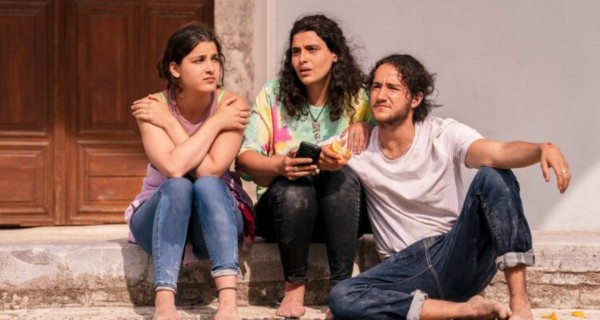
What we see on the screen is the mixed group of refugees from Afghanistan and various countries in Africa and the Middle East, including one mother with an infant; the initial 10-hour bus trip; the smuggler collecting money from the refugees; their waiting by the Turkish coast for the smuggler to return with a boat (and hoping that he will); and then the life-threatening trip across the Aegean Sea to Lesbos.
The distance across the water is less than 15 miles, but the passage was made in a small dinghy carrying 20 refugees, almost three times the maximum recommended number. It was equipped with a motor, but it soon stopped working. The boat also started to take in water. The refugees bailed it out, but Sarah and then Yusra in order to lighten the dinghy’s load jumped into the water, and for about three hours swam alongside trying to help guide it. Yusra later said they were “lucky to make it. Lots of refugees unfortunately drowned in that sea.”
Once in Lesbos they still had a long way to go before they reached Germany, and some refugees wished to go even further, for example to England or Sweden. The film does not make it clear how many countries the sisters had to traverse—one source mentions seven, including Greece, Macedonia, Serbia, Hungary, and Austria. Often they were on foot, walking along railway tracks. They met up with smugglers (reliable and unreliable), border fences and guards, and some people that were hostile to refugees, while others were friendlier. On one occasion a young man attempted to rape Yusra—apparently this did not happen in real life to Yusra Mardini, but was certainly one of the dangers facing young female refugees.
Finally, cousin Nizar tells the sisters that he has heard Germany is going to provide them buses and bring them to Berlin, and this turns out to be true (more later about the German government's attitude toward refugees.)
In Berlin they are assigned small cubicle rooms, which they share with others, in a building which looks like a converted gigantic airplane hanger. For several months, various officials process their paperwork, but otherwise they seem free to come and go as they like. In one scene in a common area they are watching TV when it announces that the Russian Air Force has aided the Syrian government by bombing some rebel-held areas in the sisters’ homeland.
Meanwhile, Yusra has not given up her hope to participate in the 2016 Olympics, and she continues to train by doing strengthening exercises, running, etc. The sisters go to a German swim club, and after Yusra tells a coach, Sven, her swim times for the 100 meter Butterfly, he agrees to give her a tryout, which he does.
He then becomes her coach, and also arranges for the sisters to move into their own private room in the swim club. Moreover, he contacts the managers of the 2016 Olympics and, after helping Yusra improve her swim times, obtains a place for her on the Refugee Olympic Team, the first such team to ever compete in Olympic completion.
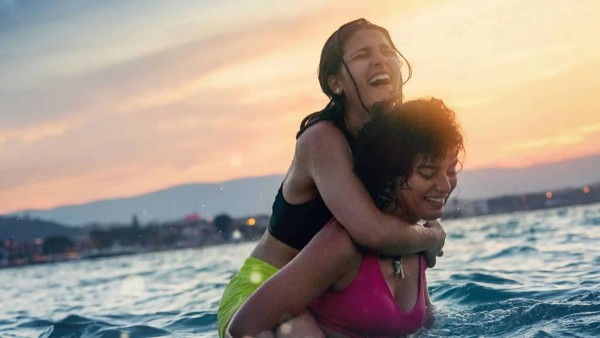
Meanwhile, the sisters seem to be going in divergent directions. Although the apparent love that they have for each other is one of the appealing features of the film, they do at times have their differences. Shortly before Sven tells Yusra she has been accepted on the Refugee Olympic Team, the sisters have a heated argument. After Sarah suggests the Yusra is overemphasizing swimming, her sister replies that at least she has a goal, but Sarah tries “to be cool,” wastes her “time partying,” and is “never going to achieve anything.”
After these words of rebuke, we slowly see a change in Sarah. She tells a friend, “I saw on Facebook that 100,000 people had to cross the sea to Greece in the last two months.” Shortly afterwards, she tells Yusra that she’s going back to Lesbos to work with an organization that helps refugees. “I want to be part of this. I need to be there. To help everyone. Give them water, shoes, everything we didn’t have.”
And Sarah does what she told Yusra she would, but still manages to take time off to fly to Rio to watch her sister compete in the Olympics. In the update at the end of the film, we read that later in 2016 the rest of the Mardini family made their way to Berlin and were living there. Also that in 2018 Greek authorities arrested Sarah and some of her colleagues on “people-smuggling charges” for helping refugees in Lesbos. (Before being temporarily freed Sarah spent four months in jail. In early 2023, Human Rights Watch and Amnesty International declared that the charges were “politically motivated” and “baseless,” and in early 2023 a Greek court dismissed the charges.)
In an indication that Yusra had become more than just a swimmer, the update also reveals that not only did she compete in the 2020 Tokyo Olympics, but that she had become a UN Refugee Agency goodwill ambassador and “a voice for refugees all over the world.” Finally, we are told that there are “over 30 million refugees worldwide, half of whom are under the age of 18.”
The above review of this excellent film suggests a number of conclusions. First, that under German Chancellor Angela Merkel, Germany pursued one of the most progressive refugee policies in all of Europe. But Merkel is no longer in office.
In 2020 The Guardian, a moderately progressive British newspaper, ran an article entitled “How Angela Merkel’s great migrant gamble paid off.” It indicated that between 2015 and 2019, 1.7 million people applied for asylum in Germany, increasing its refugee population to the fifth highest in the world. At about the same time as the film has Germany providing buses to bring the Mardini sisters and other refugees to Berlin, Merkel attempted to decrease worries about the rising number of such people, mainly from Syria, Iraq, and Afghanistan, coming into Germany. She said, “The motive with which we approach these matters must be: we have already managed so much, we’ll manage this.”
The article goes on to quote those more hostile to refugees. Donald’s Trump’s reaction to Merkel’s policy was that it was a “catastrophic mistake.” Also he claimed that because Germany had taken in “all of those illegals” German crime had increased. A conservative British politician called Merkel’s refugee policy “the worst decision a European leader has made in modern times.”
Now in early 2023, the refugee problem shows no sign of abetting, and future climate-change consequences threaten to exacerbate it. Alarmists in various countries are pushing back. According to one report in 2022 coastal forces turned back more than 26,000 people from entering Greece.
In LA Progressive I’ve written three previous essays (in 2017, 2019, and 2021) dealing with illegal immigrants or refugees arriving either at European or U. S. borders. The 2019 article states that it “is not suggesting that the present immigration question is not complex and needful of thoughtful consideration . . . but the Trumpian fearmongering now going on, is not the way to approach it.”
That essay also quotes the 1958 book, A Nation of Immigrants, of Sen. (and later President) John Kennedy: “The contribution of immigrants can be seen in every aspect of our national life. We see it in religion, in politics, in business, in the arts, in education, even in athletics and entertainment. There is no part of our nation that has not been touched by our immigrant background. Everywhere immigrants have enriched and strengthened the fabric of American life.’’ It also cites President Reagan who thought that immigrants were ‘‘one of the most important sources of America’s greatness.”
The 2017 essay suggests that the empathy and compassion toward illegal immigrants displayed by writer George Saunders in his 2007 essay “The Great Divider” should characterize refugee policies. And the 2021 article quotes similar advice from Pope Francis: “Those who pay the price [of wars] are always the little ones, the poor, the most vulnerable...Our response to the challenges posed by contemporary migration can be summed up in four verbs: welcome, protect, promote and integrate. . . . If we put those four verbs into practice, we will help build the city of God and man. We will promote the integral human development of all people. We will also help the world community to come closer to the goals of sustainable development that it has set for itself and that, lacking such an approach, will prove difficult to achieve.”
The great value of “The Swimmers” is not only that it displays the virtues of empathy and compassion, but that they come primarily from young people, the sisters Mardini. It is indeed difficult for people of their age, bombarded as they are by social media, advertising, and peers who emphasize partying over more important priorities, to dedicate themselves to such causes as global justice, peace, and the environment. But when youth do commit to such causes, their idealism and energy is wondrous to behold.
