

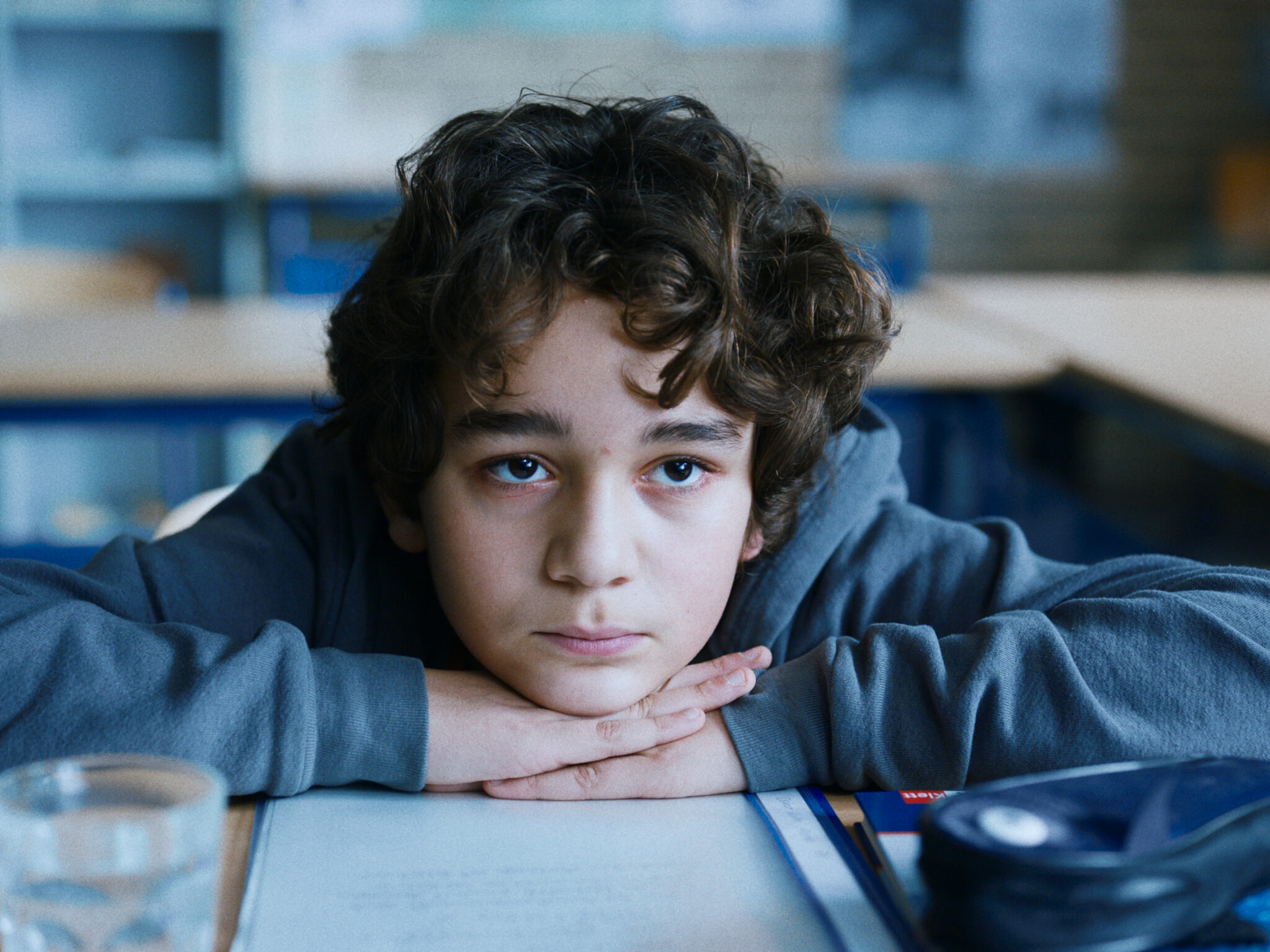

“Personal rights” vs. the interests of the larger group is just one of the school’s dramas that reflect how the school is a microcosm of society.
The classroom is often a microcosm of our larger world, including the political arena. Who determines what is taught? The teachers? Parents? State legislators? Take, for example, the following 2021 report in Education Week. It noted that the 1619 Project, which emphasized “the legacy of slavery and the contributions of Black Americans,” was “the target of Republican lawmakers, who seek to ban the materials in three states,” Arkansas, Iowa, and Mississippi. Such legislators argue that the project is “racially divisive” and that school districts that teach it should “lose part of their state funding.”
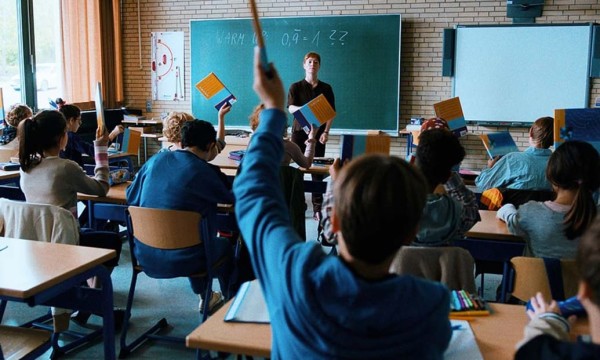
The Teachers' Lounge (Das Lehrerzimmer), a German film now on Netflix and that country’s submission for Best International Feature at the 2024 Academy Awards, shows that a sixth grade German classroom also mirrors the society in which it exists.
The main character is young, idealistic math and phys ed teacher Carla Nowak (Leonie Benesch). She is of Polish background, and this and the diversity of her students reflect the diverse nature of German society. One of her students is of Turkish background, and a little over a million and a half such people now reside in Germany. Although Turkey has provided the most immigrants, the ongoing war in Ukraine has produced the second most, almost a million and a quarter. And more than a decade of civil war in Syria has provided the third most, almost a million. (Polish immigrants are fifth on the list.) Former German Chancellor Angela Merkel is credited with pursuing one of the most progressive refugee policies in Europe, one that led Donald Trump to claim that it was a “catastrophic mistake.” And one that many right-wing groups in Europe rail against.
The heart of the story is the fallout that occurs after Carla discovers--or thinks she has--who stole money from her wallet. She does so by setting up her laptop camera to record movement around the wallet, which, upon leaving the teacher’s lounge (title of the film) remains in her jacket pocket draped over a chair. Upon returning, she finds money missing from it and opens her laptop to see video evidence of an arm wearing a distinctive blouse reaching into the pocket where she put the wallet.
She recognizes the blouse and then (almost a third of the way into the film) goes to confront the woman wearing it, who is a member of the administrative staff and mother of Oskar, one of Carla’s students. The mother, Ms. Kuhn, denies the accusation, calls it “an outrage,” and tells Carla to leave the room.
Carla then goes to the office of her principal, Dr. Böhm, and shows her the video from her computer. After seeing it, Böhm has Ms. Kuhn come to her office and shows her the video evidence, but Kuhn replies that the video is insufficient proof, that maybe someone else was wearing a similar blouse, and leaves the principal’s office in tears.
After Ms. Kuhn, taking Oskar with her, leaves the school, Carla has second thoughts and tells Dr. Böhm, “I think we’re making a mistake. Strictly speaking, the video isn’t clear proof.” A fellow teacher, Milosz Dudek--also of Polish background and apparently a faculty representative of some sort on an advisory council—tells Carla, “there’s another problem. Your video violates personal rights. Not only Ms. Kuhn’s, but the entire faculty’s.” (Quotes are taken from the filmscript, which is almost identical to the film’s dialogue.)
“Personal rights” vs. the interests of the larger group is just one of the school’s dramas that reflect how the school is a microcosm of society. And it showed up earlier when students’ wallets were searched in an attempt to find someone else’s stolen money. In that case, a child of Turkish parents was suspected, which brought forth an issue we are all too familiar with in our own society—racial or ethnic profiling.
Almost half way through the movie, another problem arises that was mentioned earlier in the first paragraph—the role of parents in determining how and what their children are taught. At an evening meeting with parents in her classroom, one of them tells Clara that her daughter “said there was an interrogation, and . . . she was coerced into divulging information on her classmates.” The mom adds that the parents talked about it on a WhatsApp chat.
During that same meeting, one parent brings up a math test and indicates that “the questions [on it] were all Greek to me,” and adds, “Those questions aren’t meant for 12-year-olds, are they?” Carla responds, “It is sixth grade material. I stick with the curriculum.”
In Germany that curriculum varies depending on what type of secondary school one attends. If one goes to a Gymnasium school, its main task is college preparation. But more students attend a German Realschule, where some attention is paid to preparing students for jobs. Although it is never clearly stated in what type of school Carla teaches, it seems more like a Realschule, and this brings up the whole question of the purpose of education. Career preparation? Or, as the environmentalist E. F. Schumacher once claimed, preparing us to live wisely.
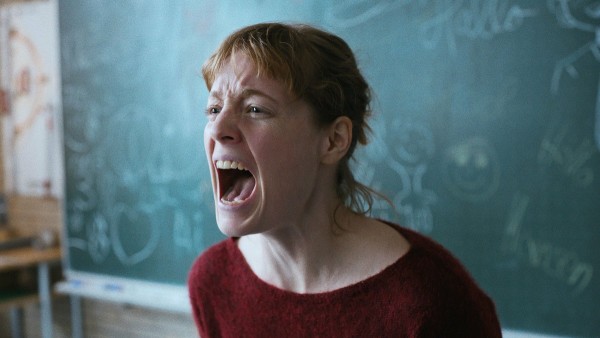
Toward the end of Carla’s meeting with parents, Ms. Kuhn appears and claims that “this woman [Carla] made secret video recordings at school,” and that “entire lives are being ruined because of her presumptions.” Carla becomes so stressed out that she flees from her classroom to a bathroom, where to reduce her anxieties she breathes into a plastic bag.
In the remainder of the movie, two more incidents occur that add to her stress and mirror larger social issues. One is the rebellion of her students and the larger issue of authority and freedom, and the other is an interview she grants with a student newspaper and the whole question of truth and censorship.
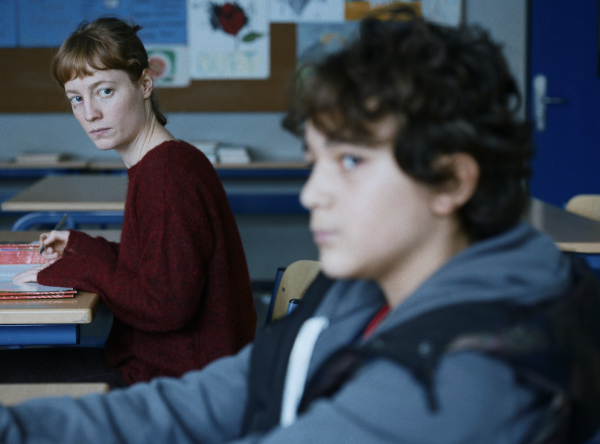
After Carla’s students hear rumors about Ms. Kuhn and the stolen money, they want to know more. After Carla says to her class, “Let’s proceed with homework,” one of them responds, “We won’t do it until you tell us what did and will happen.” As mayhem erupts in the classroom, Oskar blurts out, “my mom is no thief, but Ms. Nowak is a liar.”
For many middle and high school teachers, losing control of their class must be one of their worst nightmares. And that situation, plus the long hours they spend teaching each day, makes for a stressful occupation, whether in Germany or the USA.
As rumors swirl around concerning Clara’s stolen money, the student newspaper requests an interview with her and she grants it, but she asks if she can “read it in advance.” She is assured that she can. But the interview is printed without her first seeing it in print. When she objects, one of the students on the newspaper tells her, “We won’t be censored for you to save face.” To which she responds, “This text is unreliable.”
Apparently Principal Böhme agrees with her because she announces that the “school paper contains an unfortunate article, that she’s spoken to “the school’s legal department,” and “we have to ban the sale of this issue on campus.” In addition, the online version was taken “down from the school’s website.”
After Clara objected to the article, one of the newspaper’s students told her, “We serve truth. It’s your problem if you can’t take it.” And the student then asks Clara to look at a sign on the wall that says, “VERITAS OMNIA VINCULA VINCIT” (“TRUTH OVERCOMES ALL BONDS”).
Ah, truth. In this U.S. election year of 2024, what could be more important? In June 2020 conservative columnist Peter Wehner wrote that even before becoming president Donald Trump’s goal “was to annihilate the distinction between truth and falsity... to overwhelm people with misinformation and disinformation.” Four years later, are we not again facing a similar problem? And not only is the USA dealing with how to discover truth, but as social media and the Internet spread—and with them the alternate sources of information—the problem becomes a global one.
In a new book, Michiko Kakutani writes about the effects of the lies of Trump and Republicans: “Such developments point to how far today’s emergency extends beyond politics—how it goes to our very ability to process reality, to tell the difference between fact and fiction, between truth and fantasy.” But she also recognizes that the problem goes beyond U.S. borders. For example, “A world of rabbit holes and magical thinking, where Trump and Putin have weaponized the most noxious aspects of digital age technology—like data overload, social media echo chambers, viral memes—to foment chaos, and redefine reality.”
The Teachers' Lounge is well acted, and the drama and tension are constant. Moreover, it provides many morsels for us to muse over, some strictly educational ones like what is the purpose of education? But others applying not only to education, but also to larger social and political issues like “What Is Truth and Where and How Do We Find It?”
