


No matter how intense one’s faith or hope is, if there is no God, believing or hoping will not create one.
Having just watched (on Netflix) the film The Wonder, set mainly in Ireland in 1862, a number of thoughts occurred to me:
- Here’s another story (like the seven-part Hulu series earlier this year “Under the Banner of Heaven”) about the conflict between religious faith and reason.
- 1862 was the same year my great grandfather, Benjamin Moss, a private in the Union army, found himself in a Cincinnati hospital, and about seven years later he married a woman born in Ireland.
- There are a surprising number of similarities between The Wonder and Chekhov’s short story “The Peasants” (1897), in which a non-religious medical person (Chekhov was a doctor) looks at the lives of rural people, some of whom have religious views similar to most of the Irish characters in The Wonder.
In the remainder of this review/essay, however, we’ll focus just on point 1.
Regarding religion and faith, I wrote earlier this year: “Now, after decades of reading and thinking about previous theologians’ and philosophers’ ideas about God, all I can say is “the jury is still out.” Whether a God—however we might define he, she, or it—exists or not, no one can say for sure. We can believe or hope there is a God, but that’s all we can do. In spite of thousands of years of religious and philosophic inquiry, that’s all we got. No matter how intense one’s faith or hope is, if there is no God, believing or hoping will not create one. Conversely, no matter how ardently one insists that there is no God, such insistence will mean nothing if one does actually exist.”
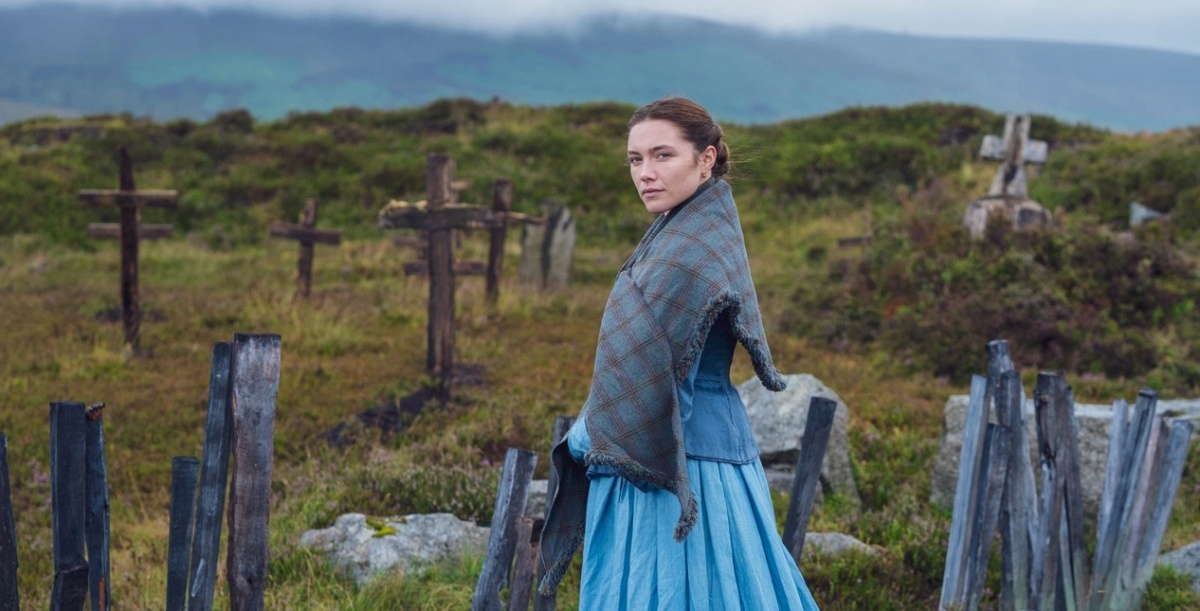
The Wonder’s basic story is that a nurse named Elizabeth (“Lib”) Wright (actress Florence Pugh) comes from London to a Midlands village in Ireland (still then part of the United Kingdom of Great Britain and Ireland) in order to observe a girl, Anna O’Donnell (Kíla Lord Cassidy), who supposedly has not eaten in four months.
Britain it should be noted was then the most industrialized and urbanized country in the world, whereas Ireland was still overwhelmingly rural, and families were still reflecting sad effects, like the loss of family members, from the Great Famine of 1845-52. That famine caused the death of approximately 1 million people between 1846 and 1851 (about 12 percent of the pre-famine population) and the emigration of about twice that number from 1845 to 1855, many to the U. S. “Ship after ship sailed down the river Shannon [in Dublin] laden with rich food, carrying it from starving Ireland to well-fed England, which had greater purchasing power.” The British government refused to allow Irish peasants to feed themselves with food they had grown themselves partly because it was the private property of absentee English landlords.
The contrast between the more urban, more worldly (she had served as a nurse in Crimea during the war there—1854-56), more educated, more secular nurse Wright and the more traditional, rural, religious Anna and her family is important. In recent centuries this contrast has often occurred, whether between “city slickers” and cowboys in the USA or imperialistic officials and native peoples in parts of Africa or Asia. To some extent it is still occurring. Witness the present political polarization in the USA. On the one side we have older, rural and small town people, less educated, Evangelical or Fundamentalist Christians. On the other, younger people from large cities, college educated, and more secular oriented. The division is not absolute, but certainly tends that way. In the U. S. we already saw signs of that division during the famous Scopes Trial of the 1920s, and we see it today a century later between Trump supporters and his many critics.
Nurse Wright comes to Ireland with a mindset that reminds me of Steven Pinker’s Enlightenment Now (2018). In it he asks, “Who could be against reason, science, humanism, or progress?” Among culprits, “the most obvious is religious faith. To take something on faith means to believe it without good reason, so by definition a faith in the existence of supernatural entities clashes with reason.”
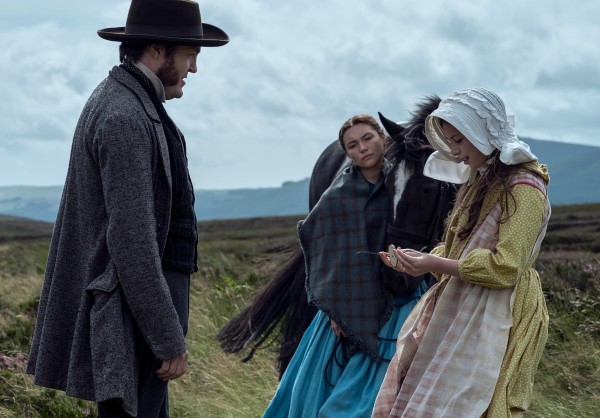 Tom Burke, Kíla Lord Cassidy, and Florence Pugh
But many people fall somewhere between being a firm religious believer or an atheist or agnostic. About a dozen years ago a Pew Research Center report found “that U. S. young adults, the so-called millennial generation, don't attend church services regularly, are less inclined to express religious preference or affiliation than their elders, but profess widespread belief in the afterlife, in heaven and hell and in miracles. Nearly 80 percent of all Americans, in fact, say they believe in miracles”—though exactly how they defined miracles varied.
My teenage years were in the 1950s. I was then Catholic, and most other Catholics—like Anna, her family, and other Irish religious people (overwhelmingly Catholic in her part of Ireland) a century earlier—believed in “heaven and hell [and purgatory] and in miracles.” I even remember saying one of the prayers Anna and her family said—“As I lay down my head to sleep, I pray to God my soul to keep. If I should die before I wake, I pray to God my soul to take.”
Most of Anna’s community seem to accept that she really could have gone four months without food. It was a miracle. Judging from the Pew Center U. S. study and another one that surveyed people in 18 countries in Central and Eastern Europe—in almost all of which atheistic-communist governments controlled education for at least several decades—a majority of people in those countries and in the U.S. still believed in miracles well into our present century (and likely still do today).
We Catholic kids in the 1950s were taught, and most accepted, that Mary (the mother of Jesus) was a virgin, and among other appearances she appeared many times to a girl named Bernadette (in Lourdes, France) beginning in 1858. Today, a Vatican website continues to relate the story of Mary appearing (18 times) in Lourdes.
For more than half of The Wonder nurse Wright cannot figure out how Anna is still living—she can’t believe that the young girl is not somehow getting food. What she finally discovers, I’ll not reveal because it would be like revealing the murderer in a whodunit.
And like a good whodunit the film’s main plot keeps you guessing; and even after we learn how Anna has managed to live while fasting for four months, there are still more surprises to come. Besides an interesting plot, The Wonder also has much else to recommend it.
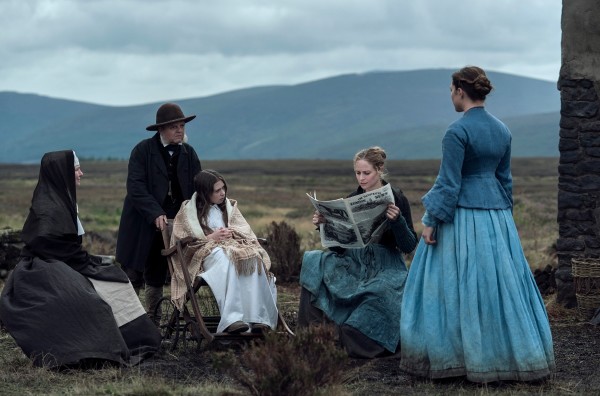 Toby Jones, Josie Walker, Kíla Lord Cassidy, Niamh Algar, and Florence Pugh
The acting, especially that of Florence Pugh as nurse Lib Wright, is excellent. Kíla Lord Cassidy as the young, fasting Anna is also first-rate. Some of the other actors’ performances are also quite good, as expected from such as Toby Jones as a village doctor, Ciarán Hinds as a local priest, and Tom Burke as journalist William Byrne. All three were familiar to me from previous PBS or streaming films or series such as (respectively) Chekhov’s Uncle Vanya, Belfast, and “The Crown.” The movie’s Chilean director, Sebastián Lelio, whose A Fantastic Woman won the 2018 Oscar for Best Foreign Film, adapted the films The Wonder from Emma Donoghue's same named 2016 novel. Donoghue, in turn, borrowed from an 1869 Welsh case of a girl who fasted until she died—similar cases of fasting girls also have occurred in other countries.
In opening and ending Lelio’s The Wonder, actress Niamh Algar, who plays Anna’s older sister Kitty, tells viewers that the characters we are about to meet (or met) believe in their stories and that we are “nothing without stories.” Some reviewers have criticized this directorial framing of the film, and it is not exactly clear what Lelio is trying to convey by it. But using stories to help us make sense of life is important. And to successfully navigate life we need more than our reasoning mind.
In recent decades I have increasingly attempted to battle against our (as Al Gore entitled a book) “assault on reason.” On the other, hand, I also realize that our emotions, imagination, hopes, stories, and even myths are also necessary for humans to live well and flourish. So too are proper values including enough humility to realize that we do not have all the answers, that mysteries still exist that puzzle us.
After Nancy, my wife of 58 years, died in February of this year, it hit me as never before why people wanted there to be a God and a heaven. My emotions cried out that such a wonderful person’s spirit could not simply cease to be. My reasoning mind, however, told me, “yes, it’s possible that, except in my mind and that of some others, she (spirit and all) is no more.”
In watching The Wonder my mind sided with nurse Lib’s conviction—a person could not live for four months without food. But I also understood why so many people, in all parts of our world, want to believe in “miracles,” big or small, and defined in different ways. My rational mind agreed with Lib, but my heart empathized with Anna and her family.
