


The Icelandic film Touch (2024), now streaming on Peacock, is about one of my favorite subjects—love.
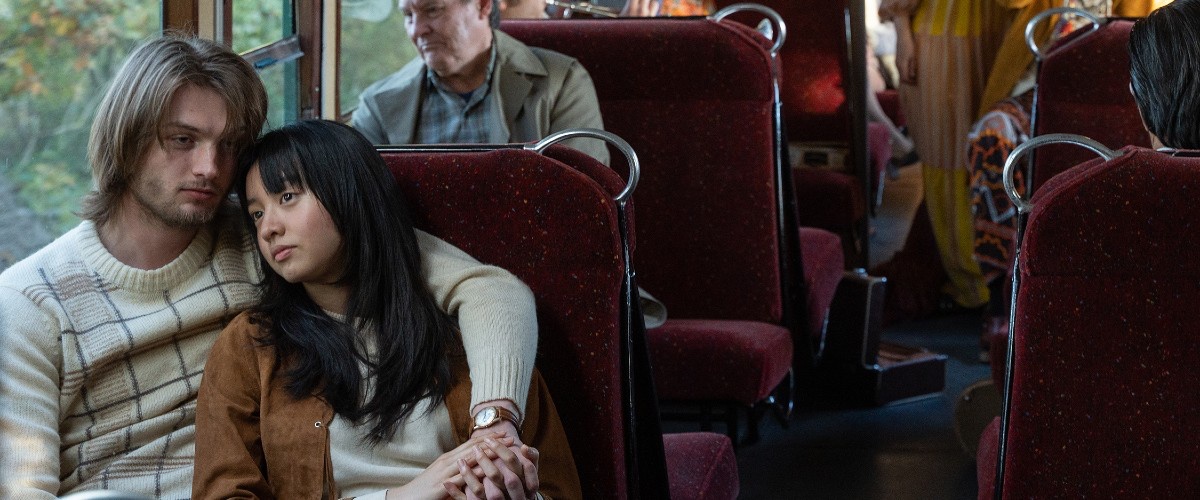
The Icelandic film Touch (2024), now streaming on Peacock, is about one of my favorite subjects—love. But at two different stages, when one is young and when one is old. The movie is based on Touch: A Novel (2022), whose author also co-wrote the filmscript. The lovers are the Icelandic Kristófer (Palmi Kormákur when young and Egill Ólafsson when old) and the Japanese Miko (model and songwriter Kōki when young and Yôko Narahashi when old). They first meet in 1960s London, where Miko’s father owns a Japanese restaurant and Kristófer comes to work in it as a dishwasher.
The scenes of the young lovers are charming, with both actors excellent. Their different countries of origin and cultural backgrounds add a special tenderness to their story. Kristófer sets out to learn Japanese, and his youthful earnestness and sincerity are pleasant to watch, as is Miko with her pleasing smile. As with many young lovers, there is plenty of kissing and before long more intimate sexual relations—though the film displays little flesh.
Besides love—though we’ll return to it later—the movie provides other subjects for us to ponder. One is the Hiroshima bombing, which helped end WW2. Whether it was needed to end the war or not has long been debated by historians, but its horrific nature has not. Although no exact number of deaths have reliably been attributed to the bomb, somewhere around 100,000 (70,000 to 135,000) have recently been suggested by history.com.
Before coming to London with her father in 1957, Miko had lived in Hiroshima (and later in Tokyo). Her mother had been six months pregnant with her in 1945 when a U.S. bomber dropped the Hiroshima bomb. And, as Miko tearfully tells Kristófer, “When Dad found Mum [amid “the burned earth and the black rain . . . and the river filled with floating corpses”] she herself was badly burned. She gave birth to me a month prematurely. And she died a year later. So I'm still a hibakusha [atomic-bomb survivor]. . . . There was a lot of discrimination. . . . People thought it was hereditary. Some people thought it was contagious. Dad wanted to get away from it all, so we moved to London.” (Film quotes taken from the filmscript.)
There is much cutting back and forth in the film, especially in its later half, between the young lovers and then later when they are in their 70s and the covid pandemic is occurring. At that later period, Miko (now in Hiroshima) tells Kristófer (who had come there to find her) why they moved out of London so quickly about six decades earlier.
Her dad had found out that she was pregnant and thought that “sterilization was better than having to trust” her not to get pregnant. As Miko tells it, “To Dad, I had committed the crime he most feared. He was convinced the baby was disabled. . . . He ordered me to stay at home. He closed Nippon [his London restaurant], paid the staff, booked our flights [to Japan], all in a matter of days. Said goodbye to no one.”
But Miko’s baby boy was fine, no disabilities and, as Miko tells Kristófer when he comes to Hiroshima (where she lives) many decades later, his name is Akira, and her grown-up son is now a chef, running a restaurant in Kure, located about 10 miles southeast of Hiroshima city .
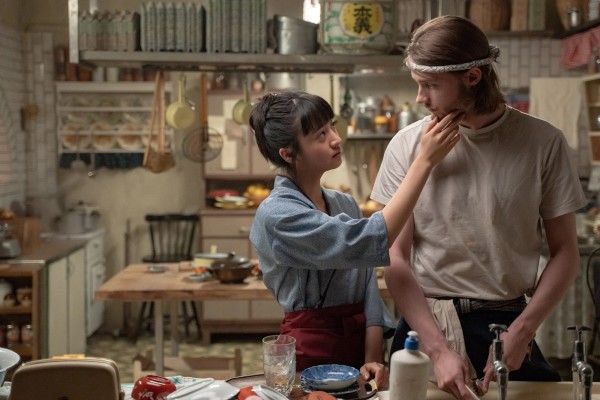 LoveKōki as Young Miko (left) and Pálmi Kormákur as Young Kristofer in Baltasar Kormákur’s ‘Touch’ © Lilja Jonsdottir
 She tells Kristófer that he has two daughters, one an engineer and the other a college student studying history. Although she put Akira up for adoption after his birth, she informs Kristófer that even though her son does not know that she is his birth-mother, she goes “to see him every week for lunch,” that she sits “at the bar,” and they chat about “this and that.”
Meanwhile, in the many decades in which Kristófer has lived in Iceland, after returning there after Miko and her father left London, he has married, brought up a daughter, and bought and run a restaurant. But for some years he has now been a widower, and he decides to fly to London to see if he can find out what happened to Miko so many decades ago—as she will tell him, her dad said “goodbye to no one,” and she didn’t either.
But before the old Kristófer flys off, we learn a few more things about him. 1) He has some kind of memory problem, perhaps early-stage Alzheimer’s, and 2) His daughter thinks he should wait until the MRI of his brain comes back before he decides on going to London—8 years before my wife, Nancy, died from Alzheimer’s complications, she had an MRI and it revealed early to mid-stage Alzheimer's.
These two occurrences of Kristófer’s provide us more to think of, and they are perhaps best brought to mind by the beginning of Dylan Thomas’s poem “Do not go gentle into that good night.”
Do not go gentle into that good night,
Old age should burn and rave at close of day;
Rage, rage against the dying of the light.
Though wise men at their end know dark is right,
Because their words had forked no lightning they
Do not go gentle into that good night..
The old Kristófer never mentions that famous poem, but he too is defying “the dying of the light.” Like another poet, Tennyson, he does not believe it’s “too late to seek a newer world”—for him the world of Miko, the great love of his youth.
When one is old and dealing with various ailments—like Alzheimer’s, cancer, heart problems, mobility issues, or some other medical problem—it is certainly problematic how much one should travel or pursue other adventures. The answers of Dylan Thomas or Tennyson are one answer; the more cautionary advice of Kristófer’s daughter is another.
His daughter’s advice brings up another issue: How much should those of us who are old, listen to the advice of our children? And what role should they play in our lives?
But putting aside these questions, we finally come back to love, but no longer young, romantic love, but now older love, that between two people in their seventies.
In London once again, the old Kristófer discovers that Miko is probably living in Japan. So he flies there. After a charming scene in which he meets a Japanese man in a bar and they go to a karaoke place where his new acquaintance sings, Kristófer locates Miko in an apartment in Hiroshima. She had just returned after being hospitalized because of COVID, and we now see how their old love differs from their young love.
One of his main concerns is her post-covid health. Early on in her apartment he says, “Miko, shouldn't you be resting? I can come some other day if you like.” Later on after she awakes from a long sleep (and apologizes) he tells her, “you needed the rest.”
Over a decade ago, in my “Amour: A Different Kind of Love Story,” I wrote about old love as depicted in the French film Amour, and how it was primarily manifested by a husband caring for his ailing wife. Some wedding vows used to include the promise “to have and to hold, from this day forward, for better, for worse, for richer, for poorer, in sickness and in health, until death do us part.” Old love often includes caring for the loved one when his/her health has declined.
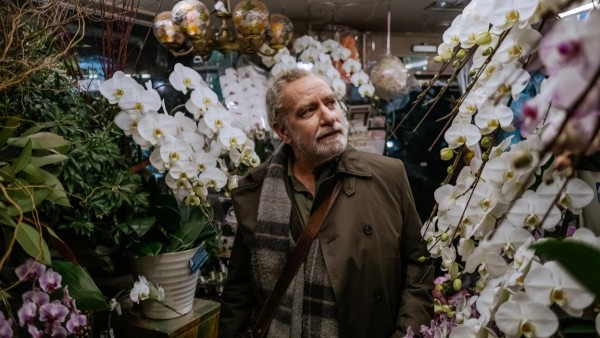 Egill Ólafsson stars as Kristofer in director Baltasar Kormákur’s "Touch." Credit: Baltasar Breki Samper / Focus Features LLC
 After Kristófer finally reconnects with Miko in her Hiroshima apartment, we see no more of the passionate kissing or scenes in bed as we saw decades earlier when they were both in London. It’s not that such activities could not occur, but what we do see are hugs and holding hands and talking and listening to each other.
In the film’s final scenes, the couple ride a train out to Kure to visit their son (who is unaware they are his parents) at his restaurant. After eating and chatting with him for a while, they leave and walk along the beautifully-lit river. Miko asks him if he still sings, as he did decades earlier at her request at a London birthday, when—she tells him—“I fell in love with you.” He replies that he sings “less and less. There's little left of my voice.” But he asks her if she thinks “that would work again.” Her reply, “You can try.” The film ends with their continuing the nighttime walk, first arm in arm and then holding hands.
They are following Tennyson’s advice. Despite their ages and his signs of dementia, they are seeking a “newer world.” A world of renewed love. And it seems appropriate.
