

Death and White Noise

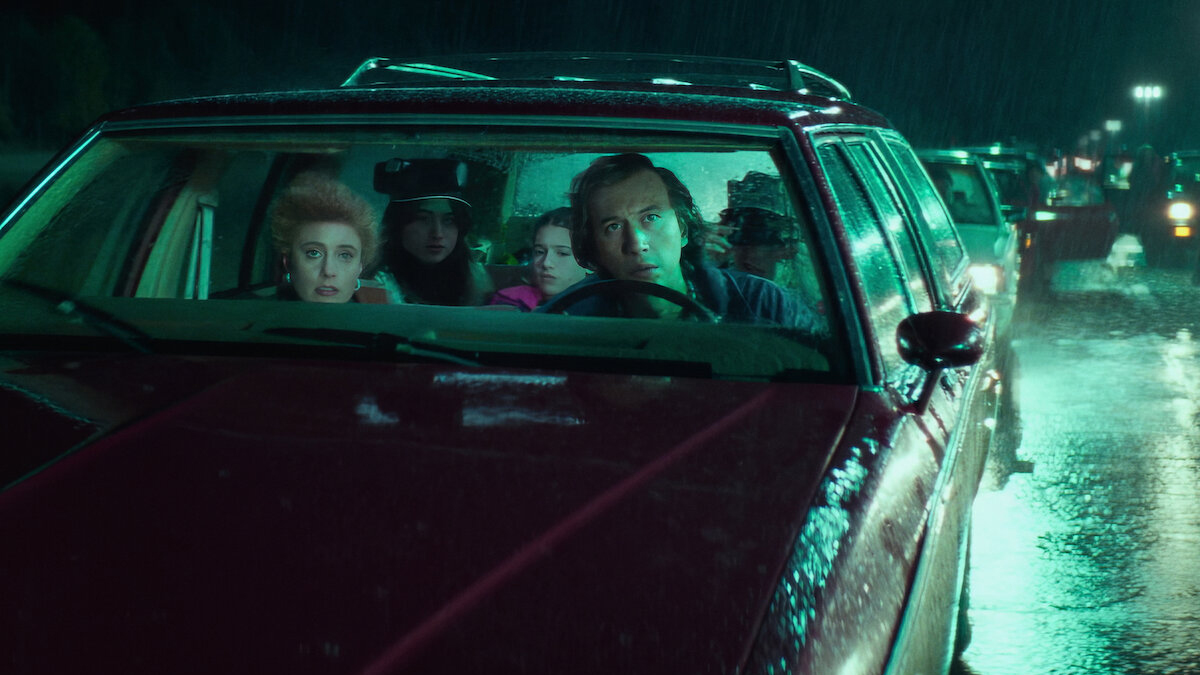
The major film event in the small college town where Jack teaches Hitler Studies is a truck-train crash that spews toxic chemicals into the air.
We’re only about seven minutes into screenwriter and director Noah Baumbach’s new film on Netflix, White Noise, when the two main characters, husband Jack Gladney (Adam Driver) and wife Babette (Greta Gerwig) have their first conversation about death. She says, “I want to die first…Life would feel unbearably sad and lonely without you. Especially if the children were grown up and living elsewhere. Right now, we’re safe. As long as the children are here. They need us.” Jack responds, “It’s great having these kids around, but once they get big and scatter, I want to go first…Your death would leave an abyss in my life. I would be left talking to chairs and pillows.” (The couple have both been divorced and by various marriages have a total of four children.)
Their conversation on death continues with each one saying (as Babette argues), “Your death would definitely leave a bigger hole in my life than mine would leave in yours.” Jack finally ends the back and forth with, “I hope we both live forever. Doddering, toothless, livers-potted, hallucinating. (pause) Who decides these things?” (All film quotes are taken from the screenplay, which in turn is heavily indebted to Dom Dellilo’s 1985 novel White Noise.)
The major film event in the small college town where Jack teaches Hitler Studies is a truck-train crash that spews toxic chemicals into the air. It leads to the Gladney family, along with other town families, temporarily evacuating their home, and to Jack becoming more exposed than other members of his family to the deadly toxicity, so much so that he later tells Babette, “I’m tentatively scheduled to die. It won’t happen tomorrow or the next day. But it is in the works.”
Jack reveals this to his wife in a conversation in which she previously tells him about a mysterious condition she has had for about a year and a half: “I was going through a phase…a kind of settling-in-period, I thought. Middle age. Something like that.” She then explains how that condition led her to taking a test drug called Dylar. To continue taking it from a “small firm doing research in psychobiology,” however, she had to agree to certain conditions that she found distasteful, as did Jack after she told him, but which I won’t reveal here so as not to be a “spoiler.”
After listening to Babette spin out her story for some time, Jack impatiently states, “You’ve taken me this far, put me through this much. I have to know. What’s the condition?” Babette’s response? “I’m afraid to die. I’m afraid of my death…I can’t believe we’re all marching toward non-existence. All of us. It haunts me, Jack, and it won’t go away.”
Jack replies, “It’s not a reasonable fear…Everyone fears death. There’s no one who has lived past the age of seven who hasn’t worried about dying.” But Babette says that she is “extra sensitive” to the fear.
As in the scene early in the film when they’re in bed and arguing about who would hate more to see the other die first, they once again try to top each other concerning their fear of death. Jack: “Baba, I am the one in this family who is obsessed by death. I have always been the one.” Babette: “What do you want me to say? Your fear is older and wiser than mine?” And finally, before Jack reveals that the toxic discharge has shortened his life expectancy, she tells him, “I love you. I just fear death more than I love you…And I really really love you.”
In a film review last month, I wrote, “We all come to films and literature with our own unique backgrounds,” which lead us to react differently. And the words cited in the above paragraph reminded me of Woody Allen’s film about Russian characters, Love and Death (1975). Like White Noise’s Jack, I was then (in 1975) a college professor, but my field was not “Hitler Studies,” but Russian history. Moreover, I was just ending directing a two-year NEH grant on “Gerontology and the Humanities,” which produced a booklet with a section entitled “Reflections on Death.” (A few years later, my essay “Why the Anxious Fear? Aging and Death in the Works of Turgenev” was published.) In the mid-1970s, Ernest Becker’s The Denial of Death won a Pulitzer Prize, and convinced me (then still in my thirties) of how powerful our fear of death was.
Many decades later I returned to considering death in an essay entitled “Wisdom, Death, and the Transcendental” (2014?). Near the beginning I described a Leo Tolstoy experience similar to Babette’s:
In the mid-1870s the fear of death began increasingly haunting Leo Tolstoy, the famous Russian author of War and Peace. The fear was part of a prolonged spiritual crisis which he later described in My Confession. In 1875, at a mere age 47, he wrote to a friend that he felt old age had begun for him. He defined this as an “inner spiritual condition in which nothing from the outer world has any interest, in which there are no desires and one sees nothing but death ahead of one.” Even though at this stage he could not envision anything after death but nothingness, he was strongly tempted to end his own life. His fear of death and his mental anguish seemed greater evils than death itself.
The remainder of my essay acknowledges that “for many people the answer to death is religion and the belief in some kind of afterlife.” But it then asks, “for nonbelievers generally, including agnostics and atheists, what sort of solace is there?” The answer? “Perhaps some sort of transcendence.” The rest of the essay then elaborates on three of my sources of transcendence, all related to beauty: “nature, the arts, and love.”
Almost a decade later, in early 2022, the death of my wife of 58 years, Nancy, produced a personal reaction the likes of which I had never before experienced. In a May 2022 LA Progressive essay, "Thoughts about Death and Faith: A Pragmatic Approach," I described the process.
Thus, because of my unique experiences all of White Noise’s discussions of death were especially meaningful—and I have only highlighted the more prominent ones. Jack also discusses death on occasion with his teaching colleague Murray (an excellent Don Cheadle), who aspires to follow Jack’s experience with popularizing Hitler Studies by creating an Elvis Studies department.
Having either been a university student or professor for over a half century, I also found interesting the movie’s depiction of college teaching, much of which appeared in the 1985 novel it was based on. That same year Neil Postman’s Amusing Ourselves to Death appeared. In it he wrote, “Our politics, religion, news, athletics, education and commerce have been transformed into congenial adjuncts of show business, largely without protest or even much popular notice. The result is that we are a people on the verge of amusing ourselves to death.”
In one of the film’s most colorful scenes Jack and Murray entertain a class of students (and a few visiting professors) with alternating tidbits about the relationships of Hitler and Elvis with their respective mothers. As colleges and universities increasingly competed with each over the last half century plus to obtain and retain students, more attention has been paid to creating entertaining courses—ones on Hitler and Elvis would qualify—and to have professors please their students. Of course, many students did not like poor grades (probably still don’t). And a few months ago The Boston Globe carried an article entitled “I was fired from NYU after students complained that the class was too hard. Who’s next?”
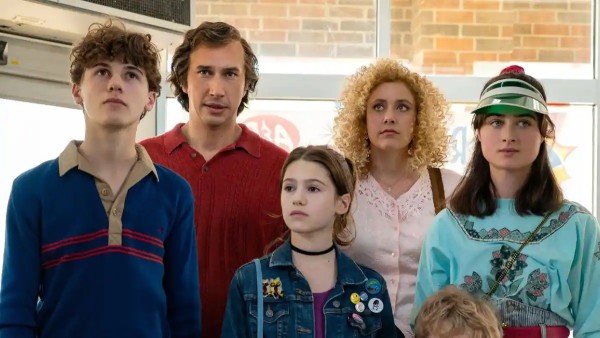
In addition to the scenes described so far, there are also others that are interesting. They would include some depicting the Gladney family’s interactions—they have colorful children—some of Jack discussing topics with his colleagues, the on-the-road scenes as townspeople flee from the toxic air, and a discussion Jack and Babette have with a German health-care nun. Baumbach often writes witty dialogues, and often does so again in White Noise, and they are delivered well by his talented actors. In conclusion: not a great film, but much better than most that are now available, and an important one because it deals with that great fear (often repressed) that we must all confront—death.
