



Is the use of property damage in nonviolent action justified?
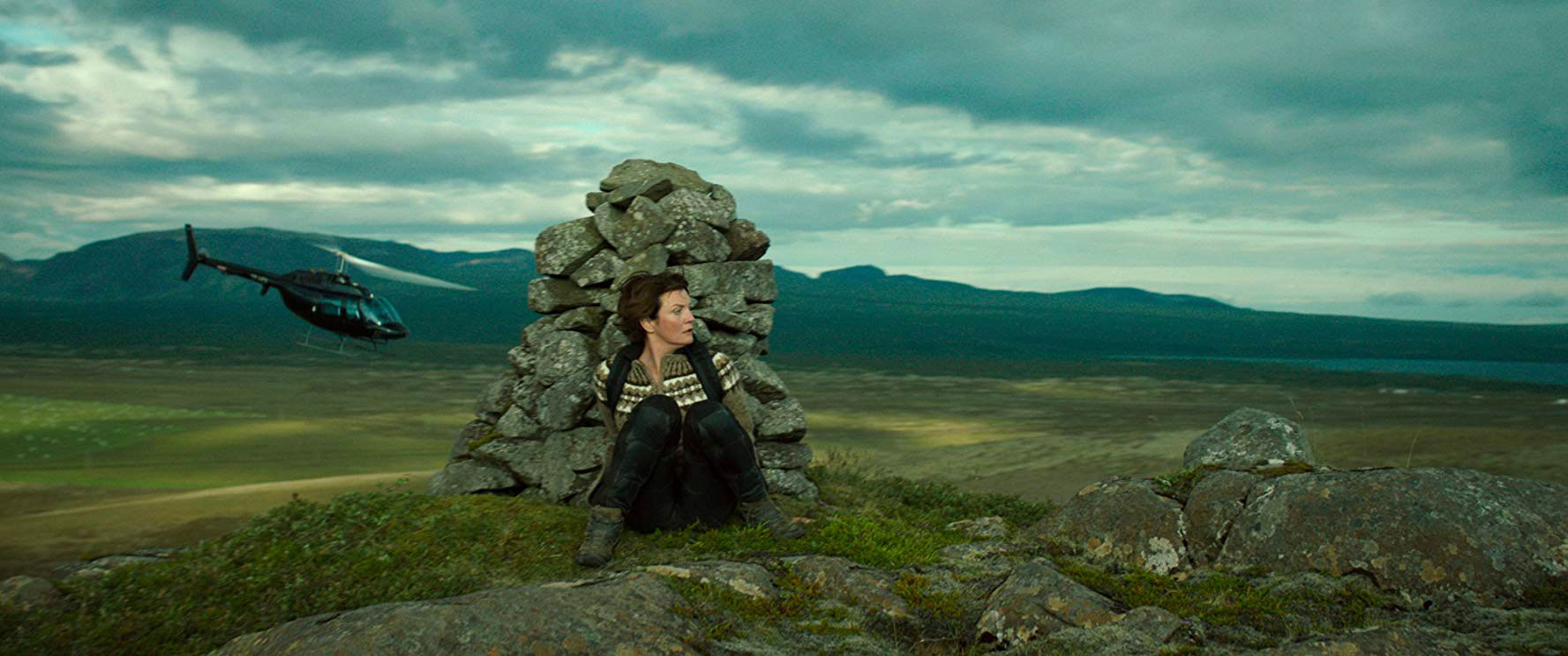
I recently discovered the film Woman at War (2018) on HBO Max. It deals with two things of vital importance—climate change and, to a lesser extent, the results of Russian aggression against Ukraine. The main character, an Icelandic choir director named Halla, is played by one of that country’s leading actresses, Halldóra Geirharðsdóttir (age 54), who also play’s Halla’s twin sister, Asa. Halla is an eco-terrorist who attacks her country’s electrical pylons, knocking them out and causing power outages. (At one point, she says she has done this on five occasions.) She commits these acts because she wants to discourage multinational corporations from coming to Iceland and aiding construction that will accelerate global warming.
At one point she sends out a manifesto. It includes these words: “I urge everyone to rise up and use their ingenuity to cause damage to these enterprises. That’s the only thing those psychopaths, those global multinationals, can understand. That’s how they operate, with threats and sabotage against nature and society….The sabotage against our nature causing atmospheric warming is a crime against humanity and all life on earth. The globalized industry is the force behind this suicidal charge that not even democracy can stop….There are laws above human laws, ancestral laws which will not be stricken out tomorrow.”
She goes on to state, “It is our indisputable right to protect the lives of future generations. We are the most powerful generation ever and we are also the last generation that can stop the war against our Earth. Our children and grandchildren will have no chance. For them, it will be too late. Now is the time, the mission is ours.”
An early scene in her home tells us much. She is exercising while looking at a TV—as we see when she scampers around a large Icelandic area with only electric pylons and wires in sight, she is a very fit middle-aged woman. On the TV, there is an Icelandic minister talking about the eco-terrorism that has recently been waged—by whom or what group is not yet known. “These organized crimes against the state and the Icelandic people will surely be punished.” The TV then, however, presents another point of view by someone more sympathetic to the attacks on the electricity grid. “Global warming is making great progress. The way of life of human beings brings us to the apocalypse. It's [climate change is] a natural disaster….Amsterdam, Copenhagen and London [all endangered if climate change raises sea levels too much] face an uncertain future. Floods, landslides.”
Behind Halla while she is exercising, above her piano in another room, are two large framed photographs—one of Gandhi and the other of Nelson Mandela. They are obviously heroes to Halla, and she probably believes she’s following their examples. But to see if she is, we must examine the question more closely.
In a 1946 piece reprinted as Chapter 70, “Sabotage and Secrecy,” in My Non-Violence (1960), Gandhi (nearing the end of his life) states, “The destruction of bridges, etc., by means of explosives does not touch this evil but only provokes a worse evil in the place of the one it seeks to end….Sabotage is a form of violence. People have realized the futility of physical violence but some people apparently think that it may be successfully practiced in its modified form as sabotage.”

An article, “Questions for the Movement: Property Damage as a Tactic in Nonviolent Actions,” in a 2004 issue of the journal Quaker Theology, contrasts the Gandhi-Martin Luther King approach with that of the Berrigan Brothers (both Catholic priests), who broke into a draft board in 1968 and burned about 400 draft folders. The first method views perpetrating property damage as contrary to non-violent teachings; the second way argues that “some property has no right to exist and therefore damage done to this type of property is not violence.”
The article’s conclusion is that “the issue of property damage as a tactic for nonviolent action is complex but important. In a time when nonviolence as it has traditionally been practiced is becoming decreasingly effective, discussion on new tactics must be at the forefront of organizers’ minds. A revolutionary nonviolence is the only way social change will take place. Is property damage the answer? Sometimes yes and sometimes no. Is property damage nonviolent? Sometimes yes and sometimes no. The use of property damage in nonviolent action is complex.”
And how about Nelson Mandela, the South African rebel who was imprisoned for 27 years, finally released in 1990, and four years later became president of his country? He started out hoping to employ Gandhian nonviolence but, as he makes clear in his autobiography (Long Walk to Freedom), he eventually concluded that the racist apartheid system in South Africa left his political group “no alternative to armed and violent resistance.” The Gandhian regard for life remained, however, and Mandela consistently attempted to avoid or minimize the taking of human lives.
No doubt, as the Quaker article mentioned above indicated, “The use of property damage in nonviolent action is complex.” I have often written on war and peace, and generally agree with Mandela that we should always attempt “to avoid or minimize the taking of human lives.” Most wars, including WWI, were unnecessary, foolish and the various losses—especially of the lives of human beings—reflected great failures of imagination and love of peace.

This point brings us to a second subject that Woman at War touches on—Russian aggression against Ukraine. But since the film first appeared in 2018, it was not the year-old attack that Putin unleashed in February 2022, but his earlier support of Ukrainian separatists in 2014 that led to their establishment of the self-proclaimed Donetsk and Luhansk Peoples’ Republics (DPR and LPR).
The Woman at War connection to the 2014 conflict is that back then Halla had applied to adopt a Ukrainian child left parentless by the death of both her parents during the separatists’ war with Ukrainian forces in the Donetsk city of Druzhkivka—about 20 miles from Bakhmut, a city where intense fighting is now (early February 2023) occurring. News reports from both 2014 and the present indicate Ukrainian deaths in Druzhkivka. At the end of Woman at War Halla goes to a Ukrainian kindergarten to adopt and take back to Iceland an adorable little girl named Nika.
There is more about this enjoyable and thought-provoking film that could be added—including the revelation of the surprise ending that enables Halla to evade imprisonment—but I’ll reveal no more here and leave it to potential viewers to read other reviews or discover for themselves.
Regarding the use of violence in engaging in sabotage against property or in waging war—the first a major concern of Woman at War, the second more a background issue—I’ll simply agree with the Quaker article that “the use of property damage in nonviolent action is complex.” There is no easy answer. Russian aggression in Ukraine, whether in 2014 or 2022-23, however, is not so complex. It is in no way justified.
