


The tragedy of what MLB did to the Oakland A’s is a story of very wealthy socially blind, and tone deaf men exacting their will as presumed “maestros del mundo.”
There IS crying in baseball, and there’s been a lot of it lately in Oakland. After 57 years, this great franchise is in chaotic shambles, facing an intenerate future. The film Major League has been brought to real life by Oakland A’s owner John Fisher (who didn’t attend a home game for the past two years), but without a happy ending. In the film, Margaret Whitlock plays a witch from hell baseball team owner; whose aim is to do everything possible to de-value her team, drive away fans so she can say, “There’s no fan support, so I’m moving the team to Miami.”
Fisher followed that model by letting great, popular players leave through free agency (without matching offers) or trades for future draft choices, denying fans any continuity of talent from one year to the next. Along with stripping the franchise of any sense of player-identity, he also raised ticket prices after half the fan base quit going to games. He pretended to search for new local sites, but he never bought the team to nurture a championship baseball team. Rather; he bought the team to use as a chit in a multi-Billion $ real estate deal. Fisher refused to sell the team to willing buyers, including Golden State Warriors owner Joe Lacob.
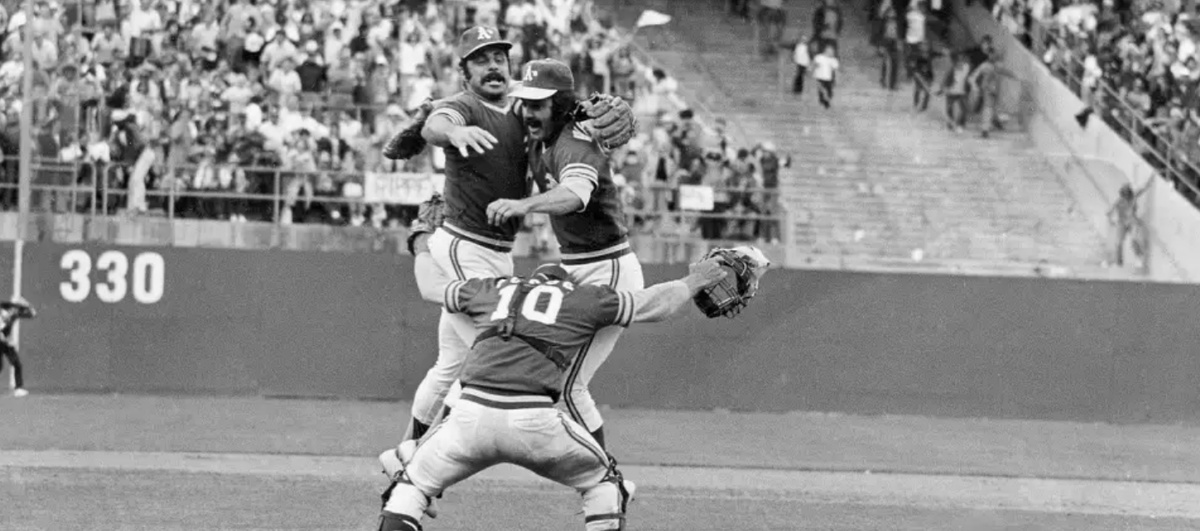
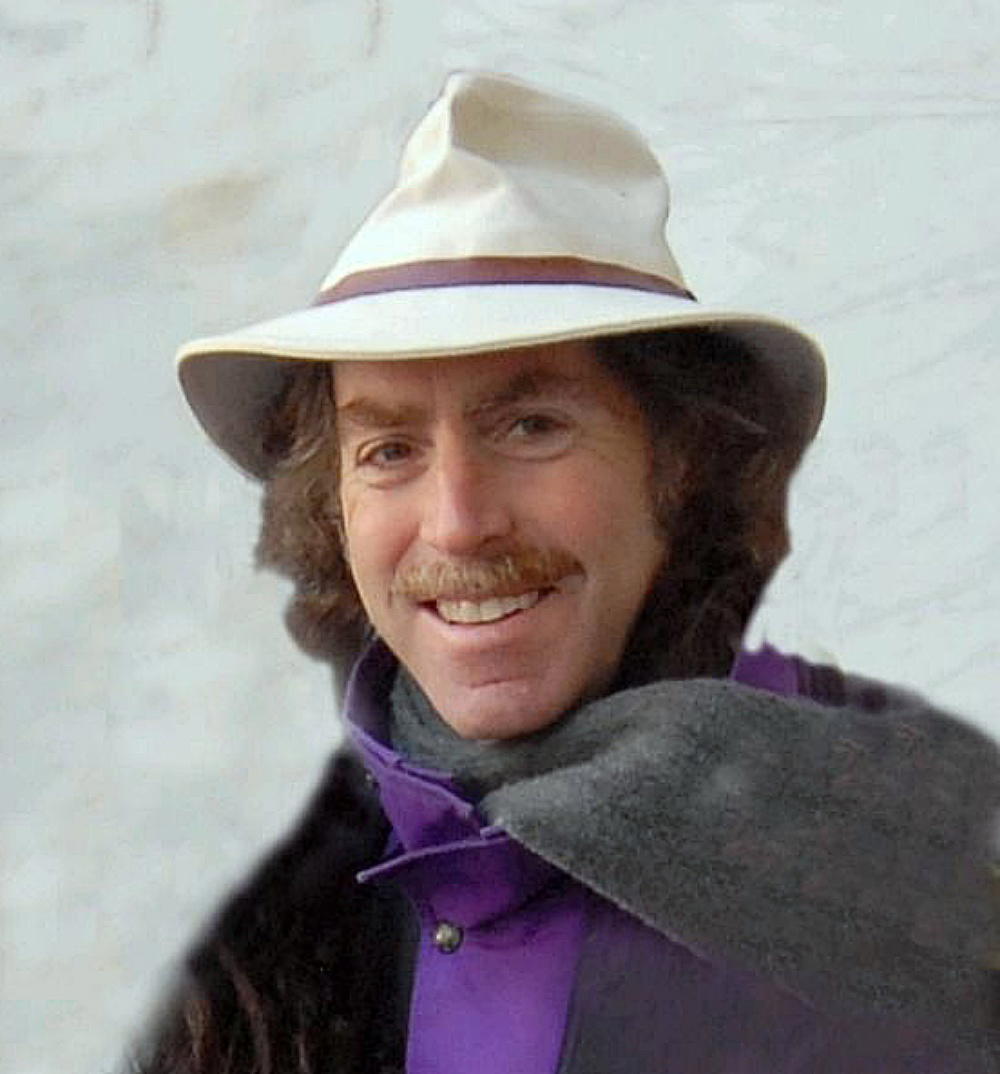
I became an A’s fan long before I moved to the Bay Area in 1970. I was a coach’s whipping boy on my high school football and track teams, and forbidden to grow facial hair or have hair past my ears and collar. While everybody else in school got to wear or grow whatever they wanted to; but I had to comply with a stupid military standard if I wanted to play sports. Along came the 1970 Oakland A’s with all those great, colorful players with cool, long hair, mustaches and sideburns; wearing my favorite color combo of green and gold. I was onboard the A’s bandwagon two years before the first World Series Championship.
My most memorable home game was the 20th straight regular season win on September 4, 2002. I’m pretty sure I got the LAST ticket in the house that night from a cool guy named Devin, wearing a Raider’s jacket. He gave me the ticket in return for a couple of beers, sharing my joint and a ride back to deep, East Oakland after the game. We had met I that night n the parking lot, but screamed and hugged when Scott Hatteberg hit the game winning “walk off” home run, after the A’s had blown 11-0 lead after 3 innings. Hatteberg was not the feckless hitter depicted in the film Moneyball, and Phillip Seymour Hoffman (great as he was) was a terrible casting choice to play Manager Art Howe. Though highly fictionalized and poorly cast, it was fun seeing my team immortalized on the big screen.
Some say the Moneyball concept is destined to fail eventually, as the model is to nurture young players and either trade them or leave them to free agency, once they attain appreciable market value. But Fisher took the concept to destructive absurdity in recent years, trading off the team’s most popular and productive players for handfuls of minor leaguers and future draft picks, and then letting them go once they developed, including Berkeley native Marcus Semien..
I resisted the ball busting of some of my baseball-loving friends to attend one last home game during the final series against the Texas Rangers. But I have good excuses. I’m not fully recovered from two back surgeries in July and August, and not yet fit enough to “enjoy” walking the ramps and stairs to get to and from the parking lot or BART station to a stadium seat. Also, I’m too emotionally vulnerable and cried enough just watching the final home broadcast. Being there with like-minded, like-hearted souls could have been somewhat healing, but I just wasn’t up for it physically or emotionally.
The SF Chronicle chose NOT to publish a letter-to-the-editor I submitted twice:
Mr. Wolff and Mr. Fisher,
Please sell the Oakland A’s to someone is more interested in nurturing a MLB team, as opposed to using the team as a prop or centerpiece of a real estate venture. It is clear that your priority “as a businessman” is to reap the greatest possible return on your investment, rather than growing and nurturing a competitive baseball team. I was told by a team official that you won’t pursue the current Coliseum site, because it doesn’t lend itself to a lucrative real estate development for housing and retail. This is about baseball, Mr. Wolff; not your ideal investment return. . .
Your claim that you can’t pay players their market rate because we have a decaying ballpark (which I happen to love), illustrates your selfish agenda and disregard for maintaining a competitive team. One could argue this places you in violation of MLB’s competition clauses, but since Commissioner Manfred is behind your selfish agenda, you’re safe.
Please sell the team to a person or corporate organization invested in the City of Oakland, and nurturing a competitive team. You have many other investment opportunities to build your Shangri-La of a housing and retail complex. But leave the A’s out of it. You’re a wealthy man and can afford to pay players to invest their careers in Oakland.
The tragedy of what MLB did to the Oakland A’s is a story of very wealthy socially blind, and tone deaf men exacting their will as presumed “maestros del mundo.” (Masters of the Universe.) John Fisher can be considered the Donald t-Rump of baseball on the basis of his destructiveness with his unearned wealth. There’s a direct connection, as “after college (Princeton) Fisher worked in the mailroom at the Republican National Committee and worked as a fundraiser for then-President Ronald Reagan and Vice President George H. W. Bush.” I called out the gross hypocrisy of Jewish Republicans supporting t-Rump just last week. What are the odds? Fisher is one of those; don’t try to TELL me this is not political. With his family Fisher donated nearly $9 million to a political action committee that opposed Barack Obama in the 2012 election.
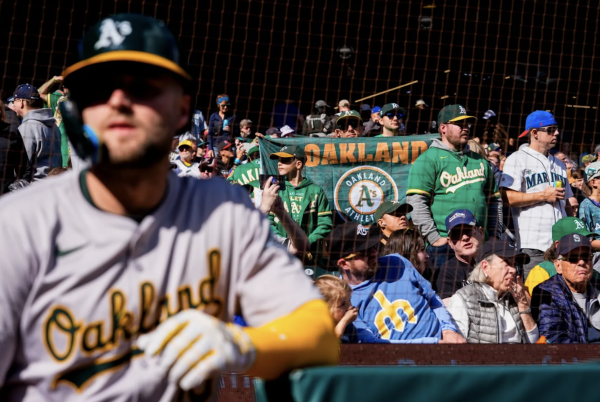 A fan waves an Oakland Athletics flag as Oakland Athletics’ Seth Brown stands at the railing before a baseball game, Sunday, Sept. 29, 2024, in Seattle. (AP Photo/Lindsey Wasson)
 For the past few years, I’ve called them the Oakland AAA’s – best minor league club in MLB! Under Fisher, “Good players have been traded for peanuts. Payroll has been stripped to bare bones. Attendance rivals a single-A club. Winning games is an afterthought. All because of Fisher's desire to move the A's to Vegas and raise his net worth... from three billion to four?” That bromide comes from a silly website that tracks the “Jewishness” of famous people. Along with the evil Stephen Miller, who authored the t-Rump family separation policy, Fisher was kicked out of all 12 Tribes, and is no longer considered Jewish.
Though I’ve been as pained as anyone by the phony, corrupt Oakland politicians and elected leaders, I don’t blame them for this fiasco. That’s all on Fisher and MLB Commissioner Rob Manfred. Baseball has not had a real commissioner since Fay Vincent retired in 1992. Bud Selig had been the owner of the Milwaukee Brewers and was just a shill for other owners, and they chose Manfred for his compliance and collusion with the billionaire owners. MLB ownership is a Billionaire’s Boys Club, composed mostly of men who earned nothing and inherited their wealth. Fisher is their poster boy for inept incompetence, and Oakland’s loss of the A’s is a lasting tribute to his greed and selfishness.
Maybe Tom Hanks, a lifelong A’s fan, can call up some friends to kick in a few 100 $million to buy the team, an offer Fisher couldn’t refuse. To A’s fans, Fisher’s brains on the contract would suffice for a signature.
