

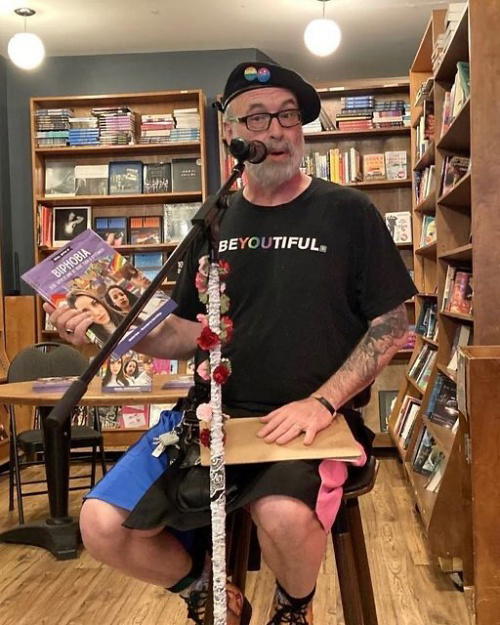

This educator couldn’t find a book for youngsters on bi+ identities, so he wrote one.
No child should ever feel excluded from books. Yet for generations, bi+ youngsters have not seen themselves reflected in the pages they read. This is changing.
It was early fall 2021, when I received two emails from teachers in my elementary school, asking if our library had any titles for Bi+ Visibility Day on September 23rd. In addition to my duties as the school’s teacher-librarian, I also advised a queer-straight alliance for students in Toronto, Canada, and I was out as bisexual to my colleagues. So, I was the person to ask if such a book existed. I was delighted that my straight colleagues knew about Bi+ Visibility Day and that they saw it was worthy of representation in their classrooms.
There was one problem: No such book on bi+ identities existed—at least nothing accessible to readers in an elementary school.
I emailed all the homeroom teachers to acknowledge the request and suggest some age-appropriate online resources they could refer to, just as I would for many cultural, political, or social observances throughout the year. I explained that Bi+ Visibility Day was co-founded in 1999 by Michael Page, who also designed the bisexual flag in 1998. Known variously as Celebrate Bisexuality Day and even Bi Pride, the day was created to raise the profile of people under the bi+ umbrella, including those who are pan, poly, or omnisexual, as well as bisexual.
I concluded, jokingly, in my email: “I may have to write this book someday.”
But the idea stuck with me. As I reflected on my work advising 2SLGBTQ+ groups of students ranging from grades four to eight over the years, there was a pattern: Most youngsters who disclosed a sexual identity other than straight typically described themselves as bisexual, if they were attracted to others of the same and different genders. Some also used the term pansexual because they did not really see gender as a factor in their sexual orientation. This aligns with a 2022 Gallup Poll which found that more than half of queer Americans identity as bisexual. Statistics Canada survey samples from 2015 to 2018 show a similar result.
In other words, more people identify as bi+ than any other sexual orientation than heterosexual.
The Toronto District School Board library database, which included 550 school libraries, provided not one non-fiction book addressing bi+ identities or biphobia.
At the same time, arguably, bi+ people are far less represented in media, including books available to children. In fact, I could find no books to recommend to my colleagues or stock in our library. The Toronto District School Board library database, which included 550 school libraries, provided not one non-fiction book addressing bi+ identities or biphobia. Even with access to publishing databases, the editor of my book and I could only find general 2SLGBTQ+ titles that tangentially mention bi+.
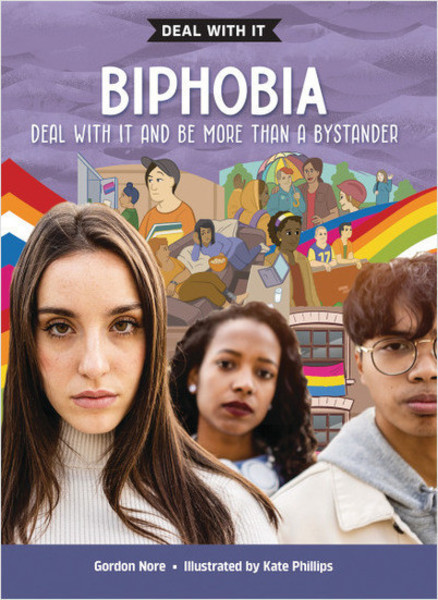
During the December school break, I sat down and drafted a query to Lorimer Books. Lorimer seemed like the place to start. They already had a series for middle years readers called Deal With It, addressing discrimination and conflict. Among the titles in the Deal With It collection were books on homophobia and transphobia—the latter written by a colleague of mine, j wallace skelton. To my delight, I heard back from the children’s acquisitions editor early in the new year, and I signed the contract in May 2022.
During the summer break, I sat down with my notes and research and began putting the book together, using the 32-page Deal With It template. The opening chapter, Biphobia 101, explores myths and misconceptions—dismantling notions of bi+ people being indecisive, greedy, hypersexual. Other chapters include The Bi+ Eraser, which describes the ways in which plurisexual people find their identities ignored or undermined. Finally, The Bi+ Stander is a call to action to address biphobia at home, at school, and in communities where young people gather.
Halifax, Nova Scotia, artist Kate Phillips’ illustrations breathed life into the kids and adults I had imagined in the various strips, graphic organizers, and illustrations. When I saw her work alongside mine, I was picturing so many students I have spoken to over a decade of advising queer straight alliances.
I recalled the boy who worried about whether his friends from a nearby Catholic school he used to attend would accept him as an out bi+ person. I thought of a seventh grader, now in her third year of university, when she first disclosed her bi+ identity in a Queer Student Alliance meeting. I thought of youngsters who sought support from me, from the administration, or even each other as they navigated sometimes discriminatory treatment from others.
What do I hope this work will accomplish? It’s a question I’ve been asked by adult readers, particularly those who are bi+ and never had a resource like this as youngsters. I hope the book serves notice that there is so much more to learn about sexuality, and about gender. I hope it breaks the ice in children’s publishing to create more works—whether picture books for little people or more non-fiction titles for kids of various ages. I hope it’s a resource and conversation starter for teachers, sexual health educators, and advocates for children. I hope my book helps queer, questioning, and allied youngsters find the words they want to use to tell their own stories.
In the United States, Biphobia: Deal With It is available from Lerner Books.
 Biphobia