

On Writing Real Lives: After Love Story


When does dramatization cross into misrepresentation? And just as importantly, who gets to decide?
Like so many others, I've lately been engrossed in Love Story, the new series about John F. Kennedy Jr. and Carolyn Bessette Kennedy.
Part of the fascination, of course, lies in the fact that theirs was already a story before it became a series: a romance shaped by glamour, public obsession, media mythology, and the kind of cultural afterlife that seems to attach itself to certain couples. Watching it, I found myself pulled in not only by the story being told, but by a brief disclaimer at the beginning of the series: some characters and situations have been dramatized.
It's a phrase we have all learned to read quickly, if at all. But what, exactly, does it ask of us?
That question came into sharper focus when Daryl Hannah published a striking op-ed in The New York Times responding to her portrayal in the series. She objected not simply to its dramatizations, but to the scenes and behaviors attributed to her that she insists are entirely false. What troubled her most was not only the inaccuracy, but the effect: that a real, living person had been turned into a narrative device, and that once released, such portrayals begin to harden into public memory.
Her response raises a question that no disclaimer can fully resolve: when does dramatization cross into misrepresentation? And just as importantly, who gets to decide?
I have been asked versions of this question throughout my career, especially in relation to my novels, which are rooted in the lives of historical women whose stories have come down to us in fragments, distortions, and silences. Watching this latest love story unfold—one already shaped by myth, media, and collective fascination—I've returned to the question with renewed urgency.
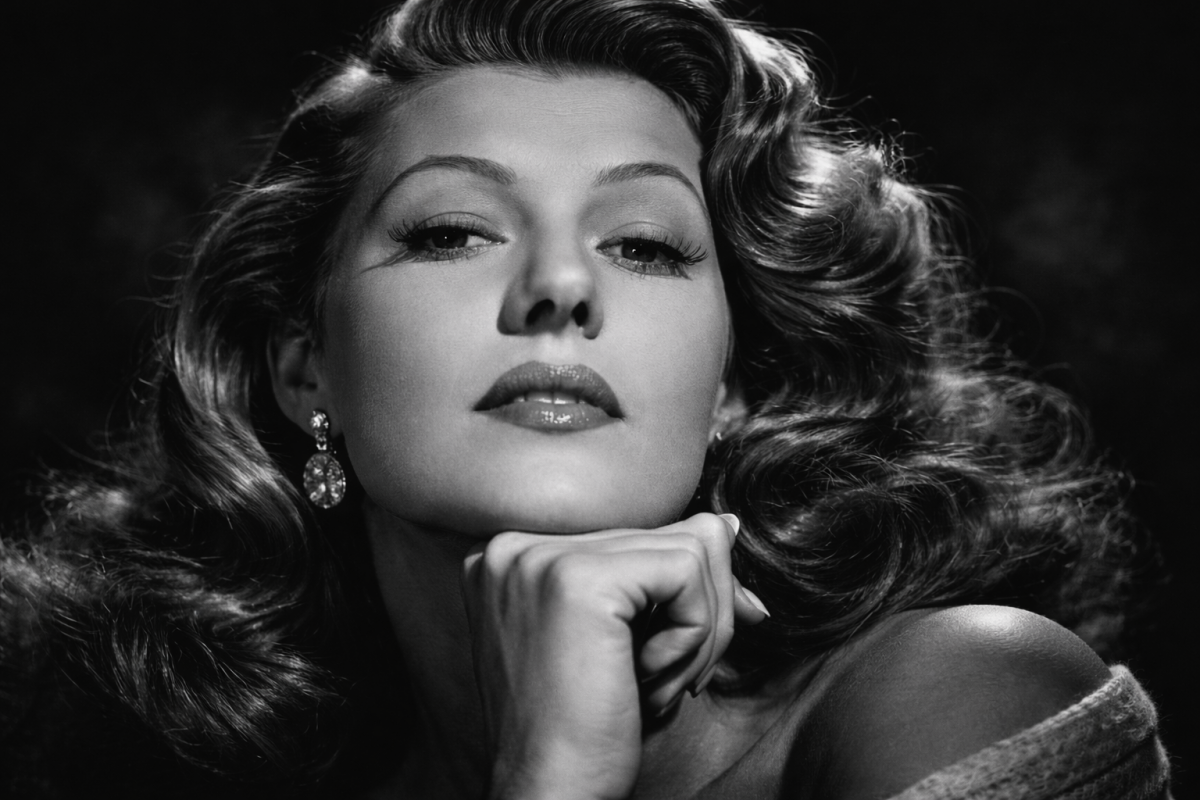
The challenge came closest to the surface for me while writing American Goddess, my forthcoming novel about Rita Hayworth.
Like the Kennedy story, it is in part a love story, one shot through with glamour, desire, power, betrayal, and the complicated machinery of public image. But writing about Rita meant entering an archive already crowded with projections: studio publicity, gossip columns, male biographies, the flattening myth of the “goddess,” and the retrospective tragedy through which women's lives are so often understood. Image item Rita Hayworth in the 1940s.
For me, the task has never been to invent freely at the expense of truth. Nor, however, is it to serve as a stenographer to the archive.
A writer of biographical fiction must go with the grain of history. By that I mean that fiction must move in alignment with what is known, what is plausible, what is emotionally and historically possible. Everything I write needs to be contiguous with the truth. The invented scene, the imagined conversation, the interior monologue—these are not departures from history so much as acts of listening within its silences.
But going with the grain of history is not the same as surrendering to the historical record. This is especially true when writing women's lives.
So much of what has been written about women has been misrepresented, sensationalized, or omitted altogether. The archive is not neutral, as Saidiya Hartman so powerfully states. It reflects power: who had access to publication, whose letters were preserved, whose diaries were burned, whose reputations were shaped by gossip columnists, husbands, studios, biographers, and institutions.
To write counter to the archive doesn't mean ignoring it. Quite the opposite. It means reading it more deeply, more skeptically, and sometimes more compassionately. It means asking: who had the power to tell this story first? Whose version became official? What might have been impossible for a woman to say publicly in her own time?
In that sense, fiction can function as a kind of counter-archive, not a correction in the strict scholarly sense, but an imaginative act of restoration.
There are boundaries, of course, and they are not the same in every case.
The rules for writing about famous people are different from those for writing about private, ordinary lives. Public figures—especially those whose lives have already entered the cultural imagination—exist within a vast field of representation: interviews, photographs, public records, biographies, and the mythology that fame itself generates.
The parameters shift again when writing about the long deceased. Time alters the ethical terrain. Distance opens imaginative space, but it also increases responsibility, because the subject can no longer answer back and because the historical record may be fragmentary, biased, or shaped by the prejudices of its era.
For me, these shifting conditions don't create permission. They deepen obligation.
I would never create a version of a real person whose character, temperament, and moral center bear no resemblance to what is known of them. You cannot take a woman whose life reveals intelligence, discipline, and complexity and render her frivolous merely because it serves your plot. Nor can one impose contemporary sensibilities in ways that violate the historical psyche of the person being portrayed.
The responsibility is not factual perfection in every private detail—no novelist can claim that—but fidelity to essence. The emotional truth must ring true to the life.
In some ways, I think this is why the best compliment I receive from readers is not simply that they loved the novel, but that it sent them to read more--biographies, letters, criticism, scholarship, and history.
That, to me, is the highest form of literary conversation. A novel should not replace the historical record; it should deepen our hunger for it. When readers finish one of my books and seek out the work of scholars—so many of them women doing extraordinary labor to recover lost histories—I feel the novel has done something good in the world. My fictional story has buttressed and amplified that scholarship, and the book has helped create an appetite for nonfiction accounts, archival work, and historical inquiry.
And given that only a small fraction of recorded history concerns women's lives, that appetite matters.
Perhaps this is what draws me again and again to these stories, not the opportunity to embellish history, but the chance to inhabit its absences, to stand where the record thins and ask what might have been felt, feared, desired, or endured there. I'd love to hear your thoughts—have you been watching Love Story? Where do you think the line lies between dramatization and misrepresentation when the lives on screen or on the page are real? Block 13th Block 14th
On a parting note, if you're in the Bay Area I'd be thrilled to see you at Book Passage in Corte Madera on April 25 from 1:30-3:30, where I'll be delivering the keynote talk for this year's Local Author Book Fair on National Independent Booksellers' Day. With love and gratitude, Jasmin.
