


Much teaching of history is rationalized via George Santayana’s aphorism, “Those who cannot remember the past are condemned to repeat it.”
During a European history course at SUNY Albany, I realized that the course’s content—that in fact all of the content of all the history classes of all my schooling—was backstory carefully choreographed to account for that (White) professor’s position: Standing there at the front of the class, he was effectively saying, “And thus, me.” (Or, to be more precise, “And thus, us.”)
Like so much of the curricular content of compulsory American propaganda (sorry, education), history—American, European, World—is a many-years-long explication of why it’s so fortunate that White people ended up running the world and exactly how that came to be.
(It is the extent of recent straying from canonical curricula that has Ron DeSantis and his Republican fellows so agitated: They’re wanting to rein—or reign—in any subversively Unamerican ideas suggesting that there might be other, less White, options available.)
Much teaching of history is rationalized via George Santayana’s aphorism, “Those who cannot remember the past are condemned to repeat it.” That’s pithy, but what is more often true is that those who do remember the past are condemned repeat it. That repetition is: sometimes a matter of people remembering what happened, not liking how things turned out, and trying the exact opposite, i.e. trying 1A instead of 1B. Sometimes that is cast as precedent, really just a way to justify our continuing to do 1A (think Roe v. Wade)—or to undo, i.e. 1B (think reversing Roe v. Wade)—what we’ve been doing for a while; there is also tradition—repetition sanctified over time, then passed along as sacrament to new generations.
For instance, modern pork is perfectly healthy, but not eating it is a multi-thousand-year-old religious tradition; in addition, there are myriad times throughout the millennia that people have chosen to exact revenge in the precise manner in which the original offense was committed, countering a perceived atrocity with a similar atrocity.
Then too there is the phenomenon of anxious people becoming their enemies. Determined to predict and counter their enemies’ future moves, they focus so obsessively on thinking like their enemies that over time they begin to be like them. (This is a reason to be selective in our choice of enemy.) A subset of this last derives from trying to live up to what we think is expected of us, which is what George Orwell describes when excoriating colonialism in Shooting an Elephant:
When the white man turns tyrant it is his own freedom that he destroys. He becomes a sort of hollow, posing dummy, the conventional figure of a sahib. For it is the condition of his rule that he shall spend his life in trying to impress the "natives," and so in every crisis he has got to do what the "natives" expect of him. He wears a mask and his face grows to fit it.
Everything considered, and humans being who we are, remembering the past is far more likely to lead to repeating evil behavior than it is to our trying different, better ways of doing things. It is this tendency to repeat the past that we are seeing now as nations, in response to Russia’s invasion of Ukraine, one by one, align into two opposing military blocs the way they did in World Wars I and II.
The kind of history we learn in school is, for the most part, two-dimensional. Authentic History, the kind we learn lifelong, encompasses far more than the date-by-date, this-happened-then-that-happened detailing of battles that are carefully selected to bolster the foregone conclusions of American superiority that our compulsory education system presents in our classrooms.
The Authentic History we lifelong learn is much broader and deeper. From cradle to grave, that History soaks into us via myth, custom, precedent, tradition, and religion, via the repository of culture that is our language, via behaviors constantly drilled into us as natural, as the way things are supposed—even ordained—to be. All societies are built on overt and covert norms inculcated from birth so as to seem natural, to become second-nature, to become, practically, invisible.
We have invented many structures to rationalize just keepin’ on keepin’ on. Which is why disrupting norms is so corrosive and destructive: We can’t see the cracks and potholes in the pavement, and, constantly hitting them, we are jarred and thrown us off course.
For the most part, American classroom history is a series of ever-more-complicated morality plays, each building on the lessons of the ones before. Carefully selected and arranged in a narrative, presented as fact, most American classroom history is fiction lacking the courage, the forthrightness, the honesty to admit its artifice, contrivance, and subterfuge.
Most. Not all.
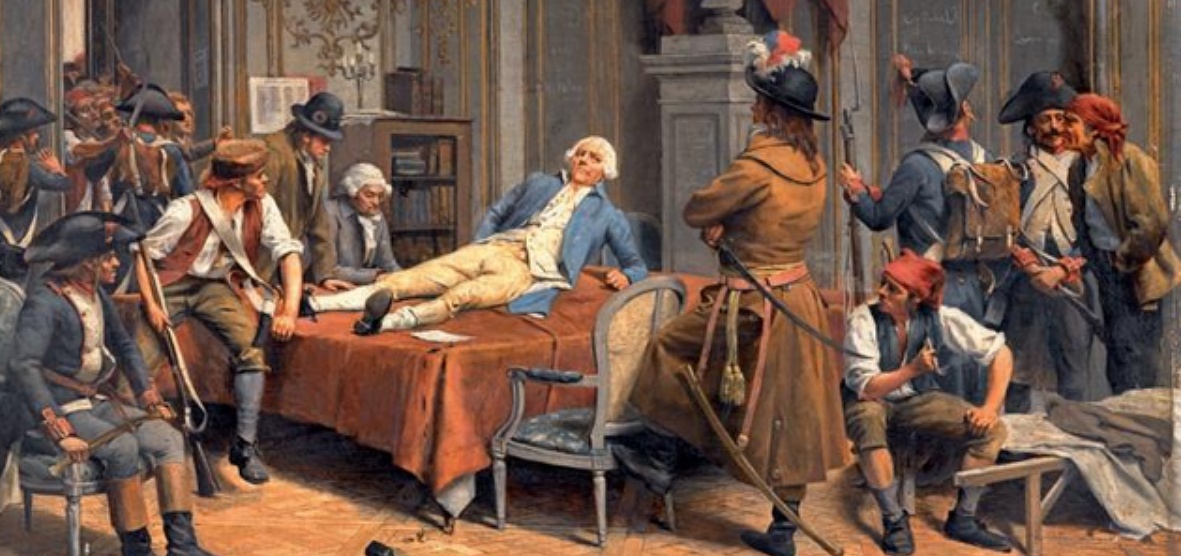
I came to Timothy Tackett’s The Coming of the Terror in the French Revolution by accident. (Tackett, who specializes in the French Revolution, is an emeritus professor of history at UC Irvine.) I was reading A Climate of Fear, a Fred Vargas mystery involving members of the fictional Association for the Study of the Writings of Maximilien Robespierre. Robespierre, instrumental in the very real and very bloody Reign of Terror that stained the French Revolution, was an enigmatic character. Googling him, I stumbled across Tackett’s Terror.
Transcending typical classroom history, The Terror begins with a brief description of the period immediately prior to the Revolution. It then expands on the conflicting economic, political, religious, and psychological forces that powered the Reign of Terror by leading us through the minds of witnesses to the bloody horror of The Terror, a mid-Revolutionary killing floor on which literally no one was safe, not even those in charge of organizing and administering its scourge of self-harm and carnage.
There is disagreement about when The Terror officially began, but between early September, 1793 and late July, 1794—so within a span of ten months—nearly 17,000 French citizens, most guilty of little more than suspicion, were imprisoned and sent to the guillotine by the powerful Committee of Public Safety. Led by Robespierre (until he too was guillotined), the banally named Committee was in theory acting in the public interest in response to perceived internal and external threats to the Revolution—internal from monarchists, disgruntled nobility, and the clergy and external from hostile and invading neighboring nations. The Committee, initially given wide latitude to seek out and rid the Revolution of its enemies, quickly—under Robespierre’s guidance—took on virtually unchecked power to arrest and execute anyone for any reason.
And it did: By the death of Robespierre, 16,594 official death sentences were carried out and many thousands more had died in prison awaiting what were merely show trials, the predetermined conclusion of each being, in nearly every case, a guillotined death.
How did a Revolution so recently born of lofty ideas of liberty, equality, and fraternity slide into a frenzy of limitless and brutal self-mangling? It is this question that Tackett analyzes by laying out the multiple factors at work: the breakdown in authority after the overthrow of the thousand-year-old monarchy, active subversion, foreign invasion, and a paranoiac cycle of mistrust, rumor, suspicion, and denunciation. Conspiracy theories ruled the day. Tensions among the populace were fed by frequent fears of food shortages, those food shortage fears fired by conspiracy theories about enemies of the Revolution deliberately causing food shortages. Waves of existential panic washed over the land, subsided, then recurred. Even the Revolutionary elite was terrified. Terrified people become terrorists.
Tackett presents the thoughts, fears, confusions, and emotions of nearly 100 men and women, revealed through their letters and diaries, and his Terror provides a sobering sense of what it could have felt like for citizens simultaneously overjoyed at the prospect of liberty and mortified by the insecurity, instability, and bloodbath surrounding them.
Throughout the book I was repeatedly struck—and frightened—by the language with which the often feuding Revolutionary factions referred to those who disagreed with them and its similarity to our own cultural moment. Death loomed, the difference between living and dying determined only by a misspoken word, by the merest nuance of speech, by a sentence uttered in the past that, in the glare of suddenly paranoid lighting took on a wholly different meaning, as the awful suspicions between and even within fluidly shifting factions ratcheted up. People who just months before had been comrades, who had joyously and jubilantly joined to overthrow the monarchy, could no longer trust one another or credit their mutual love of country. Describing this phenomenon, Tackett writes,
By early 1792 the atmosphere in the Assembly was often extraordinarily contentious and polarized. Rabousson-Lamothe described the daily scene in one of his letters home: “They insult one another, they accuse one another with a violence that approaches frenzy.” For Foubaud the hall represented “a strange Bacchanalia” which “often comes close to leaving dead on the floor.” There were even reports that some deputies attended the sessions armed with pistols in their coats. In such an environment, the great majority of deputies—whether or not they formally adhered to a club—began lining up and voting with one of the other of the two rival parties. Enormous pressure was exerted on the ostensibly nonaligned to declare which side they were on. Delegates denounced one another with such fury that “citizens who prefer to avoid both sides, are ultimately compelled to choose one of the other.”
In the summer of 1792 the near parity between the alignments would create a virtual deadlock in the midst of a national crisis, a situation that would seriously reduce the authority of the Legislature.
Those dynamics led, during the height of the Terror, to patriots hurling slurs at each other and knowingly sending one another to their deaths.
Presented matter-of-factly, Tackett’s Terror is a chilling warning for patriots of any party: We would do well to tamp down the apocalyptic, end-of-democracy rhetoric and demonization that has infected our public discourse. The Terror is a book not only for Francophiles (that picture of me below was taken at a sidewalk table in Paris), but for anyone wanting to avoid a similar abomination, a small version of which we witnessed on January 6th, 2021.
But The Terror also proves that a history book can rise above mere narritization of research, can transcend subversive fictionalization, and can present historical figures and events in a context that makes the past seem like it actually happened to living people, people who at one time really existed in the world and faced events for which they lacked precedent, a world of toppled traditions, a world in which they faced roads not taken, roads whose destinations they didn’t already know, a world in which they faced unknown outcomes and thus unknown Uses.
A world much like our own.
