



Her somewhat surprising argument is that apocalyptic transformations, catastrophic as they are, also clear the way for new, better ways of thinking and acting.
I have long been convinced (see “We’re Doomed! No, Wait” from last year, and “Climate Catastrophe” from earlier this year) that we humans will fail to do what would be required of us to confront the climate change that is the fruit of the Industrial Revolution. Consequently. catastrophe will face the coming generations.
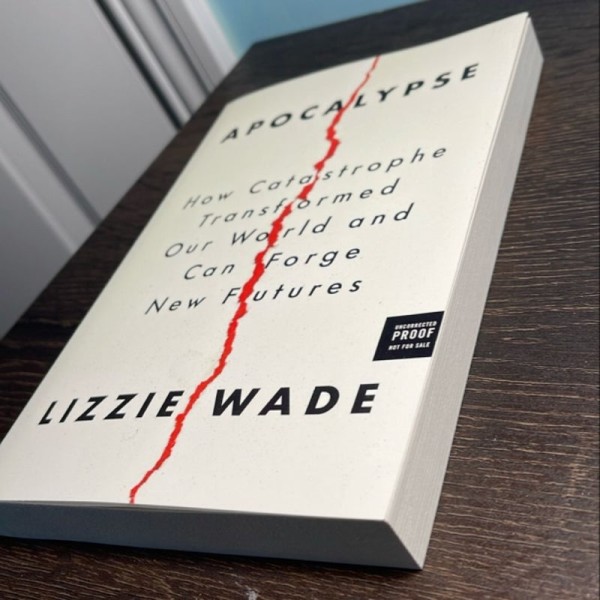
So I was perversely glad to see Lizzie Wade’s Apocalypse on the New Book Shelf at the Bucknell Library. Her somewhat surprising argument is that apocalyptic transformations, catastrophic as they are, also clear the way for new, better ways of thinking and acting. From the collapse of the great Indus Valley city of Harappa or the Egyptian Old Kingdom, survivors could build new, more decentralized and egalitarian ways of life.
The Black Death epidemic of the thirteenth century surely killed millions of people, all of whom died in an agony almost unimaginable. But the resultant reduction in population opened the way to the destruction of feudal hierarchies and higher standards of living for the vast majority of survivors.
A somewhat surprising chapter begins with the well-known Spanish conquest of the Aztecs, and the literal leveling of the physical monuments of that great civilization. Wade focuses on the destruction of the Aztecs’ ways of managing the environment of the Valley and the lake where their great capital, Tenochtitlán, stood in the middle of a lake. But instead of abandoning what was unsustainable, the Spaniards insisted on keeping it as their capital (now Mexico City). Right up to the present time, she points out, ecologically problematic as it is, the city refuses to die. It is, indeed, one of the world’s great megalopolises.
What she wants us to see is that, beyond the destruction, apocalypse can bring hope for those who survive. Toward the end of the book, she writes this:
Embracing apocalypse doesn’t mean resigning ourselves to the worst-case scenario, or giving up on the idea of progress. It means believing that destruction can be a gateway to that progress, societies can and should change, and endings are also always beginnings. (254)
I think she is both too optimistic and too narrow. We must not, in focussing on the successes of the survivors, forget that most people perish in any apocalypse. Most people die, and not necessarily in bed surrounded by loved ones.
And she, like most people writing about our contemporary climate crisis, focuses exclusively on humans. We have, in the course of the Industrial Revolution, consigned to oblivion countless species, both plan and animal. Countless more will fall as the climate heats up, droughts, floods, and storms multiply, and the global ecosystem changes irrevocably. This is an apocalypse that has no happy ending.
 Lizzie Wade
“We’re Doomed, No, Wait!” (2024) was a review of the similarly optimistic Jeremy Rifkin. My conclusion then still applies:
We are headed for a climate apocalypse. Vast regions, whole countries will be rendered uninhabitable by flood or drought. Millions, no, billions of people will be on the move, seeking succor where they can, and often met instead by hostility from those who still have a precarious hold on life. Maybe by that time the doubters will be convinced, but it will be too late for them, too. Such human society as survives will be increasingly dedicated to killing their neighbors in order to take their land. Those not killed by climate change could be killed by nuclear war.
And of course the rest of life on earth, from the corals of the oceans to the elephants and lions of the African plains, will also die back.
But the earth will survive. After our species is reduced to scattered bands of hunter-gatherers, no longer capable of feeding climate change, millions of years of evolution will produce new life from whatever survives the apocalypse. We may hope that this new life will not make the same mistakes we humans did. But one of our mistakes could turn out for the best: extensive nuclear war could cause a “nuclear winter,” which would cancel out global warming.
