

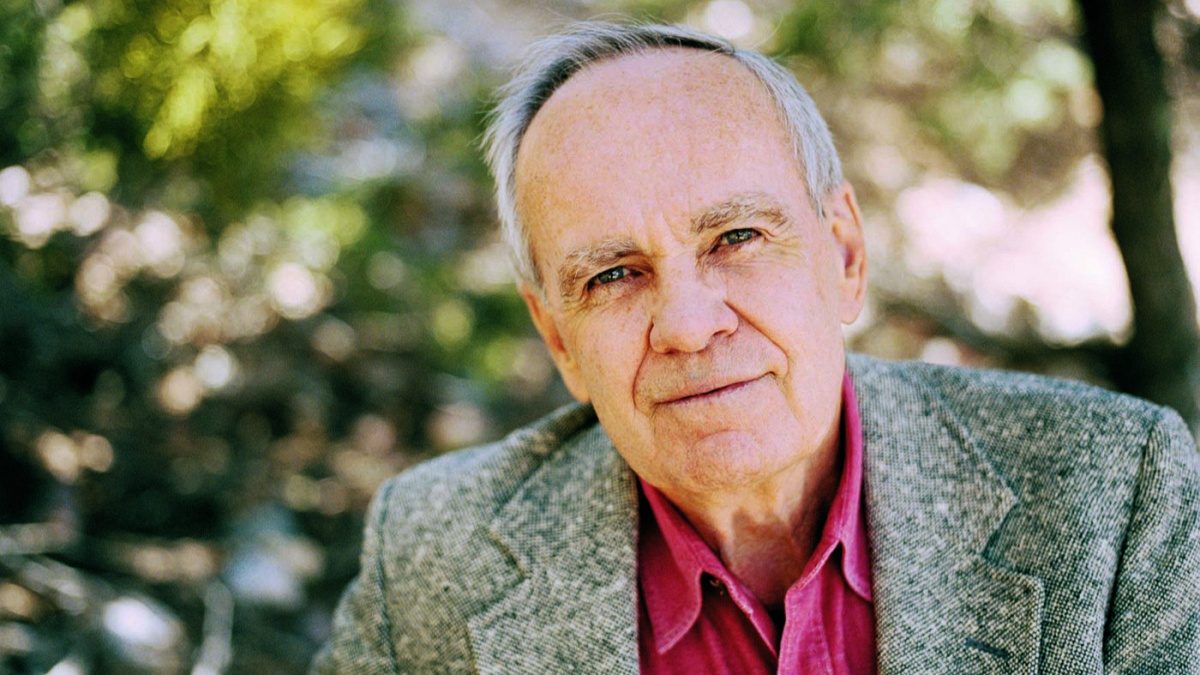


McCarthy was able to give modern emphasis to the kind of evil few could imagine as an intimate part of American history and culture.
The passing of the celebrated novelist, Cormac McCarthy, on June 13, 2023, brought a close to one of the most accomplished careers in American letters. As the author of thirteen novels, two screenplays and a dramatic work in five acts over a period spanning almost sixty years, which unflinchingly explore the depths of human evil, McCarthy had a significant impact on the development of post-war American literature. In works owing as much to his seeming indifference to the prevailing movements and fashions of the day, as they do to his innovations in style, “unblotted” punctuation, and narrative perspective, his work is suffuse with descriptions indicative of a preference for modernist aesthetics over the decentering postmodernist pyrotechnics that dominated the literary scene since the early 60s.
These features were bolstered by an elevated prose style that often wielded a Biblical resonance in which McCarthy gave presence to the desolate worlds appearing in his earliest writings starting with The Orchard Keeper in 1965, which a critic writing in Kirkus lauded for its “unusual writing furrowed by a stark, visual imagery.” Given the surreal and often gruesome themes McCarthy so often explored, however, he also had his detractors. Another critic writing in The New York Times on this same novel, for instance, dismissed McCarthy’s writing as at once “handicapped” due to a “humble and excessive admiration for William Faulkner,” while conceding that “he does write with torrential power.”
Despite and, maybe, in the face of such divergent assessments, McCarthy would go on to build a dedicated following among the public and fellow writers over his initial Southern period by the sway of novels that spiraled out from remote settings in East Tennessee of The Orchard Keeper, and subsequent offerings in Outer Dark and Child of God. While these works landed him securely in the realm of the southern gothic for their grotesque themes, freakish characters, and unnerving explorations of evil, an apparent limitation can be seen in his early portrayal of female characters who are all-too-often reduced to little more than victims of male violence, rather than as agents themselves.
Flannery O’Connor considered the engagement with the grotesque as a theme of particular centrality for Southern writers in the gothic tradition. In her assessment, the use of such tropes encapsulates a unique perception that can serve as a powerful means by which a writer can call to life “some experience which we are not accustomed to observe every day, or which the ordinary man may never experience in his ordinary life.”
The representation of such limit experience is on full display in McCarthy’s second novel, Outer Dark, detailing a despairing story resolving around incest, the theft of a baby, and a mother’s relentless search to recover him, all menaced by a “grim triune” of seemingly supernatural phantoms come to mete out an ungodly form divine retribution. The initial critical reception of Outer Dark was no better than for The Orchard Keeper, with one reviewer unable to place a series of events that, according to the text itself, originates in Johnson County, Tennessee into their own schema of reality, opining that it’s a story that takes place on “the perimeter of nowhere.”
This reviewer is far from the first person to be unable or unwilling to see Appalachia on its own terms, or at all. The wild popularity of J.D. Vance’s Hillbilly Elegy, despite its glaring distortions of Appalachian culture and historic fact, is suggestive of the way so many who look upon this region and the people who reside there are only willing to do so from a safe distance. Their perceptions of the place drawn from sensationalistic tales and demeaning stereotypes that reinforce their own implicit biases and ignorance, often tinged with a sense of snobbish elitism and cultural superiority. The inability to connect with McCarthy’s dreamlike version of East Tennessee and Appalachia and accept its fictive possibilities is reflective of the kind of response O’Connor observes when writers utilizing a Southern scene for dramatic purposes are “judged by the fidelity your fiction has to typical Southern life.”
Demonstrating a curious refusal to suspend their disbelief—a necessary prerequisite for the reading of any work of fiction—this reviewer goes on to critique McCarthy’s aims in their final line calling into question the very status of both story and audience as they ponder: “a somnolent fascination, a spectral charade, but for whom?” It’s almost as if the terrible suffering and brutality of chattel slavery and the violent dispossession and forced removal of Native people from their southeastern homelands most prevalently through the so-called “Trail of Tears,” and so compellingly rendered in Andrea Rogers’ recent collection, Man Made Monsters, are so distant and obscure, resigned to the oblivion of dominant history, as to have no enduring bearing or cogency on the present.
The views of such reviewers notwithstanding, there were a growing number of readers who appreciated the risks McCarthy was taking in his explorations of the bounds, or maybe the boundlessness, of human evil as an experiment in transgressive narrative. A posture that also seems to align with the assertion made by Georges Bataille in Literature and Evil that “a rigorous mortality results from complicity in the knowledge of Evil, which is the basis of intense communication.”
As N. Scott Momaday emphasized in House Made of Dawn in a context not all that distant from McCarthy’s, evil is not something we can afford to ignore or turn away from: “Evil was. Evil was abroad in the night; they must venture out to the confrontation; they must reckon dues and divide the world.”
Whatever one’s position, the reckoning of the dues wrought by evil is one of the driving forces that runs through the totality of McCarthy’s fiction. Similarly revolted by a violence perpetrated by the displaced and deranged protagonist of his following novel, Child of God, in Lester Ballard, which is seen as “so lacking in human momentum or point,” another critic writing in The New York Times further reinforces the predominant strain of criticism elicited by his early works for what was characterized as a “hostility toward the reader.” Unable to see McCarthy’s characters as refractions of the region’s brutal past and as archetypes for the violent behavior of those who brought such impulses into historical being, for this reviewer Child of God represented little more than a novel of excess, an exercise in mere obscenity “that no matter how sternly it strives to be tragic is never more than morose.”
In seeking, perhaps, a way of infusing what O’Connor would call his “Christ-haunted” worlds with a broader range of human experience, which the same reviewer writing on Child of God claims “does not often let us see beyond the nasty,” McCarthy’s tragi-comic masterpiece, Suttree (1979), serves as a bridge between his Appalachian writing and subsequent dive into the cauldron of the American west. As such, it’s a novel that draws his readers down out of claustrophobic Blue Ridge Mountains to the banks of the Tennessee River and into the hard streets of Knoxville, which stands “like a rampart to a farther world forsaken.”
McCarthy imparts this novel with a greater sense of humor and lightness of being in following the (mis)adventures of the eponymous narrator, Cornelius Suttree, at once farcical and mournful, through an intricately interwoven narrative “that reads,” as another critic observed, “like a doomed Huckleberry Finn.” As McCarthy’s longest work at 471 pages, readers find a sprawling narrative with a cast of marginalized, downtrodden, and misfit characters, where humor abounds to balance the loneliness of human life rendered here in a more nuanced and sensitive way than in previous works. Such assessments speak more loudly when considering Suttree is also described by the same reviewer as a novel that “comes at us like a horrifying flood.”
It’s all about perspective, right? And McCarthy’s vision, while bearing similarities, is distinct from those of other writers such as Carson McCullers, John Kennedy Toole, and Jesmyn Ward, who have all put their own wonderous, beautiful, and heartrending imprints on the archive of Southern literature.
The expanding readership McCarthy had gained by the early 80s, notwithstanding, his work had yet to achieve mainstream appeal. Seeking to disrupt a trajectory landing him in the oft disdained category of Southern writer, while also being promoted by his publisher as “the closest we have to a genuine heir to the Faulknerian tradition,” in 1985, McCarthy published Blood Meridian, or the Evening Redness in the West. The writing of Blood Meridian didn’t just reflect an imaginative shift in geographic setting, but it also precipitated his own relocation from Tennessee to the southwestern borderlands of El Paso. A move allowing him to acquaint himself with the landscape, culture, and history central to his experiment with the neo-western form.
Written over a period of more than ten years, Blood Meridian is a ferocious novel that carries readers on a journey west through the perspective of an anonymous child whose mother is dead and sister absent and estranged, in whom there “broods already a taste for mindless violence.” Harkening back to McCarthy’s previous works, this is a child who has emerged from the “darker woods” of East Tennessee in 1833 “that harbor yet a few last wolves.” From here, readers are taken on a grim trek into the further reaches of that shifting frontier boundary at the Mississippi River, and on to Memphis and St. Louis, before disembarking in New Orleans and continuing his passage west.
In his wandering through Texas and beyond, this child, now dubbed the kid, is “finally divested of all he has been,” a maturing embodiment of the thrust of westward expansionism taking him into the darkest territories of the American past. Traversing a landscape the historian Fredrick Jackson Turner cast as the “outer edge of the wave” of westward expansionism, “the meeting point between civilization and savagery,” readers are brought to the threshold of a world transformed into a “purgatorial waste,” as we are carried back to a place and time scarred by the brutality of Manifest Destiny.
With the reorientation of McCarthy’s creative focus on the frontier American west, which, as we may recall was first set at the Appalachian Mountains after the establishment of America’s thirteen original colonies, Blood Meridian traces in the starkest terms the barbarity of the protagonist’s experiences amongst a vile crew of reprobate ministers, horse thieves, filibusterers, and outlaws. Distinguished from these stock western characters, there also resides a loosely allied band of what can be best described as psychopathic killers in the “immense and bloodslaked waste” they had made of the land, which, as Carson Wells subsequently reminds in No Country for Old Men set a hundred and twenty-some odd years later, “there’s plenty of them around.” The more things change, right?
After a disastrous expedition into Mexico, the kid falls in with a group of scalphunters headed by the historical figure John Joel Glanton, who leads a years-long frenzy of murder and mutilation perpetrated against Apache people, and anyone else unfortunate enough to cross their path. Despite Blood Meridian’s grotesque and horrific subject matter, it wasn’t long before it was being hailed by Harold Bloom (yeah, I know *shrugs*) as one of the greatest American novels of the twentieth century, while also being cited by David Foster Wallace on his list of five unappreciated post-1960 American novels.
What’s more, the brutal story detailing the wholesale murder of Native people forming the basis of Blood Meridian was drawn from actual historical events that occurred in the aftermath of the Mexican-American War from 1849-1850. This element of incomprehensible verisimilitude, which also serves as an intervention against a colonial historiography that had long neglected such unsavory details form the dominant, romanticized narrative of the American West, made the subject matter all the more monstrous and ghastly.
And while Glanton’s gang kills with impunity throughout the novel, it’s also critical to note that such violence was made possible by the notorious adoption of government-sanctioned scalp bounties by officials in Mexico, following similar measures used in various places throughout the United States. The implementation of such genocidal policies gave carte blanche to roving groups of killers in their efforts to bring about the extermination of Native peoples as a means of opening western lands to Euro-American colonization and resource extraction. But also, for their own profit.
The pitiless struggle for the west, driven by imperialist motives lying at the cold heart of so much of the violence McCarthy bears witness to in Blood Meridian, also forms a prevalent theme in the works that followed. Propelled by the critical recognition of Blood Meridian, written, as another critic noted, in an “elaborate language” that “invents a world hinged between the real and surreal, jolting us out of complacency,” McCarthy finally achieved popular success with the release of All the Pretty Horses in 1992. Continuing his explorations of the complicated merging of histories and cultures, dreams and nightmares emergent from the borderlands of the southwest and Mexico, this work became the anchor for a series of novels known as ‘The Border Trilogy.’
The completion of these intertwined stories with The Crossing (1994), hailed as “a miracle in prose,” and Cities on the Plain (1998), further amplifying cinematic elements in such a masterful way as to prompt another reviewer to compare it to “something lifted from an Ingmar Bergman film,” mark the most productive period of McCarthy’s career. Moreover, All the Pretty Horses is notable for being bestowed with a National Book Award, while becoming the first of McCarthy’s novels to be adapted into a feature film—directed by Billy Bob Thornton in 2000.
Following on the commercial success of this trio of novels, No Country for Old Men, can be seen as denoting the consolidation of McCarthy’s mature literary vision with the achievement of popular and cinematic appeal. The financial stability McCarthy obtained with the completion of The Border Trilogy, after decades of living in uncertain circumstances as a struggling writer, also offers insight into the continued development in style that distinguishes No Country for Old Men from his previous works.
With its focus away from tropes drawn out of the mythological past of the old west and to the contemporary new west context of the modern drug wars, No Country for Old Men brings the expression of McCarthy’s unwavering vision on the persistence of evil, along with the effects of human frailty and vulnerability in the face of chance and chaos, into the present. Amongst his novels, No Country for Old Men (2005), is often seen as breaking from his most developed literary style, while being counted as among his weakest offerings, with one critic writing in the New Yorker even calling it a “morally empty book.”
While I respectfully disagree and see in No Country for Old Men, not just a morally complicated story of how we might deal with creeping spectre of modern evil, it also offers a story in which readers are presented with a broader cross-section of characters than in previous narratives. Significantly, No Country for Old Men includes a selection of female characters from Loretta and Carla Jean, the wives of two of the main characters, to the anonymous manager of trailer park who refuses to bend in the face of evil, offering a corrective to the often rash, foolish, and just plain self-destructive impulses of the male characters who drive much the narrative’s violent action.
Following on the success of ‘The Border Trilogy,’ in No Country for Old Men, McCarthy leverages a more sparse and direct style in presenting an image of the world that has broken with the phantasmic settings of his previous works in creating an alternative that looked and felt much more like our own. The subsequent release of the movie adaptation directed by Joel and Ethan Coen in 2007, garnering eight Academy Award nominations and winning four, including Best Picture, further developed the complexity of the characters, giving the gritty neo-western a more dynamic sense of immediacy.
Like many of McCarthy’s other works, it’s a narrative that undulates between episodic scenes of sublime natural beauty as displayed visually in the film’s opening sequence focused on the dawning of another day on the expanses of West Texas desert lands that recall the imagery of Ansel Adams. The sense of peace and tranquility established in this opening, encroached upon by the disruptions hinted at by the presence of distant farmhouses and McCarthy’s signature reference to fences that get at the colonial motives of power, control, and ownership, is shattered by the abrupt outburst of extreme, uncontrollable violence that intrudes with the appearance of the hitman, Anton Chigurh, played in the film by Javier Bardem. These contrasting images set the tone for the story to come, while serving as a potent vehicle for the wider dissemination of McCarthy’s bleak view of our world.
Yet, the vision McCarthy presents cannot be dismissed as some fevered mirage or nightmarish delusion. Instead, it serves as a mirror reflecting some of the worst developments of late-stage capitalism and taken to its dreaded terminus in his latest novels, screenplays and films. These include, of course, the apocalyptic travails of a destitute father and son who bear witness to the slow death of the Earth in The Road, along with the screenplay for The Counselor, directed by Ridley Scott. The later carrying the themes explored in No Country for Old Men further through time in its detailing of the subsequent explosion of the drug wars. Such is the vision he brings to its conclusion in his final works with the publication of the companion novels, The Passenger and Stella Maris.
It is difficult to conceive the enormous human costs the violence of the drug wars has had throughout the Americas, along with the associated suffering from addiction, as well as the crippling societal effects of criminalization and incarceration of so many caught up in this context. Subjects, it bears noting, that have been highlighted and, at times, celebrated by a portion of the public through films such as Brian DePalma’s Scarface (1983), to TV and streaming series from Drugs, Inc. (2010-2019), Breaking Bad (2008-2013) and Ozark (2017-2022), to the various iterations of Netflix’s Narcos franchise (2015-2017).
Combining this context with the frequency of mass shootings due to the easy availability of guns, along with the epidemic of sexual violence against women and children, with Native and Indigenous women being particularly affected, and we may quickly find ourselves staring back through the images McCarthy has conjured to life and into that dark abyss that Nietzsche famously warned us about in Beyond Good and Evil.
The image of the seemingly timeless and relentless thrust of evil as manifested in the sweeping violence, conflict, and warfare that is ubiquitous throughout all of McCarthy’s work. This is nowhere more chillingly embodied than in the form of Judge Holden—another seeming historical figure—from Blood Meridian. Holden is a figure whose shadow also falls over No Country for Old Men through the disciplined rationality and relentless reckoning orchestrated by Chigurh.
The elaboration of the nature of evil and its permanence in the human realm through manifestations of warfare that are pivotal to so many of McCarthy’s works is a theme that finds its sharpest expression in Blood Meridian, in which Holden describes it as something that simply “endures.” From the figure of Marion Sylder in The Orchard Keeper and Lester Ballard of Child of God to Chigurh and the large cast of other hardened killers who flitter through the pages of No Country for Old Men and The Counsellor, and all the others, McCarthy was able to give modern emphasis to the kind of evil few could imagine as an intimate part of American history and culture, the source of which brimming from Holden’s words when he says, “young men love it and old men love it in them.”
Besides the sheer viciousness of the enduring cycles recalled in this unadorned statement (or is it just an eternal return of the same?) the underlying key is revealed in the gendered language also deployed in this passage. It’s an idea that speaks to an unmistakable truth of an order and force that calls out beyond the outmoded, less attuned conceptions of voice and character common to much previous literature. One that recalls again, Bataille’s assertion found in the collection Visions of Excess that “it was only a matter of how to give vent to one’s rage: whether one only wants to wander like a madman around prisons, or whether one wants to overturn them.” A statement that does well to articulate the true name and nature of the terrible predicament that McCarthy spent his life grappling with.
