



28 Years Later picks up precipitating virus now settled into a slow burn through United Kingdom and affected areas of Europe nearly three decades removed from the original outbreak
The Calcification of Rage and the Shadows of History
In 28 Days Later, Danny Boyle gave us a world punctuated by terror and panic, but also passion. Juan Carlos Fresnadillo conveyed the mad desperation of failed containment in 28 Weeks Later. In 28 Years Later, Boyle continued the story as one of abiding survival in a world shorn from its foundations.
Nia DaCosta lends her aesthetic vision to this story frame in the second installment of the 28 Years trilogy, The Bone Temple. Returning to the realm of horror following her 2021 remake of Candyman, she presents audiences with a fallen world in which zombie hordes have become the dominant life form.
While DaCosta expressed her “reverence for Danny’s work,” her aim was to produce a film that was distinguished from the last installment as she stated, “I have no interest and no capacity to imitate it because he’s unique.” So, while the defining feature of the franchise has been a grinding, seemingly hopeless, ‘Dark Age of Rage,’ DaCosta provides a light within the oppressive darkness.
28 Years Later picks up the precipitating virus now settled into a slow burn through the United Kingdom and affected areas of Europe nearly three decades removed from the original outbreak. The condition is no longer one of contagion but normalcy. The infection of the Rage Virus that has descended over the world is basis of the environment.
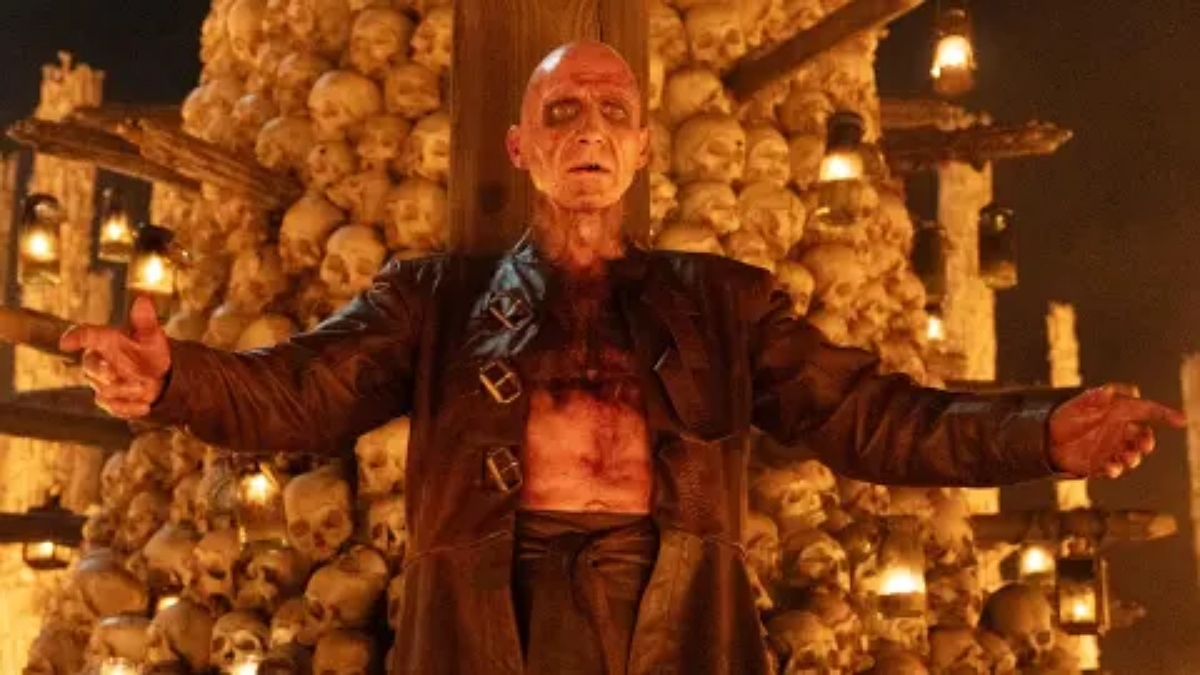
With the UK reduced to an island of scattered fellow survivors cloistered off from the cities overrun by zombies and what’s left of the civilized world, society never reset to ‘normal.’ Instead, it has devolved into one of feudal villages and isolated stockade. In the center of it all, we find the calcified “Bone Temple.” This monument, introduced in the first installment of 28 Years, is a macabre outpost constructed by the film’s main character, Dr. Ian Kelson (Ralph Fiennes), as a “memento mori”—a reminder of human mortality.
Returning to Kelson’s grotesque yet sublime monument, its grisly structure consists of a central tower fashioned from skulls and encircled by columns made from lashed human bones. Its foreboding appearance belies the practical function of the complex as a lonesome sanctuary for reason and archive for the music and stories of a lost world.
DaCosta’s film presses the naturalization of the zombie plague’s visceral horror from Boyle’s 28 Years, while making it her own. This helps to refract some of its predecessor’s lingering questions and seeming contradictions. Whatever doubts we may have about an enduring population of infected and the means to reproduction give way to the imposing presence of an alpha zombie, which Kelson bestows with the name, Samson (Chi Lewis-Parry). The intensity of his hulking presence becomes the impetus for a shift of focus to the true terror that lives in the serpentine chambers of the human heart.
Bone Temple forwards the notion that while the extreme violence stemming from the Rage Virus acts as an unintended result of our tampering with nature, the firm resilience of cruelty and evil continues to be driven by the human thirst for power. It is precisely this enduring force that continues to conspire to assault and ravage the remnants of humanity as a dark reflection of human desire and agency. This seemingly elemental human force is presented in the character of Jimmy Crystal (Jack O’Connell), in continuation of his emergence into the story in the final scene of the previous film.
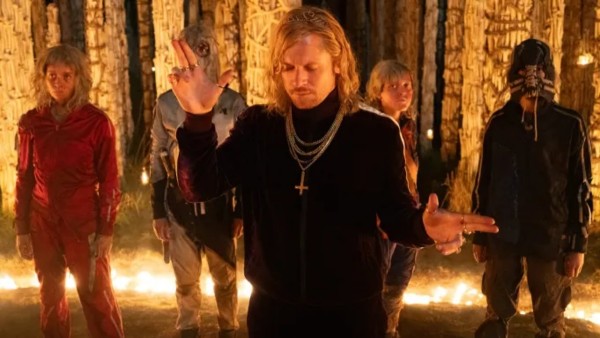
Fresh from his performance as Remmick, the Irish vampire in Ryan Coogler’s Sinners, O’Connell plays the brash and ruthless psychopath in a way befitting the character’s real-life model in the British TV personality and serial sexual predator, Jimmy Savile. Reinforcing the association, Crystal is accompanied by a gang of post-pandemic Droogs that he calls his “fingers,” all of whom have also taken on the name of “Jimmy” and don platinum blonde wigs as a reminder of Savile’s shameless army of enablers and protectors.
Dr. Ian Kelson’s Dance of Death and Life
Emerging into the spotlight from his supporting role in the series’ last installment, in reprising his role as Dr. Kelson, Fiennes serves up the kind of masterful and intense performance that has become his signature. In The Bone Temple, however, he is much more than an eccentric architect and forlorn survivor who “often thought” he’d “die here alone of age, or starvation, or violence,” but a healer of a broken world.
As a figure who’d previously seen himself thrust into the role of the Last Man, he’s far from the maniacal soldier, Major West (Christopher Eccleston) of 28 Days. Instead of employing zombies as weapons against survivors, Kelson refuses to surrender to the pull of hopelessness and despair. Instead, he perseveres through the power of music, reclaiming an iconic British playlist from the stain of Savile’s association. Kelson does this as he sings-along and dances to iconic tracks from Duran Duran and Radiohead, to Iron Maiden.
The celebration of this music catalogue operates as far more than a nostalgic reminder of the past, or even a means to exorcize the painful associations attached from Savile’s hosting of Top of the Pops—ones the BBC has attempted to expunge in hopes that they be forgotten. Beyond all of this, for Kelson music becomes his primary way to commune with the lost.
Samson seems set up to fulfill the role of the worst of the human monsters that populate DaCosta’s post-apocalyptic vision of an England in the process of being reclaimed by wilderness. This is the monster, after all, that pursued the boy-hero Spike (Alfie Williams) on his desperate run home with the miracle baby in the first installment. Like the newborn from Children of Men, this infant represented nothing less than the hope of the world. While Samson failed to seize his prey and was wounded in the process, both he and Spike escaped to fight another day.
In Bone Temple, we find Samson exerting his dominion over a territory reverted to a primitive state in which he relentlessly pursues surviving humans and large game alike. He hunts with brutal effectiveness, decapitating his prey in the style of the Yautja from the Predator franchise, using his bare hands to rip off heads with the spinal cords attached. These remnants of disembodied anatomy are not taken as trophies, however, but to satisfy that age-old zombie taste for, yeah, you guessed it, “braains!”
As neighbors within this territory, Kelson is led by curiosity and, perhaps, a despairing need for human connection to seek a relationship of care with Samson. This surprising aim is not pursued by our dearly departed Major West’s methods of violence and chains, but via a fleeting deliverance from pain and disorder administered via Kelson’s blowgun.
With Samson rendered docile, he speaks softly to the human within the monster while also soothing his pain. In a later scene, we watch as the relationship grows more tender and human, with Kelson leading the hulking Samson in dance to the beat of Duran Duran’s “Rio.” As his affection for the beast grows, Samson’s eyes reveal what he hopes against all hope to be the flickering signs of his long dormant memories.
 Jack OConnell and Jimmys
The Spectre of the End and the Face of Evil
But this new world is one of scarcity and limits in both time and resources; Kelson’s supply of medicine is running out. Just as he approaches the anguished moment when his hope is all but exhausted and readies to offer a humane means of liberation for Samson’s spirit, the human trapped within the monster breaks through. This comes with a single word: “moon.” Spoken in awe of worlds beyond, a stunned Kelson recognizes Samson’s utterance as much more than a mere signifier. It’s a gesture towards the logic of sense and understanding.
This faintest teasing of communication grants Kelson a renewed sense of hope and purpose. The result is the restoration of the possibility of a different future, offering the push he needs to turn from the tedium of his brutalist memento mori in a last-ditch pursuit of a cure for Rage. Contrasting the efforts of characters like Dr. Neville in I Am Legend or Scarlett Levy from 28 Weeks, Kelson’s treatment is directed not at the physical brain and body, but to the evanescence of the mind and heart and spirit.
With his medicine dwindling, Samson’s stillness and calm threatens to be subsumed under the crashing waves of Rage, reducing him to the state of a rushing, roaring monster. This grim inevitability stands in stark contrast with Crystal’s terrifyingly calm and joking manner. From his view, the zombies are not merely the victims of an infection but a curse and affliction delivered not from an angry, vengeful God, but Satan himself in the name of “old Nick.”
The Rage Virus, then, is recast as a metaphor not of misguided human actions but the enduring force of evil, with Crystal placing himself in the position of Nick’s human representative. The extreme violence perpetrated by Crystal’s crew, who Spike has been forced to join through a deadly initiation, forces audiences to confront the idea that even in the aftermath of apocalypse, humans retain an attraction to the impulses of fascism. As his gang of Jimmys find out though, Crystal’s vehement appeal to Satan is little more than a justification and guise; a mask that hides the abject violence perpetrated in pursuit of power and control.
The Bone Temple as the Stage of Folly
The abject cruelty perpetrated by Crystal and his Jimmys stand in stark relief from nature’s cool indifference, where the path cut by a raging forest fire is not just one of destruction and death but of purification and renewal. Viewed with new eyes from this perspective, Kelson’s bone temple takes on the appearance of a stand of scorched trees in Winter. Not dead, just in patient waiting for the return of Spring.
Crystal and his gang, by contrast, work to close off all hope for the future promised in tomorrow’s renewal. Instead, they represent just another version of the “intoxication of power” George Orwell warned of in Nineteen Eighty-Four, crystalized in the terrifying image of “a boot stamping on a human face, forever.” The difference between the two, of course—and where the true site of terror lies—is the folly of human agency whereby violence is not just a last resort in the name of survival but embraced as a gleeful choice.
Unlike Crystal and company, the heroes in DaCosta’s story refuse to surrender their humanity for a chance at a life that can never be anything more than solitary, nasty, brutal, and short. Existence for Kelson and Spike is much more than hanging on by their fingertips and trying to avoid becoming a monster. It’s about survivance through connection and community—a form of rebellion that lies in a repudiation of violence and its complicity, but also a raw embrace of the human spirit.
This drama is drawn out to perfection in DaCosta’s meticulous narrative pacing in which Kelson and Crystal are brought together in an inevitable confrontation. At first Kelson dances with the devil for survival but recognizes that his true loyalty is to something more than the physical monument of the Bone Temple itself or his life alone. Kelson realizes that the dance for his life is also one to save humanity.
His act in the midst of a storm of swirling fire and brimstone is portrayed in biting contrast to the cowardice and unprincipled self-interest displayed by so many figures of authority and influence who proved all-too-willing to turn a blind eye to Savile’s horrific crimes against women and children. Americans know this sad truth, as well, as we have come to see how our own monsters have been protected by the wealthy and powerful, and continue to be.
But Kelson chooses the harder path, the virtuous one, when he refuses to go along with Crystal’s ruse and turns it against him. And he must, even at the risk of his own life, since without Kelson’s resistance Crystal would be sanctioned to continue on his reign of bloodshed and devilish terror.
Resilience as Rebellion, Humanity as Future
With Kelson receding from the story and into legend, the lesson of his labor and joy is emphasized by the return of Jim (Cillian Murphy) within the story to fill his void. We are heartened to find that he is no longer a captive to a furious and frenetic fight for survival, but secure in a place of calm and love. A structure that appears much more like a home than a fortress or bomb shelter. One furnished with shelves of books and living plants that assure us that he has won back the leisure of peace, the gift of time to dedicate to discussions of the lessons of history and the importance of memory.
Jim’s (not Jimmy’s) reappearance isn’t just a service to the fans of the franchise; it emerges as the ultimate proof of his and human persistence. A moment that shines a light into the off-screen darkness almost three decades removed from the initial outbreak, the military purges, and the long winter from which he has emerged. Not as a broken and bitter man, but simply aged and, perhaps, even whole again. Yet, Jim remains vigilant and as the echo of John Murphy’s haunting “In The House, In A Heartbeat” reminds, he is ready to fight when the values of humanity, a sense of a future worth living, hangs in the balance.
As this most fitting ending testifies, DaCosta’s latest chapter is about more than the presence of any one character, whether good or evil, young or old. It’s a grim yet graceful meditation on why we must keep fighting, even through the darkest of times when it may appear that there is nothing left to win. 28 Years Later: The Bone Temple doesn’t just pose the question: is it enough to just survive? It demands we look deeper and contemplate whether we are up to answering the call, not just for ourselves but for others?
