

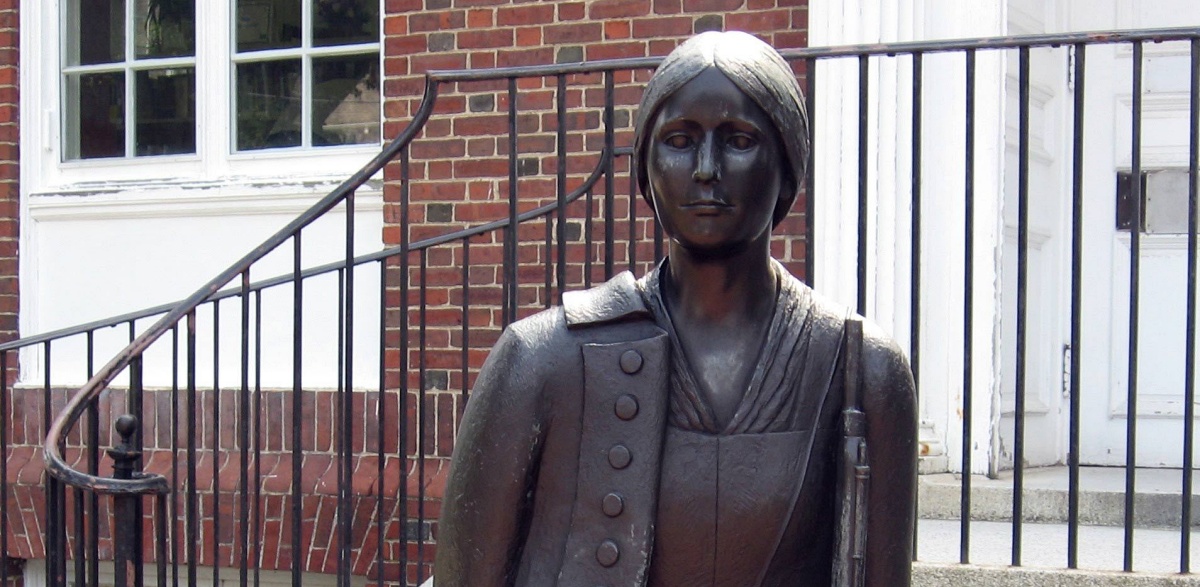


If we want to look back to when the first woman actually served in a combat role, we have to return to the Revolutionary War.
Since the emergence of the modern women’s rights movement in the 1960s and 1970s, women have fought the gender discrimination that blocked them from taking on roles in society long the sole domain of men. Over the decades they have stormed the barricades to become doctors, lawyers and corporate chiefs, as well as computer programmers, astronauts, car mechanics and rock drummers. It’s a lengthy honor roll of combatants in the gender revolution.
The most entrenched resistance has been in the traditional uniformed services – police, firefighters and armed forces – where women have faced hostility and even violence in seeking entry to these “boys’ clubs.” As The New York Times reported in 1986, about a new female firefighter’s experience on the job, men in her company “slammed doors in her face, swore at her, put firecrackers under her bed and once tried to lock her in a kitchen they had filled with tear gas.”
Women have long served in non-combat and auxiliary roles in the military. It is only since 2013 that they are officially allowed to take part in combat. But the attackers many of them fight are too often fellow soldiers intent on raping them.
If we want to look back to when the first woman actually served in a combat role, we have to return to the Revolutionary War. Her name was Deborah Sampson, a young woman from Massachusetts who enlisted in the Continental Army in 1782, was stationed at West Point for nearly a year and a half (before the military academy was founded), was chosen for the elite Light Infantry which went out on patrols against Tory loyalists terrorizing the Hudson Valley, was wounded in hand-to-hand combat, and eventually was promoted as an aide to a general.
If that seems improbable, it is perhaps even more so that she did it disguised the whole time as a man. Other women fought briefly during the Revolution, such as the legendary Molly Pitcher, who followed her husband to war and manned his cannon the day he fell mortally wounded. But there is no other documented case of a woman in extended service at that time.
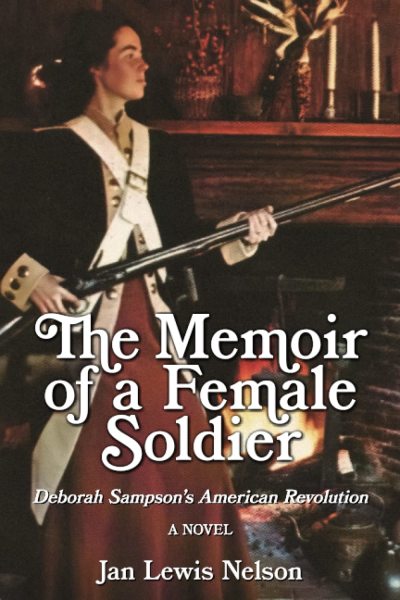
How Deborah Sampson did so, and why, is told in a new historical novel, The Memoir of a Female Soldier, by Jan Lewis Nelson, my late wife. Written in the first person as though penned by Deborah, it is based closely on the facts of her life. I say “new” but the book was written nearly 50 years ago and not published until now. The manuscript was among Jan’s effects when she passed away in 2020 after the battle she waged for 30 years against breast cancer.
Were the story of Deborah merely about her military career, it would be remarkable enough. Perhaps you might expect she was greeted after the war as a conquering heroine, but such was far from the case. Living in a society which oppressed women, she had sought freedom and opportunity by donning men’s clothing. To do so was against the law in Massachusetts and could have subjected her to severe punishment, even whipping or hanging. Many people could not forgive her crossing that gender boundary, no matter how admirably she acquitted herself as a soldier. She had to excel to avoid suspicion.
While she won respect in the army as the man she wasn’t, in this fictional memoir, written as a wife and mother over twenty years later, she seeks respect for the woman she was.
While she won respect in the army as the man she wasn’t, in this fictional memoir, written as a wife and mother over twenty years later, she seeks respect for the woman she was.
Deborah suffered all her life from a fragment of musket ball lodged in her thigh after being wounded and removing most of it herself to avoid her true gender being discovered by army medics. Her condition made it difficult living on a farm after the war, with the added pain of medical bills she could ill afford. She petitioned the Massachusetts legislature for back pay for her military service, which she was awarded in 1792. But by 1805, when the book opens, her petition to Congress for a veteran’s pension had long been ignored, despite having the support of her former general, by then a Congressman, and her friend Paul Revere.
In a modern twist to her story, she was the victim of media misinformation, most notably from an “authorized” biography. She cooperated with the author, only to read in its leather-bound pages fanciful accounts of being in a battle she was not, and fighting Indians on the frontier in the Ohio territory, where she’d never been.
To earn money and tell her tale, in 1802 she went on the road for a year as the first woman to do a lecture tour. And then, in this “memoir” set three years later, takes quill pen in hand to set the record straight about her life and military service, and counter the prejudice against her. Its author, Jan Lewis Nelson, grew up in the same Massachusetts town as Deborah. While a novel, the book is based on Jan’s three years of research, including six months when she and I lived as caretakers in the house where Deborah was born, near Plymouth.
Despite being descended from notable Mayflower settlers, as a young child Deborah lived in poverty, her mother burdened by too many children from a husband who was usually gone to sea, until he disappeared altogether. At age five she was sent to live with a cousin and then with an elderly widow, working to earn her keep. At ten years old she was placed as an indentured servant in the large family of the local minister. There she educated herself despite his opposition to women being schooled, and later became a teacher.
Her hard labor, self-sufficiency and innate intelligence enabled Deborah Sampson to grow up as the physically strong, resourceful and determined young woman who became a female soldier. In the army she was constantly on guard, fearful of her secret being revealed. After her service she and her family endured hostility and ridicule. She died in 1827 and largely disappeared from history, a fascinating female footnote.
She might finally have gotten her due when landmark legislation was passed over two years ago improving how the Department of Veterans Affairs serves women veterans and their special needs. It was named in her honor, the Deborah Sampson Act, and should have brought its namesake greater public awareness. Yet you probably never saw any media coverage about the bill. It was signed into law on January 5, 2021, when the Washington press corps was totally absorbed by the effort to overturn the results of the presidential election.
But you can get to know the woman who was Deborah Sampson in The Memoir of a Female Soldier. “A richly imaginative historical novel…a unique addition to Revolutionary War literature” (The Berkshire Eagle). Available on Amazon.
