



The linchpin of Eisenstein’s environmental philosophy is the concept of “interbeing:” “the world is part of me, just as I am part of it.
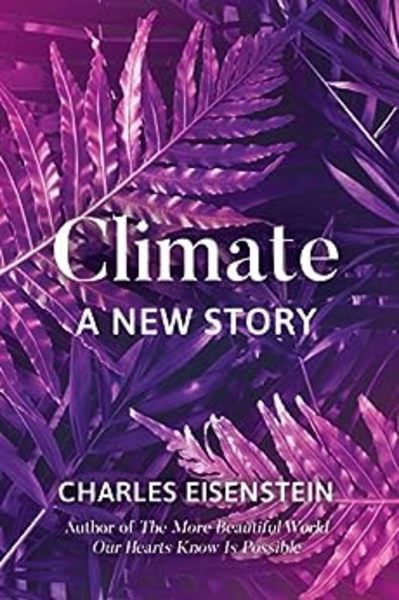
I have just completed reading Charles Eisenstein’s Climate: A New Story (2018). It has provided me with a the philosophical underpinning for fighting against the type of climate changes that have produced such horrendous consequence so far in 2023. Via articles and books (see, e.g., here and here), I have been engaged in this fight for decades. Yet, not until reading Eisenstein’s book, did I cobble together a comprehensive philosophical foundation upon which to base this struggle.
In previous writings I had emphasized many of the ingredients that make up Eisenstein’s integral philosophy. But in combating human-caused climate change, I never put them all together to form a unified base—until now.
The linchpin of Eisenstein’s environmental philosophy is the concept of “interbeing.” According to him, it means “the world is part of me, just as I am part of it. What happens to the world is in some way happening to me. The state of the cultural climate or political climate affects the condition of the geo-climate. When one thing changes, everything else must change too. The qualities of a self...are not confined to humans alone. And the results of our actions will come back to affect ourselves, inescapably.” The concept is “a way of seeing, a way of being, a strategic principle, and most of all a felt reality....When we restore the internal ecosystem, the fullness of our capacity to feel and to love, only then will there be hope of restoring the outer...Love and empathy are the felt dimensions of the Story of Interbeing, and we cannot act effectively [my emphasis] from that story, nor truly serve it, without their guidance....The healing of our planet will not come without love for our planet.”
Eisenstein borrowed the concept of “interbeing” from the Vietnamese Buddhist Thich Nhat Hanh, who in 1967 was nominated for a Nobel Peace Prize by Rev. Martin Luther King Jr., who himself had received the prize in 1964. Having occasionally taught “Comparative Religions” during my four decades of university teaching I was familiar with Buddhist thinking. After retiring I learned more about applying Buddhism to various aspects of life through researching the lives of E. F. Schumacher, who wrote an essay on “Buddhist Economics, and the Catholic monk Thomas Merton, who valued Zen Buddhism for its many insights.
Earlier this year (2023), here in Hollywood Progressive my “Our Oneness with Nature: The Wondrous Poetry of Mary Oliver” appeared. Although I was not yet familiar with Eisenstein’s stress on “Interbeing,” the essay reflected my appreciation for Oliver’s similar sentiment. I wrote of “our oneness with other forms of life—the non-human ones found in nature, whether they be in the animal or non-animal world like the sun, moon, flowers, or trees.” And though I don’t consider myself a pantheist, I quoted lines from some of her poems, for example:
Oh, mother earth, / your comfort is great, your arms / never withhold.
It has saved my life to know this. / Your rivers flowing, your roses opening in the
morning.
“If God exists he isn’t just churches and mathematics. / He’s the forest, He’s the desert. / He’s the ice caps, that are dying...He’s every one of us, potentially. / The leaf of grass, the genius, the politician, / the poet.”
“I have always known you / are present in the clouds, and the / black oak I especially adore, and the / wings of birds. But you are present / too in the body.”
“So it is not hard to understand / where God’s body is, it is / everywhere and everything; shore and the vast / fields of water, the accidental and the intended / over here, over there…[But] where, do you sup / pose, is His / pale and wonderful mind?”
Regarding Eisenstein’s line “Love and empathy are the felt dimensions of the Story of Interbeing,” in 2013 I had written “Love: The Greatest Wisdom Virtue,” and a few years later “Wisdom-Directed Empathy in Politics and Everyday Life.” Both of these essays had first appeared on The Wisdom Page website, and by that period I had considered wisdom a central aim for which we should all strive. But, as I continue to stress up until the present, as Dorothy Day once said the “important thing is love. . . keep on loving, and showing that love, and expressing that love, over and over, whether we feel it or not, seventy times seven.”
Thus, the following lines from Eisenstein seem right on target to me: “I want to question the assumption that we can and should motivate the public [regarding climate change] with fear-based appeals to self-interest. What about the opposite? What about appeals to love? Is life on earth valuable or sacred in its own right, or only in its utility to ourselves?” A person “will understand that his well-being is inseparable from that of all in his expanding circle of love.”
The author also seems correct in suggesting that no amount of rational argument, no insistence on scientific truth, is going to change our nation’s “addiction to fossil fuels.”
The author also seems correct in suggesting that no amount of rational argument, no insistence on scientific truth, is going to change our nation’s “addiction to fossil fuels.” Addictions, he argues, are not ended by logical appeals. So then the question becomes how exactly should we who are alarmed about climate-change act? What should we do? Eisenstein’s answer is much more complex than one might guess.
Recently the website endfossilfuels.us has emerged announcing a September 20 march in New York (and other actions) timed to coincide with a UN Climate Ambition Summit. Its website reads, “Thousands of us will take to the streets before the summit to demand President Biden take bold action to end fossil fuels.” And it announced that “over 500 Organizations have endorsed the March!”
But Eisenstein contends that “eliminating fossil fuels does not represent as thorough a change as the change required to halt ecocide here, there, and everywhere. Conceivably, we could eliminate carbon emissions by finding alternative fuel sources to power industrial civilization. . . . It is at least conceivable that our basic way of life could continue more or less unchanged.” The climate-change movement, he believes, has sometimes even worsened the situation. “The ecological crisis is calling us to a deeper kind of revolution. Its strategy involves restoring what the modern worldview and its institutions have rendered nearly extinct: our felt understanding of the living intelligence and interconnectedness of all things...The cause of climate instability is everything: every dimension of our separation from earth, nature, heart, truth, love, community, and compassion.” He adds, “if I were pressed to offer a universal solution, it would be to see and treat the world as sacred again.”
Although he recognizes the connection between climate change and, for example, deforestation in Central America, he also asks what others factors caused that phenomenon. And then lists 11 of them. In treating drought and flooding, he again acknowledges the role of climate change but also thinks that “contaminating water with pesticides, pharmaceutical residues, industrial chemicals, and radioactive waste will threaten planetary well-being just as much as...greenhouse gas emissions.”
Toward the end of his book, Eisenstein lists 18 specific tasks that will be “necessary over the next couple decades.” A partial, not exhaustive, list include the following:
- “Promote land regeneration” and take various steps to protect bodies of water and forests
- “Institute a global moratorium on logging, mining, drilling, and development of all remaining primary forests, wetlands, and other ecosystems”
- “Expand the land protected in wildlife refuges and other reserves”
- “Ban disposable plastic bags for retail purchases”
- “Reconstitute the World Bank to serve ecological healing rather than development”
- “Establish an ‘eco-corps’ to address youth unemployment and restore ecological health”
- “Reintroduce and protect keystone species”
- “Relocalize the food system and promote economic localization”
- “Apply pollution taxes”
- “Impose a deposit system for most manufactured goods”
- “Turn away from pesticides”
- “Demilitarize society.”
At the end of his list the author notes that he did not include instituting a “carbon tax” because his other measures would produce “large reductions in fossil fuel use,” and instituting such a tax would produce other problems. Yet what is most important to me is not any specific proposal Eisenstein makes, but his philosophical basis for addressing climate change (my emphasis).
That basis reminds me most of two thinkers I have often written about: the environmentalist E. F. Schumacher (1911-1977), who died before our current era’s alarms over climate change, and Wendell Berry (b. 1934), a writer whose environmental concerns are much broader than just climate change. (Four years after the death of Schumacher, Berry gave the first Annual E. F. Schumacher lecture, and another environmentalist and leading climate-change activist, Bill McKibben—who has stated about Berry that “there’s no writer working in the English language I admire as much”—delivered the 2009 lecture.) Eisenstein’s criticism of our modern societies’ priorities of consumption and industrial production remind me of Schumacher’s approach. And the former’s emphasis on sustainable agriculture practices and localism, along with his criticism of militarism, remind me of Berry’s.
In addition to Eisenstein’s emphasis on interbeing, love, and empathy, I like his stress on ending ecocide and have written of it as being among Vladimir Putin’s crimes in his war against Ukraine. In general the author’s overall approach appeals to me. It emphasizes the following:
- People are moved less by rational arguments than by their values and feelings
- Respecting climate-change deniers, not demonizing them
- An open-minded, tolerant, humble approach
- The necessity of fundamentally altering the economic path taken by major nations over the last several centuries.
- His stress on the importance of beauty, working holistically, and for the common good.
In closing, I offer a few quotes and an appeal for pragmatism. One of my favorite wise persons is the U. S. social worker Dorothy Day (1897-1980), and one of my favorite quotes from her is: “We must always be seeking concordances, rather than differences.”Another wise person who was her contemporary was the Protestant theologian Reinhold Niebuhr (1892-1971). He once wrote, “People with a sense of humor do not take themselves too seriously. They are able to ‘stand off’ from themselves, see themselves in perspective, and recognize the ludicrous and absurd aspects of their pretensions. . . . What is funny about us is precisely that we take ourselves too seriously. We are rather insignificant little bundles of energy and vitality in a vast organization of life. But we pretend that we are the very center of this organization. This pretension is ludicrous; and its absurdity increases with our lack of awareness of it.”
Dealing with climate change and environmental degradation is a tremendously complex task. And we humans are limited and fallible creatures, and to accomplish much we have to work with many others, including some on the other side of our polarized political divide. As Day advised us, “we must always be seeking concordances.” And as Niebuhr realized, “a sense of humour is indispensable to men of affairs who have the duty of organizing their fellowmen in common endeavors. It reduces the frictions of life and makes the foibles of men tolerable.”
In the perilous times ahead, we need to work hard and persistently to combat our complex, multiple ecological problems. But we need to work with others and to do so with love, empathy, humility, and humor. And, as I’ve earlier indicated regarding political actions, we need to do so open-mindedly and pragmatically, ready good-naturedly to admit our errors when, like all humans, we sometimes make them.
