

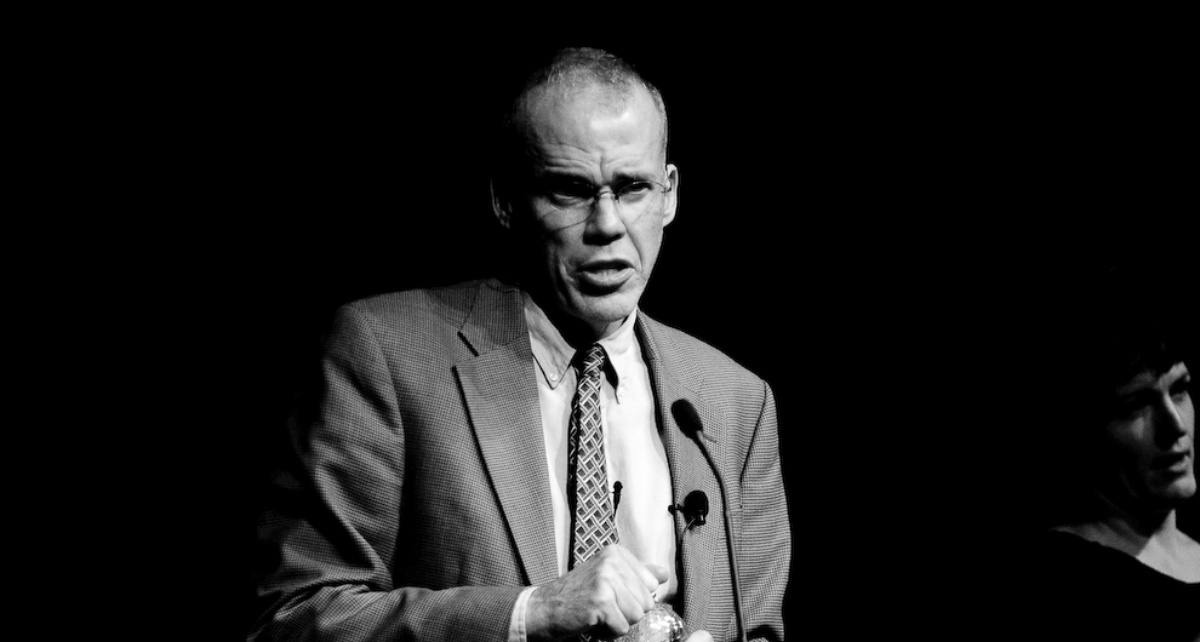


McKibben stresses that the aim of our politics should be not selfish aims, but the furthering of the common good.
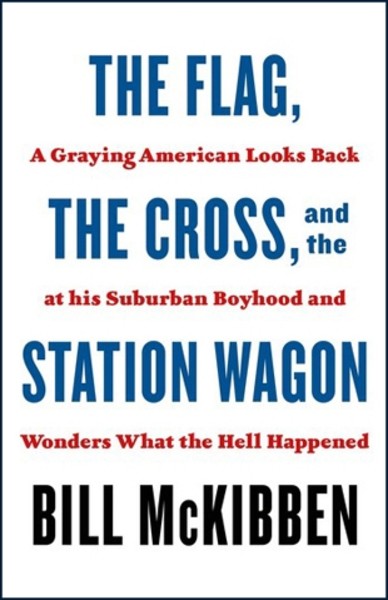
Although I’m a generation older than environmentalist Bill McKibben, I’ve appreciated his thinking since a few decades ago after reading his influential The End of Nature (1989). Later on, in 2016, I was happy to discover, that he shared my fondness for one of our great writers, Wendell Berry. (“Berry has long been the great novelist, poet, and essayist of community. His short stories and novels of the men and women of Port William are a remarkable canvas,” were McKibben’s words.) Having recently completed the environmentalist’s 2022 autobiographical The Flag, the Cross, and the Station Wagon (FCSW), I was again struck by how much I agreed with his perceptions.
In addition to his many books and articles (in publications such as The New Yorker, The New York Times, Rolling Stone) and serving on the faculty at Middlebury College (VT), he has been a major environmental activist, organizing protests and marches in the USA and beyond. In 2008 he was a co-founder of what has become one the most effective environmental organizations in the world—350.org. In 2010, a writer in the Boston Globe referred to him as "probably the nation's leading environmentalist."
In 2016 he was a major adviser to Sen. Bernie Sanders in his presidential campaign, and in 2021 founded Third Act, devoted to organizing people 60 and over to work for progressive change—as he indicated in FCSW, people of that age possess a great deal of the nation’s wealth and more spare time to devote to progressive causes than those younger.
In August 2023, he and his organization, along with many of its state branches and hundreds of other organizations, are preparing for a September 20 march in New York (and other actions) timed to coincide with a UN Climate Ambition Summit. The main page of the organizer’s endfossilfuels.us website reads, “Thousands of us will take to the streets before the summit to demand President Biden take bold action to end fossil fuels.” On that page we also read, “This summer of record-breaking heatwaves and toxic wildfire smoke makes it clear: pollution from oil, gas, and coal is deadly.”
We can't breathe or play outside. Our families are forced to evacuate as our homes are swept away by floods, burned down in mega-fires, or destroyed in hurricanes. Our water is too polluted to drink. Wild and beautiful places are disappearing, and creatures big and small are dying. Our democracy is under threat from the corrupting influence of fossil fuel money in politics.
Fossil fuel pollution impacts us all—and Indigenous, Black, communities with low incomes and communities of color disproportionately bear the brunt of the harm, with deadly consequences like asthma and cancer.
But it doesn't have to be this way.
But enough about the background of the author of FCSW. The remainder of this essay will focus on the book itself. First, why the title—
The Flag, the Cross, and the Station Wagon? The flag symbolizes the author’s embracing of patriotism and his belief that “dissent can be patriotic.” Influencing this view was an event that occurred a year after his family moved to Lexington, Mass. in 1970. It was then a small town of about 30,000, sometimes considered a suburb of Boston, which was a dozen miles away. And the event occurred on a Memorial Day weekend when the “Vietnam Veterans Against the War, led by . . . John Kerry, announced plans...to bivouac on the Battle Green,” which became famous in 1775 when British troops fired there upon American militiamen. But in 1971 city officials would not permit the veterans’ encampment, and hundreds of veterans and sympathetic townspeople, including McKibben’s dad, were arrested when tried to do encamp there. This lesson of patriotic dissent had a lasting effect on the 10-year-old William. (A few years before that protest I also voiced opposition to the war in Vietnam, and like McKibben reflected the view that “dissent can be patriotic.”)
The Cross represents the author’s concern with religion and its role in dealing with two great stains on our history—our treatment of Native Americans and Black people. He agrees with historian Ron Chernow, who wrote about President Washington that “his most flagrant failings remained those of the country as a whole—the inability to deal forthrightly with the injustice of slavery or to figure out an equitable solution in the ongoing clashes with Native Americans.”
Similarly, in a 2020 article I wrote that “we have not owned up to the grievous, centuries-long harm we have done to Native and African Americans,” and I referred to that harm we have inflicted upon these two peoples as our “holocausts.” In an earlier essay I outlined the policies (mainly harmful) of various presidents to our Native Americans. And in many articles, I have written about U. S. racism and tried to explain why it has occurred. But on reading McKibben’s FCSW and his description of that racism that has all-too-often scarred our history, two new intertwined causes jumped to the front of the line—1. our citizens have a poor knowledge of our history, and 2. the knowledge they have is too simplistic. Our racism goes far beyond holding slaves or imposing segregation laws that prevented Blacks from using the same hospitals, swimming pools, restrooms, or restaurants as we whites. The racism we have imposed for the last half-century is simply more complex than most whites have been willing to comprehend.
One of the great services of McKibben’s FCSW is not only does he call for rewriting our more complex history by making use of such means as the 1619 Project, but he also explains how racism operates through such means as city zoning ordinances. Since his book is partly autobiographical, he highlights another event that occurred in 1971 in his hometown of Lexington.
That happening was a Lexington vote when town citizens “voted nearly two to one against approving” a rezoning change that would have allowed the building of a “small low-income housing complex.” As the debate for and against the proposed change was ongoing, one citizen opined “this is the way slums start.” That fear apparently affected many of the town voters.
And that fear illustrates the complexity of racism. The zoning law didn’t say Blacks can’t own homes in Lexington, but by severely restricting low-income housing it could keep most of them out. For, as the author points out, “in 2014, for every dollar in a white household, a Black household had less than seven cents.” Moreover, he indicates the historical reasons for this great discrepancy. And when a citizen expressed a fear of “slums,” many white citizens understood that meant areas where Blacks would predominate.
McKibben also thinks that the 1971 rezoning vote also “perfectly symbolizes the hyper-individualism that has marked my lifetime. The selfishness.”
McKibben also thinks that the 1971 rezoning vote also “perfectly symbolizes the hyper-individualism that has marked my lifetime. The selfishness.” He quotes President Jimmy Carter’s speech in 1979 when he said, “too many of us now tend to worship self-indulgence and consumption.” He also praises Carter’s plans to ramp up alternate energy, especially solar. But, unfortunately according to McKibben, there was “a turn toward Reaganism, toward endless consumption, toward the ugliness that was Trump—...an astonishing amount of damage has been done in the intervening half century—scads of lives blighted by inequality, our democracy endangered, and the planet itself badly scarred, perhaps beyond salvation.”
In dealing with religion (“the cross”) he notes the changes that have occurred since 1971—he himself has been a lifelong Protestant—especially the growth of the Evangelicals and their support for Trump. He mentions the Catholic Pope Francis only once, but in a 2015 review of the pope’s climate encyclical, he praised it: “This marks the first time that a person of great authority in our global culture has fully recognized the scale and depth of our crisis, and the consequent necessary rethinking of what it means to be human.”
And like the pope, McKibben stresses that the aim of our politics should be not selfish aims, but the furthering of the common good. In my review of this same encyclical, I quoted from it. “Human ecology is inseparable from the notion of the common good, a central and unifying principle of social ethics. The common good is ‘the sum of those conditions of social life which allow social groups and their individual members relatively thorough and ready access to their own fulfillment.’” And I added, “Francis repeatedly stresses that this [the common good] should be the goal of our policies and politics, environmental and otherwise.”
McKibben more often cites and quotes from another religious leader—Rev. Martin Luther King, Jr.—who emphasized the common good. And in quoting President Carter and in his own views the author often links self-indulgence with too much emphasis on consumption. This misplaced emphasis has not only helped lead to the “station wagon” problem (the over-reliance on fossil fuels) that McKibben writes of, but also aided the election of a man that symbolizes much of what is wrong with our country—Donald Trump—who, as I wrote in 2016, “epitomizes” the gaudy dangers of overemphasizing consumption.
“I think the worst thing they’ve done is destroy a sense of social solidarity, a sense of commitment to fellow citizens. That ethos is gone and it’s been replaced by a cult of individualism.” Those words are quoted by McKibben. As he looks back at our history, he sees some effort in the 1960s (highlighted by the work of MLK, Robert Kennedy, and President Johnson) to make amends for past racism and some attempts in the 1970s by President Carter to begin replacing fossil-fuel reliance, but then the Reagan backlash followed and its culmination decades later in Trumpism.
And today, instead of frankly owning up to our past racism and environmental desecration, part of our electorate passes laws like the one in Oklahoma (cited by McKibben), which states that teachers must not instruct students that “an individual, by virtue of his or her race or sex, bears responsibility for actions committed in the past by other members of the same race or sex,” nor make students feel “guilt” or “anguish.”
The backlash that displayed itself in 1980 with the overwhelming victory of Ronald Reagan and manifested more of its ugly side with Trumpism does not want to examine our history too closely. (And higher education’s continuing deemphasis of the humanities as opposed to career preparation for our consumer capitalism furthers this tendency.) But in McKibben’s final sentence he writes of our “hope of redeeming what came before.” Like Barack Obama in his book The Audacity of Hope, the environmentalist believes in such “audacity.” His continuing activism through 350.org and other efforts like his writings testify to such hope. A hope that eventually—and before it’s too late—we will face up to our past complex racism and environmental degradation, make amends for them, and embrace more humane and sustainable values.
