




Successful movements do not simply react; they plan, phase their actions, coordinate communications, and maintain discipline.
Gene Sharp’s From Dictatorship to Democracy has become one of the most influential handbooks for resisting authoritarian rule through organized, disciplined nonviolent struggle. First written for Burmese activists in 1993, the guide has since offered practical strategies for movements in Serbia, Tunisia, Egypt, Ukraine, Sudan, and beyond. Its core insight is straightforward but transformative: dictatorships rely on the obedience and cooperation of ordinary people. When populations strategically refuse to comply, regimes collapse.
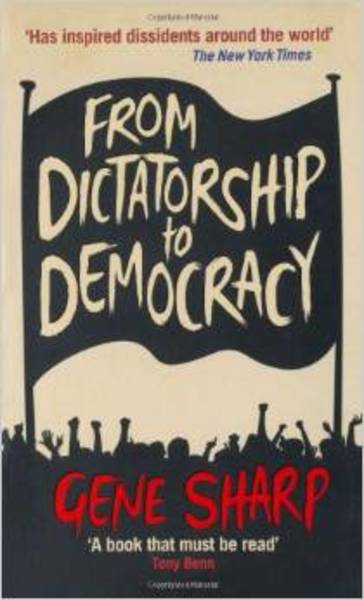
Sharp argues that dictatorships do not fall because they are persuaded to reform or because violent uprisings overpower them. Instead, they crumble when the pillars that sustain them—bureaucracies, media, economic systems, security forces, and passive public acceptance—begin to fracture. Nonviolent resistance is not passive moral persuasion; it is a disciplined, planned withdrawal of cooperation designed to dismantle authoritarian power.
Foundations of Sharp’s Theory
Sharp identifies several foundational premises:
- Political power ultimately comes from the people. Dictators depend on social, economic, cultural, and institutional obedience.
- Violence favors the regime. Authoritarians are prepared for violent confrontation and often use violence to consolidate control.
- Nonviolent resistance requires skill. Effective resistance movements rely on training, strategy, unity, and long-term planning—not spontaneous outrage.
Sharp catalogues 198 methods of nonviolent action, including strikes, protests, boycotts, civil disobedience, symbolic gestures, and institutional non‑cooperation. These are tools that, when coordinated, can gradually erode authoritarian control.
Developing a Strategy
The most important section of Sharp’s work—and what distinguishes it from inspirational protest manuals—is his emphasis on strategy. Successful movements do not simply react; they plan, phase their actions, coordinate communications, and maintain discipline.
Key strategic elements include:
- Analyze the regime. Movements must understand how power operates, who supports the regime, and where vulnerabilities exist.
- Set clear goals. Organizers must define long‑term democratic objectives, intermediate targets, and immediate achievable actions.
- Select tactics deliberately. Effective tactics are sustainable, expand participation, and weaken authoritarian pillars without prompting overwhelming repression.
- Phase the struggle. Sharp describes stages: awareness‑building, organization, mass non‑cooperation, and finally the withdrawal of institutional support from the regime.
- Maintain nonviolent discipline. Violence undermines credibility, fractures movements, and strengthens repression. Unity and training are essential.
Sharp stresses patience, preparation, and unity: democratization is not achieved through emotional outburst but through systematic social withdrawal and strategic confrontation with illegitimate authority.
Why This Matters Today
In an era marked by rising authoritarianism, information manipulation, and democratic backsliding, Sharp’s insights remain urgently relevant. He offers hope rooted in agency: ordinary citizens, organized and strategic, can resist oppression. His message echoes the democratic education philosophies of Myles Horton, Paulo Freire, and the Foxfire tradition—ordinary people possess extraordinary power when they learn, plan, collaborate, and act.
A Final Key Truth
Dictators do not rule because they are strong. They rule because people obey.
When communities collectively refuse to submit, the foundation of dictatorship cracks. Sharp does not romanticize this path—it is difficult, dangerous, and often slow. But it is also the most durable route to genuine democratic transformation.
The lesson is clear: democracy is not defended by hope alone. It is built and protected through informed, intentional, coordinated public action.
