

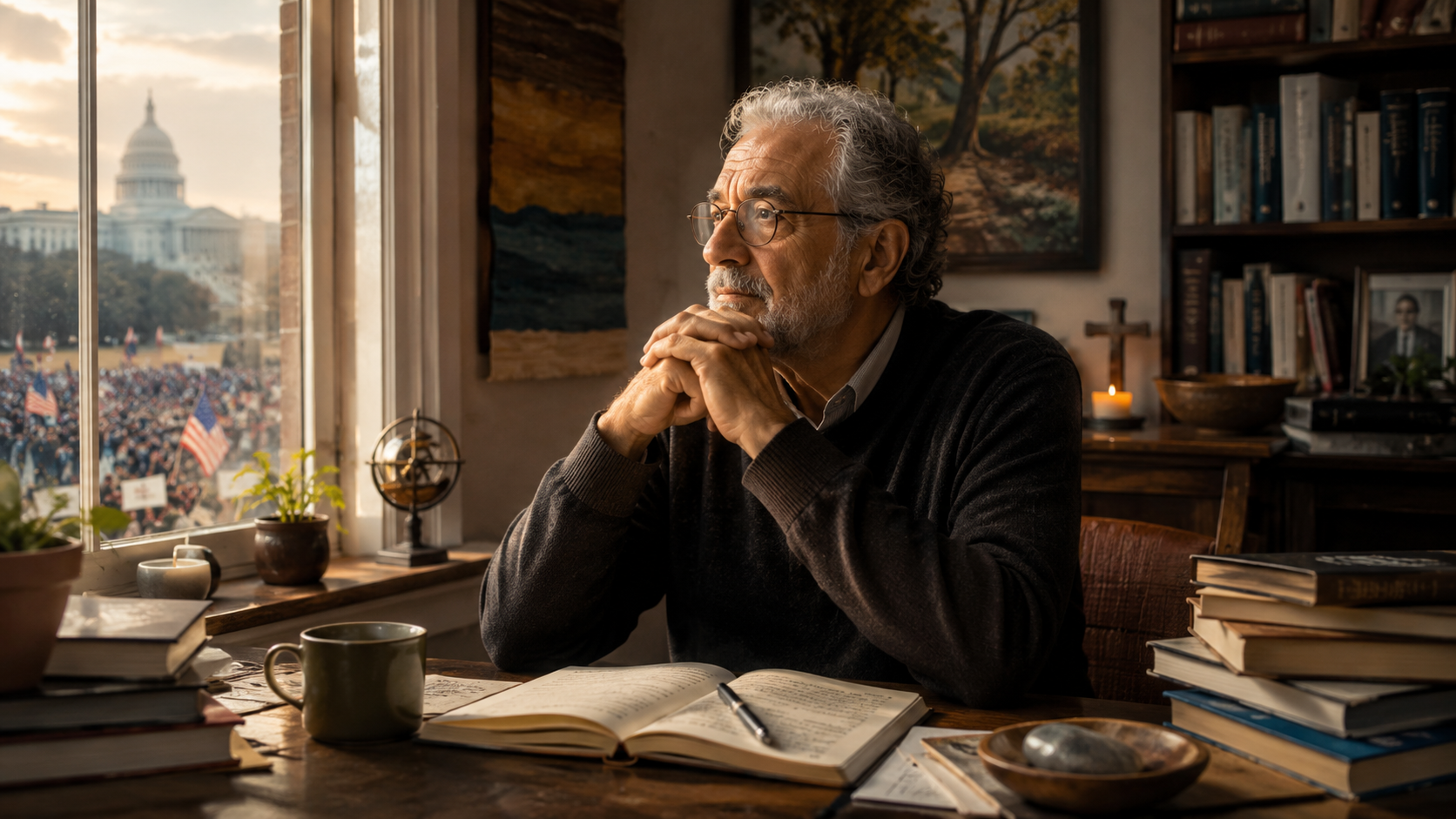
Humbly We Stumble Along

Humility about God, faith, and human knowledge can open the door to greater tolerance and more honest political dialogue.
Growing up Catholic, I was taught that humility was a great virtue. I still believe it is—see my 2015 essay “Wisdom and Humility.” Even to the point that I no longer consider myself a Catholic—more of a “I don’t knower” would probably be the words I would choose to describe my present condition.
At the end of one of my favorite books, the Pulitzer-Prize-winning (1974) “The Denial of Death,” author Ernest Becker (who tragically died of colon cancer at age 49) wrote:
“We can conclude that a project as grand as the scientific-mythical construction of victory over human limitation is not something that can be programmed by science. Even more, it comes from the vital energies of masses of men sweating within the nightmare of creation—and it is not even in man's hands to program. Who knows what form the forward momentum of life will take in the time ahead or what use it will make of our anguished searching. The most that any one of us can seem to do is to fashion something—an object or ourselves—and drop it into the confusion, make an offering of it, so to speak, to the life force.
Soon after Nancy, my loving wife of 58 years, died in 2022, I wrote something similar:
Whether a God— however we might define he, she, or it—exists or not, no one can say for sure. We can believe or hope there is a God, but that’s all we can do. In spite of thousands of years of religious and philosophic inquiry, that’s all we got. No matter how intense one’s faith or hope is, if there is no God, believing or hoping will not create one. Conversely, no matter how ardently one insists that there is no God, such insistence will mean nothing if one does actually exist.
Thus, I’m not a “believer,” only a “hoper.” Being a hoper seems more in keeping with humility. Not that I am critical of religious believers—only intolerant ones, those that are sure they have all the answers. I admire many believers, but the ones I do are tolerant, even ecumenical—Dorothy Day, Thomas Merton, Martin Luther King, Jr. (MLK) , and Pope Francis.
About Day and Merton I have written, “Although profoundly devout Catholic traditionalist in many ways, Day and Merton...were also very open to dialogue with those of other faiths, and even with non-believers. And they understood that the true test of one’s spirituality was not what religion one professed, or even if one professed one at all, but how one acted, whether or not one manifested love and sought social justice and peace.” (See here for the statement that “Merton was also an ecumenist of major importance.”)
Like Day, who wrote “there is no public figure who has more conformed his life to the life of Jesus Christ than Gandhi,” MLK thought most highly of the Hindu Gandhi and was greatly influenced by him. And in King’s non-violent protests and actions he welcomed people of all faiths—as well as non-believers.
Even Pope Francis, although the past head of the Catholic Church, was in many ways non-dogmatic. When asked if a person was gay and sought out the Lord, what would he (the pope) say to him, Francis’s reply was “Who am I to judge that person?” Like Day and Merton, Francis was very open to dialogue. As I have written before, in his long encyclical on climate change, he used the word “dialogue” about two dozen times. Moreover, in his 2015 Address to the U.S. Congress he mentioned it a dozen times. And in a 2013 sermon Francis urged Christians “to remain humble, and so not to become closed.” He also warned Christians against making their religion into an ideology: “When a Christian becomes a disciple of the ideology, he has lost the faith...But it is a serious illness, this of ideological Christians....[the] attitude is: be rigid, moralistic, ethical, but without kindness.”
Yet being tolerant and open to dialogue does not mean being wishy-washy. Especially in this political world of ours, in this Trumpian universe, it is important to take a stand. In 2019, in LA Progressive, my "A Tough Progressive Balancing Act: Passion, Tolerance, and Compromise" appeared. In it I wrote, “perhaps Ted Kennedy was the best “balancer.” No one can doubt the passion he felt for progressive causes, but he tolerated other points of view and worked effectively with opposing politicians.” In other words, he believed in tolerance and dialogue.
The poet Alexander Pope once wrote, “To err is human,” and how accurate he was. One of my biggest complaints about President Trump and the yes-people he surrounds himself with is their arrogance. (See my "Progressivism and Humility"). But not all of those who voted for Trump in 2016 or 2024 are arrogant. Some, from the point of view of progressives, are just mistaken.
What is needed in the USA is dialogue, genuine dialogue where both sides are open to listening, really listening, to the thoughts of the other side. Some minds, on some issues, may be changed. Where minds cannot be changed, compromises can be often be arranged. As Pope Francis noted, the aim of politics should be the common good. Compromises are often the only path available to achieve such a good.
