



Jones has produced a story that delivers on among the highest aims of horror, which is to confront audiences with the body’s corruption and the mind’s decay.
It is only fitting that on the heels of his wildly successful “Indian Lake Trilogy,” Stephen Graham Jones brings his award-winning horror cycle full circle in his newest hit novel, I Was a Teenage Slasher. The trilogy’s framing by the razor sharp final girl knowledge his punk/goth, part-Blackfeet protagonist, Jade Daniels, offers in her “Slasher 101” essays of My Heart Is a Chainsaw are the perfect antecedent to the riffs on the slasher theme his latest Native final girl, Amber Big Plume Dennison, defines as “slasher logic” in Teenage Slasher.
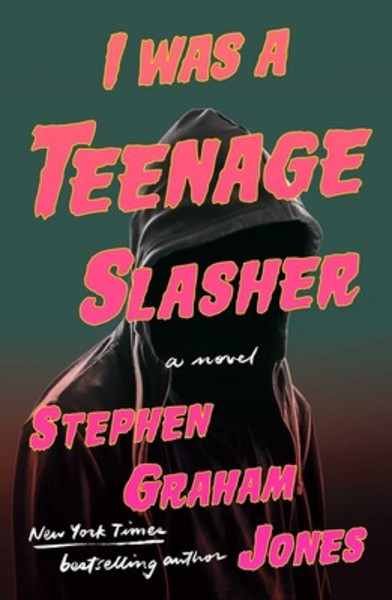
For Jones, though, the latest shakeup he gives to this genre is delivered through the introduction of the titular character, Tolly Driver, as “an unassuming high school junior, slight of build, academically unexceptional, recently deprived of his father.” That Jones has been calling Teenage Slasher, which provides readers much more than the culmination (for now) of a story form he loves, his “dream novel,” reveals its eminent place in his horror canon.
What Jones has produced in this novel is a story that potently delivers on what Clive Barker asserted as among the highest aims of horror, which is to confront audiences with “the body’s corruption and the mind’s decay; showing them loneliness and cruelty; showing them the world gone mad.” Through Jones’s adroit handling of the tumult of such bodily states and emotions, however, he also manages to put the fractured world he conjures back together again. And in a way that is not just deeply affecting, but dare I say, triumphant.
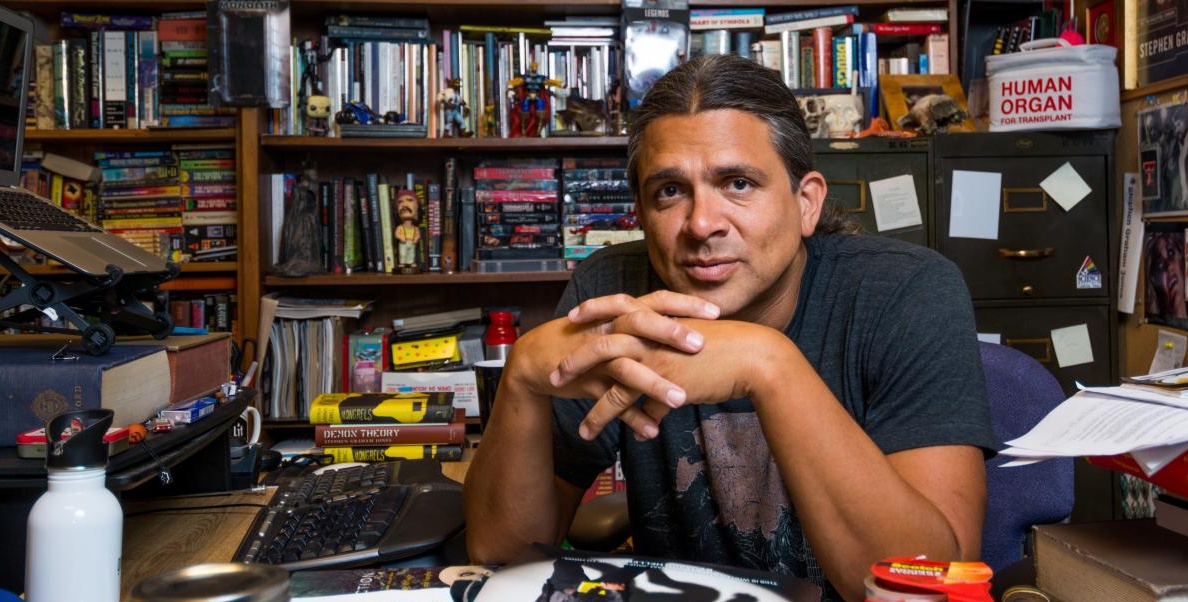
Jones accomplishes this through a consummate modesty and sincerity that has become a trademark of sorts, issuing from the down-to-earth voice and self-effacing personality he’s exhibited throughout his career as a writer and teacher. Such qualities are emphasized in the Acknowledgements appended to Teenage Slasher, as he reveals, “I know I’ve written Jade Daniels, and the guy from Growing Up Dead in Texas, the LP Deal from The Bird is Gone, that kid who narrates The Long Trial of Nolan Dugatti, that other kid in Mongrels, and those are all some version of me, one hundred percent. But Tolly, here, he’s the exact same idiot I am.”
Joining this disclosure, with his leveraging of an epistolary structure narrated from Tolly’s first person account, 17 years after, “of the tragedy that befell a group of five youths . . . ” wait, I mean, “six people of the graduating class, some of whom I’d known since kindergarten,” yields something like a classic coming of age story filtered through slasher cam.
Oh yeah, did I mention the novel is set in West Texas, in 1989? That it surrounds events that “happened to” Lamesa, Texas? As Jones further notes in his Acknowledgements, “It’s where my heart is, I guess” (seriously, never pass these up, read them all, Jones has honed them into a genre all their own as a space where diamonds abound).
Jones offers these behind-the-scenes nuggets not just as a way to air uncertainty, but more, perhaps, from a conditioned tentativeness that surfaces in those who have been made to feel out of place or excluded, reflecting an endearing vulnerability that arises from so many of his books and interviews. Jones’s willingness to dial things back through words, embrace ambiguity and unknowing, while exploring the shadowy reaches of the human psyche and heart is what makes his works so powerful, and the latest novel just so goddamned heartbreaking.
That we are talking here about slasher horror, which Carol J. Clover positioned “at the very bottom” of the genre as the horror of horrors—the immensely generative story of a psychokiller, who slashes to death a string of mostly female victims, until he is himself subdued or killed, usually by the one girl who has survived,” underscores both the slow-burning intensity and the inexplicable reassurance of Jones’s writing. Perhaps, when we consider how fiction can function as a story form suspended between confession and apology, dreaming and prayer, the motivation driving such attributes begin to come into focus.
I should mention that from another angle, fiction can also serve as a powerful corrective to official accounts and history. This is especially true where marginalized voices and perspectives are concerned. Or like Tolly observes, “if you’re from Texas, where the Rangers had chased all the Indians out a century ago,” so yeah, it’s that, too.
In these contexts, the nature of Jones’s accessibility as an author and the authenticity he conveys through gesture and voice becomes revelatory, yielding insights that can make it difficult to distinguish between the fantasies Jones unleashes on the page and “real life.” The complications that arise from this narrative order carries the distinct bite of the uncanny, imparting a strong sense of intimacy and allure but also foreboding and fright, as prominent features of all his stories.
Given such inklings, besides its presentation as epistolary, readers are stirred to wonder how might I Was a Teenage Slasher also constitute a form of autofiction? The narrative certainly flaunts its grounding to place and the energy of the 80s, often delivered in a playfully self-conscious way. It’s accompaniment of a hair metal soundtrack including Cinderella, Kix, Lita Ford and Crüe blasting Tolly’s eardrums via KBAT radio, also tracks with Jones’s life. These elements are brought together by Jones’s love for horror, which Nöel Carroll reminds “is very complex and covers a vast amount of territory,” and all the things that gave it significance, issuing like the screaming vocals of Stephen Pearcy from practically every page.
The territory of Jones’s manner and habits derive from sources as varied as dog-eared paperbacks by the likes of Louis L’amour Whitley Streiber and Stephen King, films on VHS from American Anthem and Gymkata to Black Christmas and Friday the 13th rented from the video wall of a small town grocery store, or viewed on the big screen at Lamesa’s Sky-Vue drive-in—the melted pimiento cheese of a Chihuahua dripping down his arm. Substances and experiences that anchor Jones to the West Texas landscape of oil wells and cotton fields leading back in time and space to versions of his identity that are both the same and radically different, or as he is also quick to grant, just more lucky.

It is at these literary and material crossroads where humor, mystery, horror, memoir and dark fantasy collide that Jones is most comfortable and assured. This is apparent in a question he’s long posed to himself and readers, “you never hit a story that’s only one genre, do you?” The skepticism leveled against appeals to delimiting literary categories made evident here manifests in Teenage Slasher through a narrative steeped in moments that can turn from funny, tender and poignant to harsh, brutal and terrifying on a dime.
Teenage Slasher’s fusion of these disparate narrative qualities and affects through the interactions of setting and characters derive not simply from any calculated effort to disrupt or overturn genre categories for its own sake, either. They materialize, instead, because that is what Tolly’s “Slasher Q,” along with his best friend, Amber, who he says is “why I’m writing this all down at last,” demand of the story to propel their characters towards the novel’s heart-wrenching conclusion.
Such ideas help stimulate a better appreciation and understanding on how Jones's latest rendering of a slasher narrative—fueled by a heavy dose of 80s nostalgia—can move readers to identify so strongly with a violent young narrator claiming “that’s not who I really was.” Even if one doesn’t consider oneself as part of what Tolly claims as “the crowd I do run with,” which “are . . . well. We’re the ones with black hearts and red hands. Masks and machetes.”
The deftness Jones displays in the plotting of Teenage Slasher to so readily transport us beyond those chilling words uttered in the voice of the slasher himself, making us recoil against the monster he represents, but then arrive at a place where we can see who the Dr. Frankenstein(s) are, along with the forces behind all the fire and pitchforks, fear and blood, that led him to his abhorrent state, that is where the magic of his writing lies.
The result of this delicate reworking of a core sub-genre of horror, and what makes it so compelling, is that Jones presents the slasher, two actually (*you’ll just have to read the book), as characters readers can relate to and empathize with. When in slasher mode, however, their weaknesses and vulnerabilities become veiled behind “masks” that, for Tolly, allows him to “just be blank . . . hidden from the world,” providing relief and a form of camouflage. In addition to these functions, the slasher masks also instigate a kind of psychic and corporeal break creating distance between Tolly, the person, and the actions he takes while under the colorblind spell of slasher vision.
At first glance, Jones’s choice of Tolly for the role of the slasher may seem a jarring departure from the mold of iconic splatter masters typified by the likes of Leatherface, Michael Myers, Jason Vorhees and Freddy Kruger who shaped the contours of a genre that came into its own during the 80s. When considering the relation John McCarty teased out in his study of horror, Splatter Movies (1984), however, in which the splatter/slasher narrative works “not to scare their audiences, nor to drive them to the edge of their seats in suspense, but to mortify them with explicit gore,” Jones’s intervention comes into clearer focus.
The deadpan delivery that Tolly’s voice takes on in the narration of his crimes create a deeply unsettling exhibition of the monstrous that is consistent with the notion of “art-horror” Carroll conceived as reliant upon the “paradox of fiction.” In Jones’s supple vision, the slasher figure gains additional weight in taking on a crucial social function, as well. Jones does this by challenging the slasher build Jack Halberstram critiques in their widely influential book Skin Shows (1995), which reifies “coding of monstrosity in ethnic terms as white trash, rednecks, or redskins.”
Jones not only departs from this model, he completely demolishes it. This deconstruction, though, is not something that emerges from Teenage Slasher out of whole cloth. Instead, it’s the culmination of a distinctive slasher technique tested and honed in previous works including his 2012 The Last Final Girl and The Only Good Indians, both of which expand the horizon of what a slasher story could be in wildly imaginative ways.
The interventions deployed in the former include the prevalent use of music and popular culture as central aspects of a story featuring a slasher whose distinguishing feature is the donning of a Michael Jackson mask. Jones followed this up in 2020 with Good Indians whereby the slasher was cast in the form of an elk-headed woman returned to exact harsh retribution against a group of Blackfeet men who’d violated their cultural obligations to tribal elders.
For Jones, who is Blackfeet himself, the scenario focused on a group of hunting buddies who “overstep their boundaries” highlights a fundamental violation that puts the entire community at risk. Jones leverages the crime they commit in slaughtering a herd of elk to activate the emergence of an indigenized slasher who, vitally, does not come from the dominant colonial world and materializes from an elemental order drawing its power from Blackfeet knowledge and cosmology. With a message that speaks strongly to the inherent historical agency of Native people, Jones transforms a tale of supernatural horror into a story of Native cultural survivance.
Hence, in Jones’s horror lexicon, the possibilities of the slasher are pushed far beyond being a purveyor of terror and gore to more fully claim a role that functions in service to justice and right than is usually evident in the genre’s more conventional examples. As he stated in an interview focused on Good Indians, “for me, the slasher is a wonderful model of - it's a wonderful thing to believe in, really. It's wish fulfillment. The spirit of vengeance rising to punish the guilty, that presupposes a world in which evil is punished and - which is to say it presupposes a fair world. And that's not the world we live in. But I really like to engage slashers because they let me believe in that world for just a little bit.”
The slasher, then, in Jones’s conception is neither evil personified nor a natural constituent of the world, but instead a necessary reaction brought by human folly. For the role of the slasher to restore order and justice is necessitated by the inherent failure of authority figures, social structures and institutions, supposedly established to protect people and their communities from the abuses and exploitation of the vindictive, greedy and violent—whether driven by pettiness or meanness—along with the just plain evil. Hmmm, sound familiar? If not, maybe go read up on what happened at places like the Marias River in Montana, Sand Creek in Colorado, or Palo Duro Canyon in Texas.
Jones’s prevailing desires for fairness and the punishment of evil had its clearest articulation through the voice of Jade Daniels, the incomparable final girl of My Heart Is a Chainsaw, who proudly declares, “horror is my religion.” Jade’s teasing out of this notion of the slasher, remaking them into a type of anti-superhero, speaks to the strong sense of identification, even kinship, Jones feels with these avatars of vengeance and terror. Viewed through Jade’s very much jaded perspective, “SLASHERS” achieve their most essential being through the dispensation of just retribution, arriving to avenge the wrongs of “some prank or crime that hurt someone,” through a “violent brand of justice” when accountability, much less justice, is simply not forthcoming.
I Was a Teenage Slasher hits on many of these themes and frustrations, while introducing a whole new set of it’s own. Here we have a story told by the slasher himself with harrowing honesty and dreadful detail, but also a mournful longing. It’s a narrative bolstered by a friendship and connection that endures everything the world can throw against it, and more, from the humiliations of adolescence and trials and tribulations of high school bullying, to the boundless cruelties of classism, sexism and racism, along with the rotten luck of food allergies and the unforgiving hardness of windshields and steel.
Through it all, Tolly and Ambs are there to guide us beyond all the bright red blood and explicit gore that works not to mortify or disgust, but grant a kind of vision that allows us to see ourselves in others. To relish in the simple pleasures in life. Sharing a Dr. Pepper while watching “the meteors scratch light into the sky then fizzle into lonelier and lonelier sparks,” a taco made with spam and pimiento cheese, or the unconditional love of a mother. But never in regret of the actions of others and things we have no power to control or change.
These are just some of the lessons readers will find in Stephen Graham Jones’ I Was a Teenage Slasher. A book that through its own bloody confession and details of tragedy and loss, marks out a path of grace and forgiveness in a way that transforms horror into its own kind of antidote for a world that can appear utterly lost and hopeless.
