




As in Twain’s book, James and Huck must rely on each other to avoid capture, and they bond in the process.
Writing a novel inspired by Mark Twain’s The Adventures of Huckleberry Finn is a bold move. James, by Percival Everett, is a remarkable achievement that surpasses the original.
Twain tells Huck’s coming-of-age story while also critiquing the irrationality of slavery and racism in the United States. For his part, Everett describes his book as “in conversation with” Huck Finn. He profoundly deepens Twain’s critique by making the protagonist not Huck, but instead his enslaved raft companion Jim, whom Everett calls James. And Everett does even more than that: The award-winning James is a brilliant, unique creation with its own humor, horrors, and plot twists both outlandish and grave.
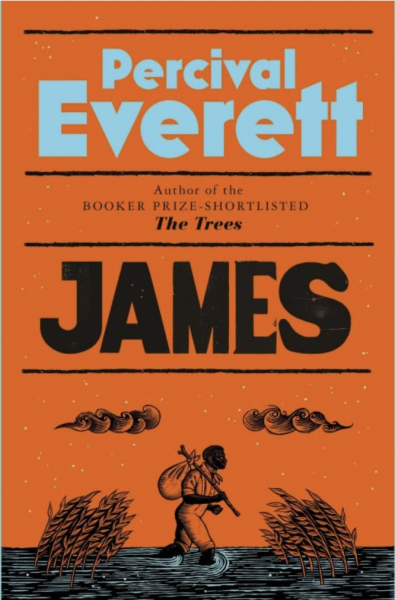 James by Percival Everett. Hardcover edition published 2024 by Mantle. 320 pages. ISBN/UID: 978-1-03503-123-8
 In both novels, James/Jim meets up and goes on the run with Huck after learning he is about to be sold to a slave owner in New Orleans, far from his family. While hiding, he yearns for freedom in the North, where he hopes to earn money to buy his family’s liberation.
In Twain’s book, Jim is child-like and subservient to young Huck—a portrayal that has deservedly sparked controversy and criticism over the years. Everett transforms Jim into James, a reader who mentally debates the Enlightenment philosophers Voltaire, Locke, and Rousseau about their limited understanding of human equality and acceptance of slavery.
James hides his intelligence for survival. He adopts a minstrel-like demeanor and pretends to act simple in front of the white masters to avoid getting whipped or sold down the Mississippi. The book begins with wryly funny accounts of how James maneuvers his life as a slave—even holding code-switching “classes” for the Black children.
As in Twain’s book, James and Huck must rely on each other to avoid capture, and they bond in the process.
When they are separated, Everett follows James’ journey, and the tale takes a dark turn. James is sold to an abolitionist who pays him a wage, lifting his hopes of earning enough money to buy his family’s emancipation. But he is badly let down as he is forced to deal with being exploited and dehumanized as a worker and a Black man.
Later, James encounters plantation slaves and witnesses their horrific treatment of being whipped or beaten to death. This experience of violent racism and injustice changes James. He starts to understand the anger he has felt simmering below the surface all his life, and he develops a need to rise up and fight back.
Twain leaves Jim’s future to the reader’s imagination. Everett’s conclusion is also open-ended, but in a much more glorious and satisfying way. James’ adventures are clearly just beginning.
James is an impactful and revelatory read that will stay with me for a long time.
