



Solomon decries the tendency of the Anti-Defamation League (ADL) and the American Jewish Committee (AJC) to equate criticism of Israeli policies with antisemitism.
Columnist Max Boot, a U.S. Jew who emigrated from Russia to the USA as a boy, recently wrote, “There was, admittedly, always a tension between the Zionist and democratic strands of the state—tension that became especially pronounced after 1967 when Israel occupied the Gaza Strip and West Bank with all of their Palestinian inhabitants. But, in recent years, religious extremism and ultranationalist ideology have moved from the fringes of Israeli politics to the center of power.” Boot has also written of the desire of some Israelis to “annex the entire West Bank—which would entrench a military occupation that has been denounced by human rights groups as an Israeli version of apartheid.”
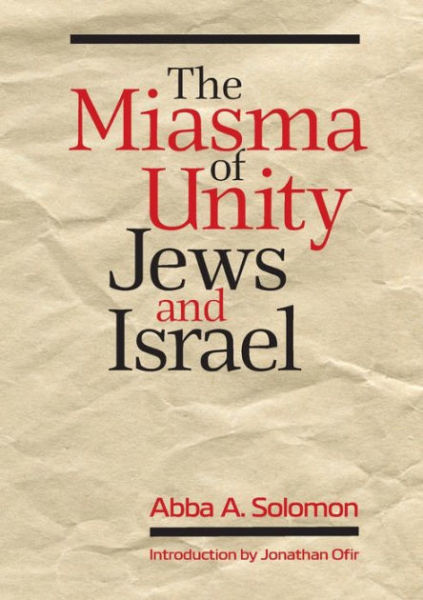
Abba Solomon, the Jewish author of the 2013-2022 articles gathered together in The Miasma of Unity: Jews and Israel, is more specific in mentioning some of the groups that agree that “Israel’s rule of Palestinians’ meet the criteria for...apartheid, a crime against humanity.” And he goes further and suggests that Zionism necessarily led to a “government oppressive to non-Jews in Palestine.”
It was in 1897 that Theodor Herzl established The World Zionist Organization, whose aim was to establish “a national home for the Jewish people.” This did not become a reality until 1948, when Israel was established. But in his first article in this Miasma...collection, Solomon adds, “750,000 Palestinians were displaced to establish Israel, not allowed to return to their homes.”
Although there has been some confusion on exactly what Zionism means, to Solomon it has always implied and in practice meant oppressing non-Jews residing in the new Jewish “homeland.”
Although there has been some confusion on exactly what Zionism means, to Solomon it has always implied and in practice meant oppressing non-Jews residing in the new Jewish “homeland.” Thus, he goes further than Max Boot’s “tension between the Zionist and democratic strands of the state.”
In his first article in this collection under review, Solomon also decries the tendency of the Anti-Defamation League (ADL) and the American Jewish Committee (AJC) to equate criticism of Israeli policies with antisemitism. In the remaining 35 pieces here—more than half of which were earlier posted on LA Progressive—he again sometimes criticizes this or similar false equivalencies. For example in a July 2016 article he wrote, “Worldwide, Israel advocacy groups conflate Zionist advocacy with the defense of human rights of Jews.”
Solomon’s approach is one with which I wholeheartedly agree. My first published article (in 1970) was on “Vladimir Soloviev and the Jews in Russia.” It was adapted from my Georgetown U. Ph.D. dissertation on “Soloviev and the Russophiles.” Like Soloviev, a trenchant critic of Russian and other nationalisms, Solomon often criticizes nationalism, particularly that which he perceives as inherent in Zionism. More significantly, however, Soloviev was the strongest Christian critic of Russian antisemitism. And my article ends with a quote from his friend Rabbi Gets, who stated that Soloviev enjoyed “wide popularity” and “sincere love among the Jews.”
Also at Georgetown, however, was my favorite professor and an important role model, Hisham Sharabi, an Arab-American, born in Palestine, who became a leading voice for Palestinian Arab rights. Thus, I agree with Boot and Solomon that one can both deplore all the antisemitism that Jews have suffered over the centuries and, at the same time, be critical of Israeli treatment of Palestinian Arabs.
In a March 2016 article in the present collection, “The Occupation of the American Mind” (which was reposted on LA Progressive), Solomon reviews the video The Occupation of the American Mind: Israel’s Public Relations War in the United States. It criticizes, as does he, U. S. media, which “in contrast to most of the world’s, omit the Palestinian story [of Palestinian Arab suffering and being persecuted], and thus why US public opinion favors Israel so markedly.”
In that same article Solomon also notes that U. S. politicians overwhelmingly favor Israeli policies: “The Republican party is becoming the repository of unconditional Israel advocacy”; Joe Biden, then still vice-president, had made a career “steeped in American Zionism”; and Hillary Clinton’s “loyalty with Israel is slavish.”
In a later June 2019 article, Solomon indicates that Sen. Bernie Sanders was not as “slavish” as Hillary Clinton and advocated for Palestinian Arab rights, but still “seems to include support for the survival of political Jewish primacy in Israel/Palestine that non-Jews must work around.” (In May 2023 Sanders demonstrated greater sympathy for Palestinian rights when he helped Rep. Rashida Tlaib, D-Mich., a Palestinian-American and a Muslim, schedule a "Nakba Day" event in a Senate hearing room. That event recalled the "displacement of Palestinian people when Israel was founded in 1948.”)
Although a short November 2016 essay, “A Most Mournful Gathering,” describes Trump’s 2016 election as “a cataclysm for the Jewish community,” Solomon’s articles seldom deal with the Trump administration’s policies.” A notable exception is the author’s February 2020 piece, earlier posted on LA Progressive, “Jared's—and Jews'—Shame.” It begins by stating that “arrogance and complacency is the core of Trump son-in-law Jared Kushner’s plan for the final extinguishment of Palestine.” That Trump himself approved of the plan is indicated by Solomon’s later referral to it as the “Trump/Kushner plan.”
More than a few of the collection’s articles point out that U. S. politicians and Jewish organizations that attempt to take a more balanced stance toward Israel and the Palestinian Arabs often fail to treat the Palestinians justly. One example is “the liberal Zionist D. C. group J Street.” Three different pieces deal with them, the first in June 2019 that also discusses Sen. Bernie Sanders, the second a 2017 essay entitled “Agony of J Street”; and the third a 2014 essay co-written with brother Norman on “the Blind Alley of J Street.”
In the last piece, the brothers quote favorably a human rights lawyer who stated that “J Street, by making it easier for them [progressives] to appear to be critical, in fact serves as a roadblock on the path to a consistent, human rights and international law-based position.”
Abba Solomon is also not overly impressed by politicians who maintain they wish a two-state solution (Israel and Palestinian Arab states) to Israeli-Palestinian tensions and conflicts. In a 2022 article (the second one in this present collection) Solomon states: “The project of Israeli settlement beyond the 1949 armistice lines means the time of the internationally-favored “two-state solution” is over. In fact, it was never really a serious Israeli goal to begin with.” Regarding the Biden administration insistence that it also supports a “two-state solution,” Solomon would probably agree with a Feb.-2023 Vox article that noted that “Israeli governments have expressed little political will for Palestinian statehood”; that “the Trump administration reversed longstanding US policies in ways that undermined Palestine”; and that “Biden’s team has since offered no hints of how to revive the long dormant negotiation process.”
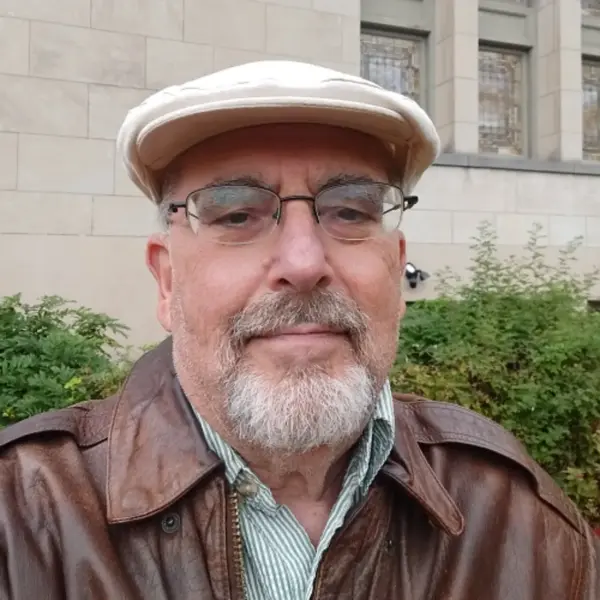 Abba Solomon
An interesting offshoot of Israeli evolution has been the development of its “military/police/security industry.” In a 2015 review of Jeff Halper’s War Against the People: Israel, the Palestinians and Global Pacification, Solomon writes that Israel supplies “governments from Colombia to Uzbekistan with drones, attack helicopters, missiles, arms, and cyber eavesdropping system....Notoriously, over the years Israel has been involved with governments of torture, terror and even anti-semitism, in Apartheid South Africa, Guatemala, and Argentina, among others.”
Finally, a few technical matters: Several pieces of the above collection are co-authored with the author’s brother, Norman, and a few more (as indicated above) are book reviews. Like many books made up of collected articles, there is no index or bibliography. Most, and perhaps all, of the articles are available online, slightly more than half at LA Progressive.
Nevertheless, it is useful to have these 36 selections gathered together, especially since as their author notes, the U. S. media and powerful Jewish organizations tend to skew their coverage in a pro-Israeli direction—e.g., Solomon wrote in 2014, “The New York Times sent out a clear signal: the mass slaughter of civilians is acceptable when the Israeli military is doing the killing.”
