

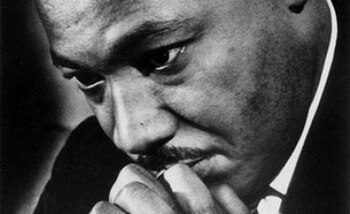

Biographer Jonathan Eig captures King’s life from a new and interesting perspective in King: A Life
Biographer Jonathan Eig captures King’s life from a new and interesting perspective in King: A Life
Part II
Black Americans were protesting, and their protest alarmed white Americans. Given the “river of Negro protest,” wrote a reporter for Newsweek, America might want to ask “‘who are these revolutionaries? What do they want?’”
See Part 1: "We Have Woke Up"
For journalist Jonathan Eig, the second question was easy. Both the subject of his book (Dr. King) and Black Americans during the Civil Rights era wanted the same thing. That is, freedom from the tyranny of oppression. They wanted freedom from the fear of terrorism, from lynching, segregated schools and institutional racism in governmental institutions. Black Americans wanted the freedom to walk the streets without being subjected to the unfair privileges reserved for whites. They wanted the freedom to send their children to good schools. They wanted the freedom to vote. Black Americans knew their lives mattered and wanted everyone to recognize this fact too.
Black Americans knew they were human beings. When will white America learn this lesson?
As for the first question, Eig shows that every Black person was involved in the movement against tyranny, and, therefore, every Black person was a revolutionary, seeking change.
King had the dual job of inspiring the protests and explaining the purpose of the protests to white America
In the meantime, Dr. Martin L. King, Jr., as the movement’s leader had the dual job of inspiring the protests and explaining the purpose of the protests to white America, writes Eig. King of a people was tired of “‘quietly’” enduring, “‘silently’” suffering,’” and “‘patiently’” waiting. Citing Bob Dylan’s “Blowin’ in the Wind,” Eig writes that change is as unavoidable as the air that swirls around us.” Black Americans felt it, but not those who wanted the status quo to remain in tact. King felt it.
The civil rights leader, Eig argues, had thought about teaching like W. E. B. Du Bois or Benjamin Mays, but he came under the influence of Gandhi and what he learned from the man made him change his mind about the direction of his life. Writes Eig, King makes a decision: He “would force his ‘oppressor to commit his brutality openly… with the rest of the world looking on.’”
King had done as much in Birmingham, Eig reminds us, when he led a prayer protest along with Rev. Ralph Abernathy. Bull Connor, seeing the protesters, shouted to his officers that King and Abernathy weren’t to go any further. The men, along with hundreds of Black protesters had just a few blocks to go before reaching the Sixteenth Street Baptist Church. Police, following the orders of Connor, set barricades before the protesters. That’s when King and Abernathy, followed by the protesters, writes Eig, knelt down in prayer.
Connor’s officers proceeded to lift “King by the elbow.” They “pulled him to his feet and they did the same to Abernathy.” The two were then shoved into a police wagon but not before the crowd heard King shout, “‘keep the movement going.’” The two leaders found themselves sitting, side by side, in the dark, listening to Connor tell the officers to take them to jail. “‘Put them in solitary.’”
*
The white clergy of Alabama had a problem with King’s presence in the city of Birmingham, and taking the opportunity of King’s rather stationary position in their jail, sent the Civil Rights leader a letter, dated April 12, 1963.
“We the undersigned clergymen,” the letter begins, “are among those who in January, issued ‘An Appeal for Law and Order and Common Sense’ in dealing with racial problems in Alabama.” There was cooperation from the Black community, wrote the clergymen. “However, we are now confronted by a series of demonstrations by some of our Negro citizens directed and led in part by outsiders. We recognize the natural impatience of people who feel that their hopes are slow in being realized. But we are convinced that these demonstrations are unwise and untimely…”
It’s not the KKK that is a great stumbling block “‘toward freedom,’” but the “‘white moderate also is more devoted to ‘order’ than justice.
King, sitting in his cell at the Birmingham Jail, responded on April 16, 1963. He addressed the concerns of the clergymen for preferring “law and order,” their insistence that the movement for Civil Rights and its use of demonstrations in Birmingham were “unwise” and “untimely.” He wrote of understanding why the clergymen were so incensed that they would resort to writing him a letter, insisting that the “battle for integration” continue in the courts, rather than on the streets of Birmingham.
The clergymen, in turn, should understand that for Black Americans the courts was the site where many were found guilty for violating Jim Crow laws. In these courts did Blacks receive “justice”?
“‘I think I should give the reason,’” King wrote, “‘for me being in Birmingham, since you have been influenced by the argument of ‘outsiders coming in.’” There’s the business of sharing staff among “‘the eighty-five affiliated organizations all across the South.’” The Alabama Christian Movement for Human Rights is just one of the organizations sharing “‘staff, educational and financial resources with our affiliates.’”
But there is another reason, King offered, for being in Birmingham… Injustice is here!
Just as the “‘eighth century prophets,’” I am “‘compelled to carry the gospel of freedom beyond my particular hometown.’” We share an “‘interrelatedness.’” And, therefore, an “‘injustice anywhere is a threat to justice everywhere.’” Since you live in the US how then can you consider me “‘an outsider anywhere in this country?’”
King’s letter continues: Birmingham is “‘the most thoroughly segregated city’” in the US. Consider, then, its “‘ugly record of police brutality,’” its “‘treatment’” of Blacks “‘in the courts is a notorious reality.’” and its “‘solved bombings’” of Black homes’” is a brutal fact. Under the leadership of Rev. Fred Shuttlesworth, the Alabama Christian Movement for Human Rights began conducting non-violent workshops because, King wrote, we are dealing here with “‘unjust’” laws. Something St. Augustine recognized in his day. “‘An unjust law is a code that is out of harmony with the moral law.’”
On the other hand, as St. Thomas Aquinas acknowledged, “‘any law that up lifts human personality is just.’” However, King declared, “‘all segregation statues are unjust because segregation distorts the soul and damages the personality.’” In other words, King explained, “‘An unjust law is a code inflicted upon a minority which that minority had no part in enacting or creating because they did not have the unhampered right to vote.’”
In Germany, King continued, let’s not forget, it was “‘illegal’” to “‘aid and comfort a Jew in Hitler’s Germany.’” It’s not the KKK that is a great stumbling block “‘toward freedom,’” but the “‘white moderate also is more devoted to ‘order’ than justice.’” It’s the moderate “‘who prefers a negative peace which is the absence of tension to a positive peace which is the presence of justice.’” It’s the moderate “‘who constantly says, ‘I agree with you in the goal you seek, but I can’t agree with your methods of direct action.’”
The moderate, King explained, “‘paternalistically feels that he can set the time table for another man’s freedom.’” The Negro, in other words, can wait until a “‘more convenient season.’” However, King insisted, “‘tolerance’” is worse than “‘outright rejection,’” Now is the time to lift our national policy from the quicksand of racial injustice to the solid rock of human dignity.’”
When advocates on behalf of uplifting human dignity speak up regarding the brutality used against Blacks, when they speak on behalf of a “‘social revolution,’” they are punished. Incarcerated. Called “‘dirty n-lovers.’”
“‘I came to Birmingham with the hope that the white religious leadership of this community would see the justice of our cause…’” But our cause has been called “unwise” and “untimely.’” We are called “‘outside agitators’” and “‘rabble-rousers…’”
We have waited for more than 340 years! It must be easy for “‘those who have never felt the stinging darts of segregation to say, “‘wait.’”
‘But when you have seen vicious mobs lynch your mothers and fathers at will and drown your sisters and brothers at whim; when you have seen hate-filled policemen curse, kick, brutalize, and even kill your black brothers and sisters with impunity; when you see the vast majority of your twenty million Negro brothers smothering in an airtight cage of poverty in the midst of an affluent society; when you suddenly find your tongue twisted and your speech stammering as you seek to explain to your six-year-old daughter why she cannot go to the public amusement park that has just been advertised on television, and see tears welling up in her little eyes when she is told that Funtown is closed to colored children, and see the depressing clouds of inferiority begin to form in her little mental sky, and see her begin to distort her little personality by unconsciously developing a bitterness toward white people; when you have to concoct an answer for a five-year-old son asking in agonizing pathos, ‘Daddy, why do white people treat colored people so mean?’; when you take a cross-country drive and find it necessary to sleep night after night in the uncomfortable corners of your automobile because no motel will accept you; when you are humiliated day in and day out by nagging signs reading ‘white’ and ‘colored’; when your first name becomes ‘nigger’ and your middle name becomes ‘boy’ (however old you are) and your last name becomes ‘John,’ and when your wife and mother are never given the respected title ‘Mrs.’; when you are harried by day and haunted by night by the fact that you are a Negro, living constantly at tiptoe stance, never knowing what to expect next, and plagued with inner fears and outer resentments; when you are forever fighting a degenerating sense of ‘anodynes’ -- then you will understand why we find it difficult to wait. There comes a time when the cup of endurance runs over and men are no longer willing to be plunged into an abyss of injustice where they experience the bleakness of corroding despair. I hope, sirs, you can understand our legitimate and unavoidable impatience.’
King “mixed poetry, prayer, and patriotism,” developing a skill that would have been a “ponderous” task for others.
*
On June 23, 1963, King echoed a phrase that perhaps some Americans today still don’t want to hear. Eig cites that the source of this phrase is as that of poet Langston Hughes, from his poem, “I Dream a World.” “‘Now is the time to make real the promise of democracy.’” I recognize in King’s selection of this phrase from a Hughes’ poem, he was shaking any fear of looking out across the American landscape and locating like-minded voices to add to the development of his public voice.
Eig notes how King “mixed poetry, prayer, and patriotism,” developing a skill that would have been a “ponderous” task for others. King, however, employed these poetic and religious and patriotic forces “to inspire all Americans to seize the moment of opportunity; to bring peace, love, and equality to those who had so long been denied; and to fulfill, at last, the promise of the American dream.”
But, it should be noted, as Eig writes, that King’s dream is situated in the reality of a present that encompassed “the children of slaveholders and the children of those they enslaved” both living together, as brothers, having tackled, together, the American nightmare.” The one we still live in now, I’ll note, because one side is too fearful of letting go of the nightmare that denied them a belief in their invincibility.
In King’s dream, there is harmony between the races because both faced the abyss determined to survive and thrive as one nation. For to be free at last is to be free of tyranny. Free of the tyranny of colorblindness and all other diversions on the road to ending the nightmare. On that June 23th, King, in a speech given at a demonstration for Black Pride, in Detroit, prepared for the “I Have a Dream” speech. In the meantime, writes Eig, he worked on “a new book, one that grew from the seed of his ‘Letter from Birmingham Jail.’” The book’s title became, Why We Can’t Wait.
In Birmingham, some “3,600 Black people registered to vote in a two-month period, an unprecedented number.” However, it didn’t go unnoticed by the city’s officials. They began to prepare for battle. A man nicknamed, “Dynamite Bob,” was preparing too.
On September 15, 1963, was the day Robert Chambliss selected to display his work. When the explosion of fifteen sticks of dynamite sent the Sixteenth Street Baptist Church rocking, Chambliss, no longer so angry, expressed glee as he watched from a distance. The explosion blew “out the east side of the redbrick church,” where many were injured and where four girls laid. Dead. Writes Eig, “it would take fourteen years for officials to convict Chambliss for his role in the bombing.” Another 30 would be needed to convict his accomplices, Edwin Blanton Jr. and Bobby Frank Cherry.
Gov. George Wallace declared the tragedy as the work of “communists.”
Sixty-eight days later, President John F. Kennedy is killed in Dallas, and King, in Atlanta, told Coretta, that he too, expected a bullet. “‘This is what is going to happen to me too.’” But by the end of 1963, Time magazine named King “Man of the Year.” He would be the first Black person to receive the honor, writes Eig, although it was an honor that only made King more skeptical. He recognized and voiced his concerns that reparations “‘as a form of social atonement, a way to heal, to restore bonds shattered by slavery and racism’” might be pushed back as individuals in the struggle receive awards. Such awards could block the way of collective progress.
It was necessary, King declared, to consider both the “‘forgotten white poor’” as well as the “‘mistreated Black.’” For King, there could be no choice between “‘ending poverty and compensating Black people for the injustices they suffered.’” After all, King insisted, “‘Democracy, in its finest sense, is payment.’”
*
King traveled to Washington DC as a citizen opposed to the war in Vietnam. As Eig points out, “public opinion surveys showed that only 19 percent of Americans favored withdrawal of American troops from Vietnam, while 23 percent favored escalating the battle.” However, while King thinking about ways to broaden the movement to include an active and collective course of action in opposition to the Vietnam War, back in Selma, there is outrage among the Civil Rights community over the killing of a 26-year old Jimmie Lee Jackson by Alabama troopers. Jackson was defending his mother, while both were protesting when troopers began attacking her. Coming to his mother’s rescue, Jackson is shot twice in his stomach.
Three days later, Malcolm is killed in Harlem, and King received, writes Eig, a warning from the DOJ to be “careful.”
At Jackson’s funeral, King spoke on behalf of all Black Americans. Jackson, he stated, “‘was murdered by the irresponsibility of every politician… who has fed his constituents the stale bread of hatred and the spoiled meat of racism. He was murdered by the timidity of a federal government that is willing to spend millions of dollars a day to defend freedom in Vietnam but cannot protect the rights of its citizens at home.’”
So much for being careful. King was threading the needle.
In Selma, King stepped up to the podium, citing the historian C. Vann Woodward’s 1955 book, The Strange Career of Jim Crow. Segregation, King told his audience, “‘had been employed not merely to express and maintain white supremacy but also as a ‘political stratagem’ to hold down the wages of Black and white workers.’” He concluded the speech by asking a rhetorical question: “‘How long?’”
*
On April 4, 1967, a year exactly before he is assassinated, King delivered, “A Time to Break the Silence,” to an audience consisting of Clergy and Laity, at Riverside Church.
“‘For those who ask the question, ‘Aren't you a civil rights leader?’ and thereby mean to exclude me from the movement for peace, I have this further answer…’” And King reminded everyone that the motto of SCLC is: “‘To save the soul of America.’”
Therefore, he continued, “We were convinced that we could not limit our vision to certain rights for black people, but instead affirmed the conviction that America would never be free or saved from itself until the descendants of its slaves were loosed completely from the shackles they still wear. In a way we were agreeing with Langston Hughes, that black bard of Harlem, who had written earlier:
O, yes,
I say it plain,
America never was America to me,
And yet I swear this oath —
America will be!”
It should be clear to anyone, King continued, that “if America's soul becomes totally poisoned, part of the autopsy must read: Vietnam. It can never be saved so long as it destroys the deepest hopes of men the world over. So it is that those of us who are yet determined that America will be are led down the path of protest and dissent, working for the health of our land.”
King, writes Eig had faith in America, despite how the country treated him. He was “flawed,” “complicated,” and “human.” And a “radical” thinker.
An injustice anywhere is an injustice everywhere…
If only, Eig ends King: A Life, we could “see and hear clearly again, as America saw and heard him once before.”
King: “‘Our very survival… depends on our ability to stay awoke to adjust to new ideas, to remain vigilant and to face the challenges of change.’”
