

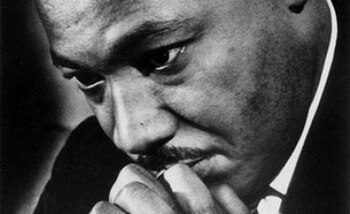

Although MLK had come to realize that reforming the USA was more complex he had thought, he still stressed the importance of holding proper values.
An essay, “Why Jonathan Eig's New Biography of MLK Is So Valuable,” will follow shortly on LA Progressive.
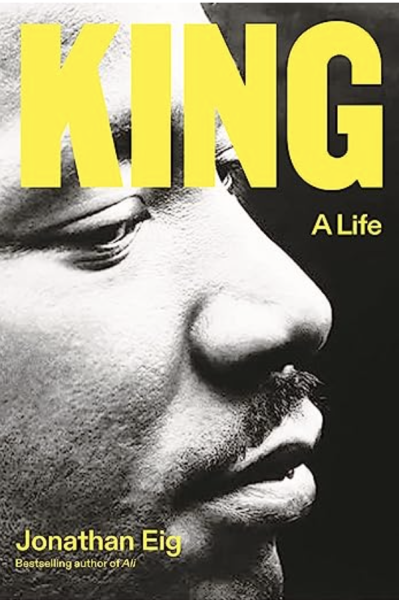
Jonathan Eig’s new (2023) biography of Martin Luther King Jr. (MLK) is the first comprehensive one since David J. Garrow's Pulitzer-Prize-winning Bearing the Cross: Martin Luther King, Jr. and the Southern Christian Leadership Conference appeared in 1986. In a review for the British journal The Spectator, Garrow praised the new work and recognized that it will become the “standard account” of the famous U. S. Baptist minister.
In distinguishing between the two biographies, Garrow indicates three main differences:
- Eig devotes much more space—almost a quarter of his text—to MLK’s pre-Montgomery-Bus-Boycott years. (Both biographies are over 550 pages of text, excluding notes, etc.)
- The newer biography includes much more on Coretta Scott King—and also indicates that King was often sexist toward his wife (and other women).
- Eig goes into much more detail on how and why King’s life was not only “deeply courageous,” but “also deeply flawed.”
“Deeply courageous”? Yes. “He pushed white liberals to confront their own racist behaviors...When pressure against him grew and he might have backed down, he stepped up, time after time, despite the obvious risk. He warned that materialism undermined our moral values, that nationalism threatened to crush all hope of universal brotherhood, that militarism bred cynicism and distrust. He saw a moral rot at the core of American life and worried that racism had blinded many of us to it. [But] he also insisted that ‘we must never lose infinite hope.’ He never did.”
“Flawed?” Yes. He “cheated” on Coretta, “continually” and with many different women.
It is often difficult for us to accept that our heroes are flawed, sometimes deeply so as with the frequent marital infidelities of John Kennedy and MLK. But Eig believes that to ignore the flaws and just celebrate the positive is more harmful. “Our simplified celebration of King comes at a cost. It saps the strength of his philosophical and intellectual contributions. It undercuts his power to inspire change...the nation remains racked with racism, ethno-nationalism, cultural division, residential and educational segregation, economic inequality, violence, and a fading sense of hope that government, or anyone, will ever fix those problems.”
Besides, to ignore the flaws is to violate truth. And like Gandhi and many others have pointed out, “tell the truth” should be a lodestar, especially for biographers and historians.
In spite of Eig’s great admiration for King and what he accomplished, MLK’s womanizing is not the only flaw identified. As Eig writes, “King was a man, not a saint. He chewed his fingernails...He hid his cigarettes from his children...He slept poorly...He ran chronically late for meetings. As an adolescent, he twice attempted suicide...As an adult, he was hospitalized repeatedly for what he called exhaustion and others described as depression.” In addition, Eig mentions that King sometimes drank too much, and was at times guilty of something that we professors, present and past, take very seriously—plagiarism.
And yet—despite all the threats to his life (and that of his family); despite all the jailings he endured (about 30); despite his relative youth (his years of fame extended from 1955 until 1968, when he was killed at age 39); despite his all-too-human doubts, insecurities, and personal failings; despite unfair FBI hounding and phone tapping resulting from J. Edgar Hoover’s erroneous belief that MLK was spewing communist propaganda; despite the great difficulties of trying to get the USA on the right track (after hundreds of years of slavery and almost a hundred of subsequent segregation); and despite civil rights activists who opposed King’s non-violent approach—MLK remained committed to his noble values.
Eig writes that King learned his basic values from the Black church. “He learned the values of love and sacrifice and humility...and he learned to live those values.” Later at Crozer Theological Seminary in Pennsylvania he learned from Gandhi that “love is mankind's most potent weapon,” not only for personal, but also for social, transformation. And also from Gandhi he learned that love in the social and political arena meant non-violence, either at home or abroad. No mater what the domestic or foreign provocation, including armed racist police, like Alabama’s Bull Connor, King never deviated from his emphasis on love and a non-violent approach.
From 1957, when he delivered a powerful sermon on “Loving Your Enemies” (“Yes, it is love that will save our world and our civilization, love even for enemies)” until early 1968, when he told his congregation that he wanted to be remembered as someone who “tried to love and serve humanity,” he was consistent.
Since King today is celebrated primarily for his civil rights activity, for fighting against segregation, and for his famous “I Have a Dream” speech, it is appropriate to recall some of his other efforts to make our country greater. And Eig does that.
He especially emphasizes MLK’s belief that our escalating Vietnam War was wrong. And King began saying so early on when the war was still not so unpopular. For example, in a speech at Howard University in March of 1965, when more of our citizens supported escalating our involvement than withdrawing our troops. Time and again he was told, and sometimes even by those within the civil rights movement, that criticizing the war would harm his battles against racism and his relations with President Johnson, who had done much to help the movement but also escalated the war. (And it is true that as King’s attacks against the war increased his popularity decreased.)
But King’s response was: “As a minister of the Gospel, formed in the “prophetic Judeo-Christian tradition...I cannot advocate racial peace and non-violence for black men alone, nor white men alone, nor for yellow men alone...If a man of God fails to see this; if he fails to seek to help bring about peace on earth as well as good will among mankind, he isn't much of a spokesman for the Christ who predicted, centuries ago, that he who lives by the sword shall perish by the sword.” (King took his prophetic role seriously, and the differences between presidential political activities and prophetic functions can lead to serious rifts.)
Perhaps MLK’s finest speech against the Vietnam War occurred in April 1967 at New York’s Riverside Church. John Lewis, who had heard King speak many times and later became a congressman, also spoke in 1963 when MLK delivered his famous “I Have a Dream” speech. But he still thought that the Riverside “speech was his finest...It was deep, comprehensive, thoughtful and courageous. It was about what we were doing in Vietnam, but beyond that it was about what we were doing on this earth.”
The speech was especially notable for the great empathy that it displayed for the Vietnamese peasants: “So they go, primarily women and children and the aged. They watch as we poison their water, as we kill a million acres of their crops. They must weep as the bulldozers roar through their areas preparing to destroy the precious trees. They wander into the hospitals with at least twenty casualties from American firepower for one Vietcong-inflicted injury. So far we may have killed a million of them, mostly children.”
Empathy is one of the most important virtues that wise men possess and King had displayed it before. After his Montgomery, Alabama home was bombed in January 1956, with his wife, Coretta, and infant daughter inside, King recalled how he was “on the verge of corroding hatred for those responsible.” But then he tried to put himself in their places and he realized that their “whole cultural tradition...teaches them that Negroes do not deserve certain things...When they seek to preserve segregation they are seeking to preserve only what their local folkways have taught them was right.”
And later, in the summer of 1966, he recognized the importance of empathy when in Mississippi he stressed the importance of working together with whites. Acknowledging that Blacks were only 10 percent of the U. S. population, he stated (as Eig quotes him) that “there’s going to have to be a coalition of conscience and we aren’t going to be free here in Mississippi and anywhere in the United States until there is a committed empathy on the part of the white man.”
In his final years, King not only became more critical of the Vietnam War, but also broadened his criticism and fight to other areas such as against imperialism, materialism, and the worst abuses of capitalism. He also increasingly worked for improving the conditions of all poor people whatever the color of their skin and for overcoming racism’s many dimensions in northern cities like Chicago as well as in southern areas.
For example, in his final book, Where Do We Go from Here: Chaos or Community? (1968), he wrote: “As we work to get rid of the economic strangulation that we face as a result of poverty, we must not overlook the fact that millions of Puerto Ricans, Mexican American, Indians and Appalachian whites are also poverty-stricken. Any serious war against poverty must of necessity include them.” And, “Our economy must become more person-centered than property-and profit-centered.” Eig stresses that Hoover and the FBI were wrong—King never supported communism, its atheism was anathema to him. Rather, “his vision embraced the best elements from capitalism and socialism.”
Although by the time a rifle bullet took his life in April 1968, MLK had come to realize that reforming the USA was more complex and difficult than he earlier had thought, he still stressed the importance of holding proper values. “For the evils of racism, poverty and militarism to die, a new set of values must be born.”
In summary, as I ended an LAP essay on MLK four and a half years ago: “One could acknowledge that King had his flaws and failings—some regarding women and marital fidelity. But who among us humans does not, including others that we honor like Washington and Lincoln? Nevertheless, like the lives of those two presidents, MLK’s is well worth honoring.”
