




Amy Coney Barrett’s new book makes clear that she knows what the Constitution says and that she heartily joins the other corporate extremists on the Roberts Court in working to shred that document.
Do you know how many amendments there are to the United States Constitution? Do you know when the last one was adopted?
The 27th Amendment was finally ratified on May 7, 1992. It had originally been proposed in 1789, as one of the amendments offered - 10 of which were adopted as our Bill of Rights. The 27th Amendment deals with how Congress people can increase their own pay. Yes, back in 1789 thinking people were concerned about Congressmen bilking the taxpayers.
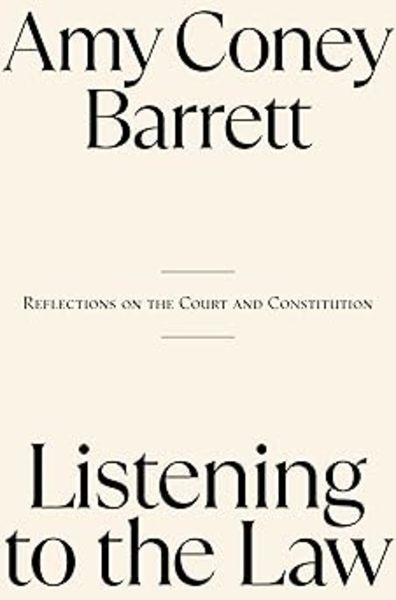
This tidbit of information is available in Amy Coney Barrett’s new book—Listening to the Law: Reflections on the Court and Constitution—in the same chapter in which she twice declares her opposition the Equal Rights Amendment (ERA) for women. She also gives us a first hand look at the sophistry used by extremist corporate politician/judges when they want to ignore or change the Constitution or the law to advance their own ideology.
Article V of the Constitution governs how amendments get made. Like most of the Constitution it’s language is simple and straight forward. It is just one paragraph long. It says that when the Federal Congress approves an Amendment and three fourths of the states ratify it it becomes officially part of the Constitution.
Article V doesn’t include any role for the President in the amendment process. Congress can approve an amendment, which then goes to the states for ratification or rejection. Once ratified the Amendment automatically becomes part of the Constitution.
And Article V doesn’t provide for any time limit on ratification. Hence an amendment proposed in 1789 could, and did, take more than 200 years to be ratified by three-quarters of the states. Not three-quarters of the 13 states when the amendment was first proposed. By the time it was finally ratified, there were 50 states, and 38 of 50 were necessary for ratification.
Article V also does not allow Congress to impose conditions on ratification efforts in the states. And it does not provide that any state can ratify and then un-ratify an amendment. If states could un-ratify amendments, many states would have un-ratified various Amendments, creating a patchwork of Constitutional provisions among the states. Amy Coney Barrett writes clearly about how the Constitution grants the Federal government only limited powers, leaving powers not specifically listed in the Constitution to the states.
But she also doesn’t like the concept of equal rights for women. She is a longtime member of a Catholic sect which commands male dominance and prohibits women in leadership roles. The highest status a woman can attain in the sect is that of “Handmaid.”
In chapter 9 of her book, Barrett applauds the time limits for ratification on the Equal Rights Amendment. Although she petends to be an “Originalist,” giving the words of the Constitution the meanings they had at the time they were written, and pretends that the original language limits Congress’ powers to what was granted to them by the Constitutional text, her fringe religious belief in the superior authority and rights of men leads her to believe that Congress can add time limits to the amendment process, in order to block what she sees as a religiously equalizing women’s rights.
Her book is a catalog of this sort of ideological sophistry, in which she gives support to John Roberts’ lifeling campaign to overturn Brown v. Board of Education, and a wealth of other business oriented political desires. She is also a staunch enemy of universal standards of human rights.
She believes in racial gerrymandering in state politics. In Alexander v. South Carolina State Conference of the NAACP (2024) she joined the rightwing majority of the Roberts Court in upholding South Carolina’s racially gerrymandered voting districts. And again in 2025, she joined the (shadow docket) majority in upholding voting maps in Texas that Texas legislators bragged were racially gerrymandered.
Not surprisingly, neither of these decisions is mentioned in her book. However, her book does bemoan America’s racial history. It’s just that she thinks that things like the 13th Amendment and Brown v. Board of Education were wrong. This is despite Amy Coney Barrett having raised two Black children, adopted from Haiti. As she said during oral argument in the Alexander case, politics in the USA involves an entanglement of politics and race.
Which leads directly to her extraordinary views on personal and human rights under the Constitution. In recent days, the Supreme Court announced that it believed that it now has, with Amy Coney Barrett’s membership, enough votes to reinterpret the 14th Amendment.
The 14th Amendment marked a change in the way amendments were constructed. None of the first ten Amendments, the Bill of Rights, is more than one sentence long. The 13th Amendment, ending slavery is two sentences. The first sentence ends slavery in the United States. The second empowers Congress to pass laws to enforce the Amendment. The 14th Amendment has FIVE different sections, and covers more than a whole page of single spaced text in an appendix to Amy Coney Barrett’s book.
The first section is what businessmen and the political rightwing considers “The Bad One.” Section one gives citizenship to “all persons” born in the United States and subject to the jurisdiction of the United States. “Subject to the jurisdiction of” is diplomatic speak which excludes children of foreign diplomats who are born while their mothers are in the United States as part of diplomatic missions of foreign governments.
Tak a pause and think about that. People who claim that “anchor babies” born to undocumented residents are actually saying that all those children are “not subject to the jurisdiction” of the United States or the individual states! So shouldn’t we be releasing them from our ICEstapo holding cells and concentration camps? If they are not subject to the jurisdiction of our laws, that would include our immigration laws. So they are not violating any laws by being here.
It sounds silly doesn’t it? There must be something missing. And there is. The reality is that everyone born here is subject to our law, even the children of foreign diplomats. Treaties are our laws just as statutes are. That, too, is stated in the Constitution. And our treaties with other nations allow diplomats living here on diplomatic business, to have their children remain subject to the jurisdiction of their home nation’s laws. That doesn’t apply to undocumented people, who are thus subject to the jurisdiction of our laws. Their children who were born here are, therefore, citizens. Period. Full stop.
But the Supreme Court has announced that it intends to reconsider that. The basic argument is that the Amendment was passed just after the Civil War ended slavery and was thus meant to provide citizenship to the newly freed Black people.
Work through that argument. Were the Black slaves not citizens? They were counted a 3/5s of a regular person for purposes of setting voting censuses. Only citizens can vote. Even if that 3/5s status didn’t make them citizens, because they were slaves, didn’t the 13th Amendment cure that “defect”?
In her chapter 12 explanation of how “originalists” like her and the late Antonin Scalia apply originalism, to get the Constitution to mean what her corporate sponsors want, she says that originalism means to apply the meanings of words that the writers understood at the time of writing. So when the 14th Amendment says, “All persons born or naturalized in the United States...are citizens of the United States,” she points out that the Amendment’s writers had just finished the Civil War which freed Black people from slavery. Thus it is only reasonable, for her, to think that when they said “All people...” what they really meant was “Former slaves and their children.”
The nation had been through a civil war. Many White nationalists today deny that slavery was a cause of that civil war. But in the years betwen our founding and the Civil War, the country loudly debated the role of slavery and we had riots and lynchings over the place of immigrants. President Monroe had promulgated his doctrine claiming that citizens of Latin American nations which had broken colonial status had a right to their own self-determination.
So it is pretty clear that the men who wrote and ratified the 14th Amendment had a pretty clear understanding of the difference between “All people” and “Former Black slaves.” Section one of the 14th Amendment doesn’t mention race or slavery. Amy Coney Barrett’s argument imposes her desires on what the Amendment’s writers actual understood their own words to mean. This mirrors her argument that Congress can impose time limits on the amendment process, although the Founding fathers granted no such power to Congress in the actual terms of the Constitution.
This fall, the Roberts Court announced that it had the votes to re-interpret the meaning of the 14th Amendment. Watch for Amy Coney Barrett to join her five rightwing colleagues in limiting 14th Amendment citizenship. This term, The Roberts Court will rule that the writers didn’t use “All people” to mean any other than “Former Black slaves.” With that, Birthright citizenship will end in the United States of America.
The same section of the 14th Amendment says that eveyone is entitled to “due process of law” without defining what due process might mean. The same section also guarantees every person “the equal protection of the laws.” Again, Amy Coney Barrett disagrees.
Many people believe that the mention of “due process” in the 14th Amendment is the first and only appearance of such a concept. But the 5th Amendment guarantees “due process of law” and the 6th Amendment guarantees “process” in laying out the guarantee of fair trials. Amy Coney Barrett pretends that “due process” only refers to legal procedures, but not to substantive legal process. The distinctions set out between the 5th and 6th Amendments make clear that Barrett’s distinction is facile and disingenuous.
The clearest proof of the disingenuity of Amy Coney Barrett’s position is it’s application to religious discrimination. Barrett believes that the 1st Amendment guarantee of religious freedom does not apply equally to all religions. She joined the Roberts Court in ruling that taxpayers of any religious persuasion can be forced to pay taxes to support Catholic schools. Carson v. Makin (2022) (Remember that a majority of the six rightwing Roberts Court justices claim to be Catholic.)
For those who have forgotten their high school history, the 1st Amendment was proposed by James Madison in reaction to some states taxing members of the Baptist religion to support government supported schools run by members of the state’s “official” religion.
Equally emphatic, but with less nuance to argue, the Catholic justices permitting states to ban abortions for everyone, including those for whom abortion is religiously allowed, or even sometimes mandated, for example Jews, not to mention other non-Abrahamic believers, was a clear indication that the Catholic religious mandate against abortion is more important to Amy Coney Barrett than the 1st Amendment. Not surprisingly, she doesn’t address this issue in her book.
Another part of the Constitution that is abhorent to corporatist judges is the concept of individual rights. As the Donald strives to deport people, even citizens, for the offense of disagreeing with him, Amy Coney Barrett joins the fray by pointing out that the Consitution is the fundamental WRITTEN law of the law. In her 19 page chapter 11, she says recognizing individual right beyond those identified in the Constitution would lead to anarchy.
The argument sounds sensible. But in all 246 pages of her text, Amy Coney Barrett never once mentions a simple sentence of Constitutional text that the Founding Fathers adopted in 1791. That sentence reads, “The enumeration in the Constitution, of certain rights, shall not be construed to deny or disparage others retained by the people.” Oops. This is what is called the 9th Amendment to the Constitution.
Amy Coney Barrett says that only rights that people had back in 1789, when the Constitution was drafted could possibly be included in the 9th Amendment. But what unenumerated rights did the majority of Americans have back then? Most of them were farmers, and 1789 was before the corporate industrial revolution started polluting our air and water. But Amy Coney Barrett doesn’t believe any citizen has any natural right to clean air or clean water.
In 1791, the citizens who voted to ratify the 9th Amendment were mostly also the citizens who had fought a war against royal rule and the oppressions of English corporations which controlled the English government. They understood the dangers and oppressions to be suffered under a government of the masses by the king and for the elite.
But on December 9, 2025, Amy Coney Barrett and her colleagues heard oral arguments in a case claiming that the Constitution allows no limits on the amount of bribes corporations can shovel to politicians, greately expanding the corporate freedom of multinational corporations that the odious Citizens United decision presaged. This term, they will grant corporations and billionaires the right to buy every politician they can afford.
In sum, Amy Coney Barrett’s new book makes clear that she knows what the Constitution says and that she heartily joins the other corporate extremists on the Roberts Court in working to shred that document. The book reads like a guide to ReTrumplican plans for formalizing Donald Trump’s role as a king, exempt from the terms of the Constitution and answerable only to the billionaires and multinational corporations which fund him.
She is clear about how sophistry is and will be used to get around what the Constitution actually says, and around what historians, and the Founders’ actual writings, tell us the Founding Fathers meant. It is an appallingly flagrant and open discussion of anti-democratic governance and a well thought out plan to achieve that goal.
As billionaires and multinationals are given more and more keys to the kingdom, we will sink into strife as they begin to war with eah other about who rules what territories. The second week of December saw an emerging war between Netflix and Paramount over media control.
Paramount represents the interests of the Donald’s family. Netflix appears to represent more future-looking interests. Like the Montague and the Capulets, or any number of warring English “noble” families forming the Angevin, Plantagenet, Tudor, etc. dynasties. Each dynasty was formed after endless battles in which wealthy lords sacrifice their serf-citizens to the fray. That is a natural result of the sort of anti-Constitutionalism promoted by Amy Coney Barrett.
