



From the point of view of the poor, poverty is just a never-ending chain of problems and crises that you hope to survive, but none of which will get you out of poverty.
Attentive readers will remember Matthew Desmond’s Pulitzer Prize winning Evicted, which meticulously dissected our perverse system for housing the poor, leading so often to serial evictions.
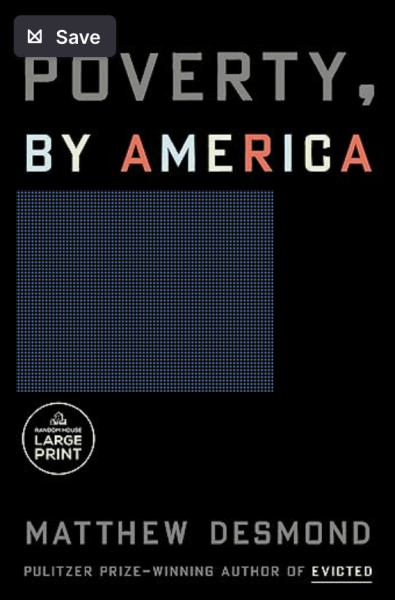
In this new book, Desmond takes a much broader view of the same problem. He seeks to analyze how all of us who are not poor actually contribute to the persistence of poverty in the world’s richest country. Then he advocates for what he calls “poverty abolitionism,” a commitment like the abolitionism of the antebellum years, to press for measures that will finally eliminate poverty in this country.
From the point of view of the poor, poverty is just a never-ending chain of problems and crises that you hope to survive, but none of which will get you out of poverty. If you’re working poor, you can get in trouble because the authorities question your ability to take care of your children while working two jobs to make ends meet. If you’re a child in such a situation, you could be sent to foster care, which often entails bouncing from foster families to group homes, in none of which you get to stay long.
“Poverty is often material scarcity piled on chronic pain piled on incarceration piled on depression piled on addiction — on and on it goes. Poverty isn’t a line. It’s a tight knot of social maladies. It is connected to every social problem we care about — crime, health, education, housing — and it’s persistence in American life means that millions of families are denied safety and security and dignity in one of the richest nations in the history of the world.” (p. 23)
The persistence of poverty is not for lack of money: government spending on programs for the poor has more than doubled since Reagan, and hasn’t decreased even under conservative presidents who like to rail against dependency. In some programs, funds sent to the states don’t get through to the poor, but Food Stamps, Medicaid and Supplemental Security Income deliver 85-90 percent of their budgets to directly benefit the poor.
How do all of us contribute to the persistence of poverty? Desmond cites four broad areas. First, we undercut workers by demanding low prices and distrusting unions. Second, we force the poor to pay more by keeping them in areas of concentrated poverty that are underserved by essential services like supermarkets. Third, we depend on welfare to keep the poor in their place while we benefit from tax breaks like the mortgage interest deduction. And fourth, we buy opportunity by walling ourselves off from the poor, literally with gated communities and restrictive zoning, or figuratively by pricing our neighborhoods out of their reach.
The net effect is that we perpetuate poverty even though we have the resources to eliminate it.
How should poverty abolitionists respond? Desmond has three broad themes. First, invest in ending poverty. Programs originating in the Great Society (like Medicare Medicaid, Head Start and Food Stamps) continue to mitigate poverty today, but now, with deteriorating real wages and weaker unions, Desmond likens their impact to dialysis, “a treatment designed to make poverty less lethal, not to make it disappear” (p. 137). It would help a lot if the richest among us just paid all the taxes they owed, but what we really need are investments that don’t take poverty as a given, but rather threaten its existence. That means making sure that aid provided to the poor stays in their pockets rather than being siphoned off by low-wage employers, profiteering landlords, and banks.
Second, empower the poor. A crucial first step is to see that more people have “the power to decide where to work, live, and bank, and when to start a family” (p.139). That means assuring jobs that pay a living wage, getting rid of restrictive zoning, and effectively regulating exploitative banking practices. It means assuring the right to birth control and abortion. It means not buying from companies that resist unions or pay low wages.
Third, tear down the walls. “Do we not colonize the future when we reserve spaces there for our children while denying other children a fair shot?” (p. 161). We need to eliminate the formal and informal ways that we use to keep the poor from access to the perquisites of our affluent lives.
The first abolitionists had a radical vision: to abolish the very foundation of the American economy, to build a new society founded on freedom, not slavery. It nonetheless took a war to abolish slavery, and the society that grew from the ashes was far from the aspirations of the abolitionists. Poverty abolitionism as articulated by Matthew Desmond is a similarly radical vision, without a strategy to achieve it. Would even another war make it real? Jesus said the poor will always be with us. Perhaps. Marx said capitalism needs poverty, and therefore produces it. But American capitalism (after being saved by FDR) also produced the widespread prosperity and lower poverty levels of the postwar years.
Maybe we could at least aspire to what most Western European democracies have achieved: a much smaller part of society that’s poor. All that would take is a reversal of fifty years of policies that have concentrated wealth and spread poverty. That’s really what Desmond’s proposals come down to, apart from the abolitionist rhetoric. If we think that’s utopian, we are the poorer for it.
