


Besides personal developments like aging and death, there are also all the world’s troubles, many of which impact our lives.
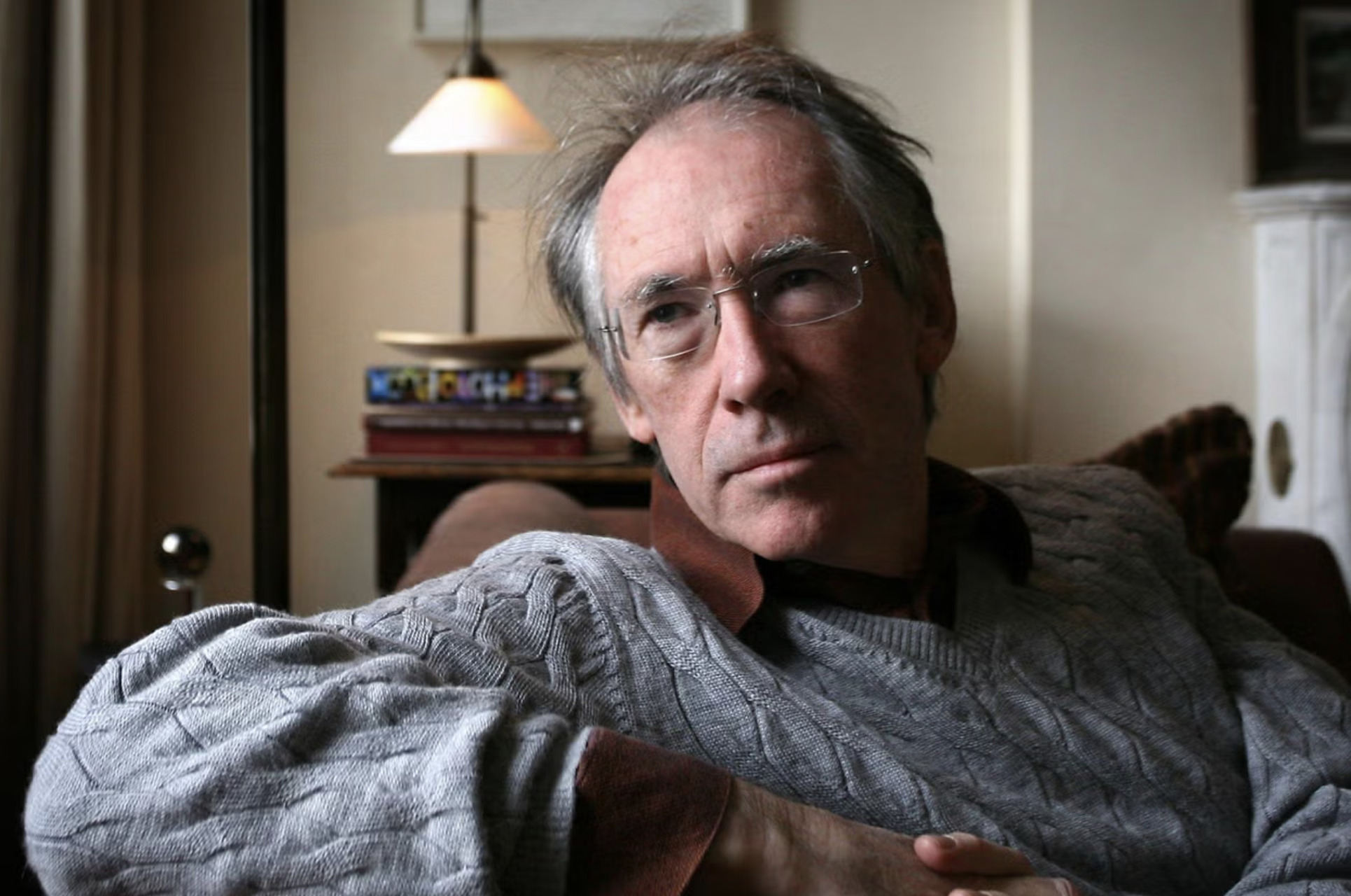
The Englishman Ian McEwan is one of my favorite writers. I have often quoted (see, e.g., here) the following passage from his novel Black Dogs (1993): War involves a “multiplicity, a near-infinity of private sorrows . . . a boundless grief minutely subdivided without diminishment among individuals . . . all those unique and solitary deaths, all that consequent sorrow, unique and solitary too, which had no place in conferences, headlines, history, and which had quietly retired to houses, kitchens, unshared beds, and anguished memories.” Before writing on war, all historians should read these words, as should rulers before declaring it.
Recently I discovered and read another of his many novels--Saturday. (Many of his novels, such as Atonement, have also served as the basis of films). And just as Black Dogs questions the wisdom of much war, so too does Saturday (2006) examine another phenomenon much discussed in modern times--progress.
The novel’s main character (a neurosurgeon Henry Perowne) believes in it. Witness the following: “The teachers who educated Daisy [his daughter] at university thought the idea of progress old-fashioned and ridiculous. In indignation, Perowne grips the wheel tighter in his right hand. He remembers some lines by Medawar [a British biologist and writer], a man he admires: ‘To deride the hopes of progress is the ultimate fatuity, the last word in poverty of spirit and meanness of mind.’ Yes, he’s a fool to be taken in by that hundred-year claim.” Henry recalls one of Daisy’s lecturers depicting “modern life as a sequence of calamities. It’s their style, their way of being clever. It wouldn’t be cool or professional to count the eradication of smallpox as part of the modern condition. Or the recent spread of democracies.” McEwan also has Henry mention “supermarket cornucopias, torrents of accessible information, warm clothes that weigh nothing, extended lifespans, wondrous machines. . . . portable telephones barely bigger than your ear. Vast music libraries held in an object the size of a child’s hand. Cameras that can beam their snapshots around the world. Effortlessly, he ordered up the contraption he’s riding in now [a Mercedes] through a device on his desk via the Internet. The computer-guided stereotactic array he used yesterday has transformed the way he does biopsies.”
Henry Perowne’s belief in progress reminds me of Steven Pinker’s Enlightenment Now: The Case for Reason, Science, Humanism, and Progress (2018). Although there is much to admire in both Perowne’s and Pinker’s belief in progress, my own view is more ambivalent, as I indicated in my 2008 An Age of Progress? Clashing Twentieth-Century Global Forces (AoP?)
Like Perowne and Pinker I am willing to acknowledge much technological progress since the late eighteenth century. But--as I wrote in AoP?--“although significant scientific, technological, and economic progress, as well as expanded freedoms cannot be denied, in other fields the measurement of twentieth century progress (or wellbeing) was more complicated. . . . : Two forces that greatly contributed to twentieth century progress—scientific/technological developments and economic growth—also had detrimental environmental effects. . . . There was little doubt that by 1999 Planet Earth was in worse shape overall than in 1900, with global warming having become an especially troubling problem.”
Although I tried (in AoP?) to present a balanced view of progress--listing both pros and cons--I also wrote that “technological progress greatly outpaced people’s ability to deal with technological change.” And I quoted General Omar Bradley, who stated: "Ours is a world of nuclear giants and ethical infants. If we continue to develop our technology without wisdom or prudence, our servant may prove to be our executioner."
Another motif dealt with in Saturday is that of uncertainty. About a year ago--in The Amazon Prime Series “Expats” and Life’s Uncertainties--I wrote that the series exemplified that “most of us want life to go as we plan it.” But “life doesn’t always proceed as we wish. Besides a major illness and death—two really big unfortunate occurrences and sometimes even disasters—there are many lesser happenings that derail our plans and intentions.”
In Saturday the major uncertain event that occurs is a home invasion--Henry’s house, which he shares with his wife, Rosalind, and his son, 18-year-old Theo, is seven thousand square feet. The perpetrators are a man named Baxter and his accomplice Nigel. Earlier in the day--Saturday February 15th, 2003--the cars of Henry and Baxter had been involved in a non-fatal accident, and Baxter had insisted that Henry pay him cash for some minor car damage. But Henry, suspecting that Baxter was some sort of crook, had evaded his insistence by noting some troubling mental afflictions with him and asked, “Has anyone mentioned Huntington’s Disease to you?” (According to the Mayo Clinic, the “disease causes nerve cells in the brain to decay over time. The disease affects a person's movements, thinking ability and mental health.”)
The home invasion of Baxter is scary. He often holds a knife to Rosalind’s throat and makes daughter Daisy strip--both Daisy and her grandfather (Rosalind’s dad) are visiting from out of town. Henry and his family are not sure exactly what Baxter wants, but his unbalanced mental condition gives them plenty of reason to be terrified.
Both Daisy and her grandfather are poets, and she has just written a book of poetry, a proof copy of which she has with her. After Baxter discovers the copy is full of Daisy poems, he says to her, “Read one. Read out your best poem.” She seems to comply except the poem she apparently reads is not hers, but one she knows by heart from the nineteenth century poet Matthew Arnold. It’s “Dover Beach.”
The sea is calm tonight.
Upon the straits; on the French coast the light
Gleams and is gone; the cliffs of England stand,
Glimmering and vast, out in the tranquil bay.
Come to the window, sweet is the night-air!
Only, from the long line of spray
Where the sea meets the moon-blanched land,
Listen! you hear the grating roar
Of pebbles which the waves draw back, and fling,
At their return, up the high strand,
Begin, and cease, and then again begin,
With tremulous cadence slow, and bring
The eternal note of sadness in.
Sophocles long ago
Heard it on the Ægean, and it brought
Into his mind the turbid ebb and flow
Of human misery; we
Find also in the sound a thought,
Hearing it by this distant northern sea.
The Sea of Faith
Was once, too, at the full, and round earth’s shore
Lay like the folds of a bright girdle furled.
But now I only hear
Its melancholy, long, withdrawing roar,
Retreating, to the breath
Of the night-wind, down the vast edges drear
And naked shingles of the world.
Ah, love, let us be true
To one another! for the world, which seems
To lie before us like a land of dreams,
So various, so beautiful, so new,
Hath really neither joy, nor love, nor light,
Nor certitude, nor peace, nor help for pain;
And we are here as on a darkling plain
Swept with confused alarms of struggle and flight,
Where ignorant armies clash by night.
Baxter’s response to the poem is surprising--we don’t expect it from a little-educated crook like him (and at least one critic faults McEwan for inserting this Baxter response.) The suspected crook, believing Daisy wrote it, says this, “‘You wrote that. You wrote that.’ . . . It’s a statement, not a question. ‘It’s beautiful. You know that, don’t you. It’s beautiful. And you wrote it.’ She dares say nothing. ‘It makes me think about where I grew up.’”
McEwan explains Baxter’s state of mind by his Huntington’s Disease--“It’s of the essence of a degenerating mind, periodically to lose all sense of a continuous self. . . . Baxter has forgotten that he forced Daisy to undress, or threatened Rosalind. Powerful feelings have obliterated the memory.” Such an explanation prepares us--at least somewhat--for Baxter’s following remark, “‘I’m not taking anything else. You hear? Only this. It’s all I want.’ He clutches the book like a greedy child fearing the withdrawal of a treat.”
So as not to spoil the ending for potential readers, I’ll reveal no more about the novel’s ending except to state that the Perowne family survives their ordeal unharmed except for the broken nose of the grandfather, thanks to a Baxter punch.
But life remains full of uncertainties, and there’s always aging and death. Mindful of both, McEwan has Henry go into “the bathroom and undresses in semi-darkness because he doesn’t want to see himself in the mirror—the sight of his haggard face could set him off on a meditation about ageing, which would poison his sleep.” And his mother has some form of dementia and has moved out of her house into assisted living. On one occasion, McEwan has her walk Henry “to a cemetery near her house to show him the rows of small metal lockers set into a wall where she wanted her ashes put. All that’s bound to happen.”
Besides personal developments like aging and death, there are also all the world’s troubles, many of which impact our lives. McEwan’s Saturday imagines a middle-aged doctor standing at a window near the beginning of the twentieth century. “If he had young boys, he could lose them within a dozen years, at the Somme [WWI battlefield]. And what was their body count, Hitler, Stalin, Mao? Fifty million, a hundred? If you described the hell that lay ahead, if you warned him, the good doctor—an affable product of prosperity and decades of peace—would not believe you.”
Writing about the novel, one article states that McEwan’s Saturday, “translates the terrorist attacks [of 9-11-2001] which threatened ‘our whole ways of life’ . . . into the main protagonist’s private experience of momentous change in the reality around him. Perowne’s sense of unease, his repeated misinterpretations of the various situations he finds himself in, converge to form an allegory of a post-9/11 world where disaster is no longer a mere possibility in people’s lives, but a double lining, a virtual reality always at the ready to getting actualised.”
Besides 9-11, there was the 2003 U. S.-led attack on Iraq, which is often mentioned in the book, including the massive British demonstrations against it on 15 February, which often impede Henry as he drives around London. Mindful of the evil actions of Saddam Hussein, Henry at times--e.g., in a debate with daughter Daisy--defends the attack, but on other occasions expresses his doubts.
The crux of the novel is how Henry deals with all these uncertainties that intrude upon him. About a decade ago my “Wisdom, Death, and the Transcendental: Beauty, Nature, the Arts, and Love” suggested that love and the arts were two ways of dealing with life’s chanciness, including death. And love is certainly one way. As St. Augustine once stated, “Love and do what you will.” And Henry deeply loves wife Rosalind and his two children, Daisy and Theo, and he cares for his friends, patients, and colleagues. (See also "Liberalism, Progressivism, and Love.")
Regarding the arts, he realizes he is deficient in this regard. But he appreciates music, often playing classical selections while he operates and enjoying Theo’s blues-guitar music when he goes to hear him perform. He’s even trying to improve his appreciation of novels, following Daisy’s suggestion that he read Tolstoy’s Anna Karenina and Flaubert’s Madame Bovary.
In my “Wisdom, Death, and the Transcendental” I mention Arnold’s “Dover Beach” as one example of a poem that can help us achieve transcendence. Like Baxter, I think “It’s Beautiful.” Beautiful and one gateway towards dealing with the many uncertainties of life.
