




The model for Simon McKeever was a figure right out of the great people’s culture of the 1930s, a decade when the once-mighty movement for a workers’ literature was in full swing
The official release date of Albert Maltz’s third novel was May 9, 1949. Several weeks before that date, the book had already created controversy. Should Maltz, a known “Red” and one of the ten “unfriendly” film industry witnesses before the House un-American Activities Committee, be allowed to earn money in Hollywood? How had he even been allowed to publish a novel? Shouldn’t he be in prison?
These and other questions were addressed on May 24, when The Daily Compass, a New York tabloid specializing in investigative journalism, published its findings. Under the title “Story Behind New Maltz Ban,” the paper reported that The Journey of Simon McKeever had been purchased in April by Twentieth Century-Fox for $35,000. Since Maltz was one of the ten film figures held in contempt of Congress for refusing to state whether or not he was a Communist, there was considerable surprise in film circles. Maltz hailed the transaction as indicating “a change in the policy of the blacklist of the Hollywood Ten by the studios.”
Then, two weeks after it had acquired Simon McKeever, Fox announced that it would not make it. Darryl Zanuck, production chief of Twentieth Century-Fox, had read the book and, believing it highly suitable for the screen, bought it despite the storm that might break around it. When conservative forces in Hollywood objected to the sale, the board of directors at Fox called a meeting. In an unprecedented move, the board voted on McKeever and forced Zanuck to drop it.
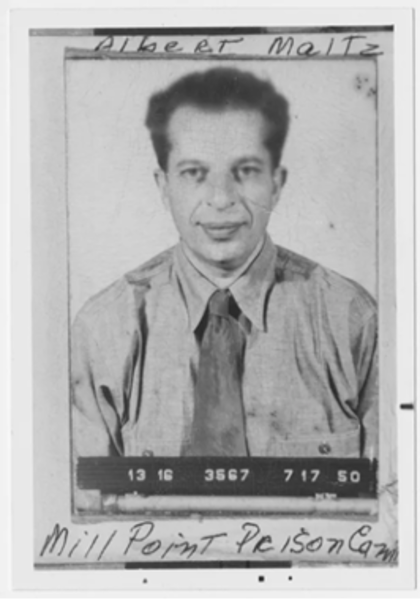 Albert Maltz
In response, a public meeting, organized by Carey McWilliams and sponsored by the National Council of the Arts, was held at El Patio Theater, where thirty-five prominent writers and film personalities stood on the platform with Maltz as he told “the full story of the book banning.” The meeting concluded with a dramatization of McKeever, scripted by Arthur Laurents, with Will Geer as McKeever.
But the well-meaning efforts of Hollywood liberals to restore Maltz’s book to the Fox production schedule backfired, and the lockout against the Hollywood Ten was firmly re-established. “This is obviously the last piece of work any of the Ten will ever sell to a studio,” one film executive said at the time, blithely adding, “until they have won their cases.”
Maltz and his co-defendants did not win their cases. As the Compass noted, the uproar over McKeever only provoked the reactionaries, with grave consequences. Within a year Maltz would go to prison, and it would be twenty years before he would again sell a screenplay. His right to sell books was rescinded as well. He would never place another novel with a U.S. commercial press.
The good news is that The Journey of Simon McKeever is back in print for the first time in 75 years, in a new paperback edition set for U.S. release on January 14. It seems a fitting moment to look back on the strange story of the novel that was, and the film that might have been.
The Journey of Simon McKeever received excellent press reviews, made spicier by mentions of the Twentieth Century-Fox fiasco. New York Times editor William Du Bois dubbed Maltz’s title character a “spunky septuagenarian” and described the book as “always engrossing and, at times, inspiring.” The reviewer also showed temerity, first by weighing in on the argument of Maltz’s famous congressional testimony, and second, by siding with the artist against the Philistines:

Insisting, with others, that un-American activities committees are un-American, Mr. Maltz refused to answer. Anyone who reads Mr. Maltz’s new novel can imagine what Simon McKeever would have bellowed to the same question. Even a picture-story editor would be hard put to find a more representative American than Simon McKeever, or one less likely to overthrow democracy by violence.
For a major U.S. news outlet to defend Maltz was a rare phenomenon during the Second Red Scare. But the notion that Simon McKeever somehow embodied aspects of the national character was shared by many.
Just what type of American did Simon McKeever represent? An immigrant, a soldier, a self-educated manual laborer inclined to think for himself, he is sobered by personal tragedy but remains an optimist and lover of humankind. In the tradition of Walt Whitman, he is a vigorous man of the people who stands up for the poor and despises riches. Nearly 74, he has lived a meaningful life but isn’t ready to surrender, bodily or spiritually. His unwillingness to “knuckle under” is what leads him to assert his independence and, ultimately, to become an artist.
Near the end of his career, Albert Maltz spoke about the origins of Simon McKeever in a series of oral history interviews. As he recalled, on the way home from a week of screenwriting work on a film set in northern California in 1946, he stopped to pick up an old man who wanted a hitch:
In those days I always picked up people on the road because it was a chance to talk with varied persons. And when this man picked up his old-fashioned Gladstone bag and began to walk toward my car, I saw that he was unable to take a step of more than a few inches at a time. His name was William Stevenson, and I didn't know it at that time but I was to write my next novel about him.
He told me that he was running away from an old-age home and that he wanted to get to Glendale, where there was a doctor that could cure his arthritis. We traveled together (and paused for meals) for about eight hours, as I recall, and I found him an absolutely fascinating man.
 Patrick Chura
In journal notes Maltz made while the film controversy of 1949 was raging, he recorded deeper descriptions of Stevenson’s character:
In the many hours we spent together, I came to feel that I was in the presence of the human personality at its best. He was old and ill, but he was vitally alive and unconquerable. He was a militant union man who quoted Debs and saw the world in change and knew that only men could change it for the better. He had labored hard all his life, he was proud of his skills and the usefulness of his labor, but he was keenly aware at the same time that he had been ill-used by our economic system. His solution for that was social change through the efforts of men. He had been a union man all his life and when he got cured of his arthritis he intended to go back to work again and join a union and move the world forward.
The model for Simon McKeever was therefore a figure right out of the great people’s culture of the 1930s, a decade when the once-mighty movement for a workers’ literature was in full swing. In this aging fugitive philosopher, the novelist saw an opportunity.
When Maltz met Stevenson, he’d recently had a public showdown with other socialist writers about the form and meaning of proletarian art. Early in 1946 Maltz published in New Masses the essay, “What Shall We Ask of Writers,” in which he asserted that communist novelists were producing inferior work because they were placing political concerns above artistic ones. For creative writers, Party doctrine was in Maltz’s view “not a useful guide, but a strait jacket.” Essentially Maltz asked that leftist writers be judged by the quality of their works rather than the Party committees they join, reminding fellow Marxists that “where art is a weapon, it is only so when it is art.”
A handful of senior leftist critics immediately and harshly rejected Maltz’s argument in New Masses and the Daily Worker. Under withering attack for being “corrupted by Hollywood,” Maltz recanted his views and wrote a rebuttal to his own “mistaken” article. He was accepted back into the Party fold, but the painful controversy stayed with him.
The Journey of Simon McKeever may be understood as Maltz’s last word in the debate. With this sublime and technically flawless novel, he transcended the intraparty dispute he’d suffered for, satisfying both leftists and literary critics with a story that, in the words of scholar Bernard Dick, “raised proletarian fiction to an art.”
One of Maltz’s key methods was to make intentional reference to elements of perhaps the greatest of all working-class novels, John Steinbeck’s The Grapes of Wrath. In McKeever, Maltz paid homage to the Pulitzer Prize-winning ur-text of the Great Depression, redeploying many motifs from the 1939 dustbowl epic and road novel. The hitchhiking McKeever, who has just freed himself from a shabby state-run rest home, is a wizened version of Tom Joad, the hitchhiker just released from the McAlester prison in the opening chapters of The Grapes of Wrath.
As in Steinbeck’s masterpiece, Maltz’s central characters in McKeever are painfully pushed around by a harsh and unforgiving world but somehow able to spiritually transcend the conditions of their environment. In one chapter, Maltz essentially re-writes the famous ending of The Grapes of Wrath, in which Steinbeck depicts an elderly migrant worker, dying from starvation, who is saved by the selfless gift of mother’s milk from Rose of Sharon. McKeever, his stomach crying out with hunger pains, accepts the identical nourishment of “precious liquid” and “openhearted kindness” from the Cooley family, an act of charity that elicits in him a mystical love for humanity.
Ultimately, McKeever finds something more precious than a miracle cure for his arthritis. He achieves an epiphany that will enable him to bequeath to humankind his hard-won personal truth and thereby “move the world one inch forward.”
Nearly three decades after the publication of McKeever, Maltz’s affinity for Steinbeck led to another opportunity. In the mid-1970s, Jane Fonda made no secret of her search for a film role that would cap her father’s long career and put him in contention for the Best Actor Oscar he had yet to win. Henry Fonda had come close to winning the award only once. At the 13th Academy Awards of 1941, he was nominated for his role as Tom Joad in John Ford’s film version of The Grapes of Wrath.
Siezing the moment, Maltz got in touch with the Fondas and sent them a copy of McKeever. Henry read the novel and loved it; hearing in it the echoes of Joad and Ford. On November 11, 1976, he wrote with news that must have helped Maltz exorcise some of the trauma of spending ten months in prison and twenty years on the blacklist:
Dear Mr. Maltz,
I can’t tell you how excited I am about Simon McKeever. I don't wonder that [Walter] Huston and [Spencer] Tracy both wanted to play him. I think he's a delightful old fart, and I mean that only affectionately.
You can uncross your fingers. I am involved.
Cordially,
Henry Fonda
The Simon McKeever film project, starring Fonda with a cameo by Jane Fonda as the Glendale doctor, was announced. But the 72-year-old leading man fell ill, progress stalled, and the chance passed. Devin McKinney's recent biography of Fonda describes the unrealized ambitions of the actor’s last years. Among the projects with strong potential was The Journey of Simon McKeever. The biographer’s certainty that Simon “could have been a great Fonda character” makes the loss more regrettable. Soon after the Fonda deal fell apart, Maltz made a last-ditch attempt, writing to Burt Lancaster to ask him to consider the role. “In 1949 Walter Huston was excited about playing it and used to go around to parties reading aloud from the book,” Maltz explained, “but the blacklist stopped the film from being made.” He added, “In 1966 Spencer Tracy wanted to play it, but unfortunately he died.” Maltz then shared an opinion first held by Darryl Zanuck: “I believe the character of McKeever offers such opportunities for an actor that the one who plays it will automatically become an Academy Award contender.”
Maltz and Zanuck were probably right, and it makes one wonder. If Henry Fonda had been able to play McKeever in ’77 or ’78, he’d have won his overdue Oscar and probably thanked Maltz in his acceptance speech. With that bucket-list item checked off, perhaps moviegoers wouldn’t have been treated to what the New York Times called the “processed American cheese” of Jane Fonda’s exhibitionist Chelsea Thayer and her cantankerous father Norman, played by Henry, in On Golden Pond. This was the role that won Fonda his Best Actor Oscar in 1981.
Nothing against On Golden Pond, a certifiably tear-jerking father-daughter film in which the actors play themselves—except for the fact that it ended up substituting for McKeever, the work of an artist who deserved a win.
There would have been a different kind of pathos in the decisive scene of Maltz’s film, between the Glendale doctor that Jane was scheduled to play, and Henry Fonda’s Simon McKeever. Here is the altruistic empathy of Jane, who welcomes into her home and examines a stranger in pain who had knocked on her door in the middle of the night:
I’m sorry, Mr. McKeever, I’m terribly sorry, but there are no injections that can help you. There is nothing known in medicine now that can either prevent or cure your condition. It’s the work you did, and your age.
His mind fought to keep him proud before this stranger, . . . then he swallowed and said, ‘A life without happiness wouldn’t be a good life at all, would it? But I guess a life without disappointment wouldn’t be real.’
Whether or not the seemingly cursed film version of The Journey of Simon McKeever is ever made, Maltz’s final plea in his letter to Lancaster makes a superb case for the new edition of the long-neglected novel: “I want to stress that the story is not about the problems of old people in our society. It is an adventure story that celebrates man’s courage, and determination, and life force, at their highest.”
