




For all its global sweep, the book is also deeply personal. Applebaum writes with a mournfulness that gives the book its emotional power.
Anne Applebaum’s Twilight of Democracy: The Seductive Lure of Authoritarianism is, at its core, a study of how intelligent, articulate, and once-democratic people drift toward illiberalism—and how that drift reshapes political life in nations we once assumed were stable. Written with the precision of a historian and the sadness of someone watching old friends transform, Applebaum’s book feels even more urgent today than when it was published.
Her central argument is deceptively simple: authoritarianism doesn’t arrive through tanks, coups, or generals anymore. It arrives through clerks. The 'clerks,' in Applebaum’s framing, are the journalists, political strategists, television hosts, intellectuals, and social-media influencers who willingly translate the ambitions of would-be autocrats into narratives, policies, and emotional identities for the public. These are not fringe actors; they are people who were once part of the same democratic circles Applebaum inhabited. What becomes chilling is her description of how quickly and completely many of these individuals embraced a worldview built on resentment, nostalgia, and conspiracy.
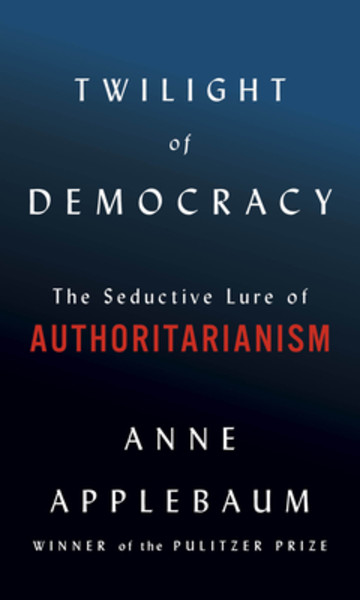
Why do smart people—people who once believed in democratic values—slide into authoritarianism? Applebaum offers several explanations, and each feels recognizable in our own political moment. Some are driven by resentment: the belief that they have been slighted, undervalued, or displaced by cultural or political change. Others are seeking certainty in a world that feels increasingly complex, valuing the comfort of rigid ideology over the messiness of pluralism. Still others are seduced by belonging—the intoxicating pull of being part of a tight, loyal group with clear enemies and unwavering purpose. Once inside these movements, the reward structure is powerful: access, status, media attention, and the emotional thrill of perceived righteousness.
Applebaum also argues, convincingly, that democratic decline is not primarily ideological—it is emotional. The authoritarian narrative taps into deeper longings: for simplicity, for order, for a lost (often imaginary) past where roles were clear and uncertainty was minimal. She sees this in Poland’s nationalist turn, in Hungary’s media capture under Orbán, in the Brexit movement’s fantasies of restored British sovereignty, and in the United States’ plunge into Trumpism. Each example shows how elites—people with education, networks, and influence—became evangelists for an illiberal politics they once would have rejected.
This is where Twilight of Democracy becomes genuinely useful for readers today. Applebaum does not describe a sudden collapse of democratic norms; she describes a slow, steady erosion fueled by people who know exactly what they are doing. Democracies do not fail because dictators rise. They fail because educated, credentialed individuals choose to help them rise.
For all its global sweep, the book is also deeply personal. Applebaum writes with a mournfulness that gives the book its emotional power. She is grieving the loss of friendships, the fragmentation of intellectual communities, and the fear that her children will inherit a world far less open and democratic than the one she believed she lived in. That vulnerability is part of what makes this such a compelling work—it is not detached analysis but a witness statement.
Ultimately, Twilight of Democracy is not simply about politics. It is about human nature. It asks us to confront the uncomfortable truth that authoritarianism’s appeal is not confined to the uneducated or uninformed. It can flourish among the highly educated, the ambitious, and the socially connected. It grows when individuals choose identity over integrity, belonging over truth, and power over principle.
For anyone trying to understand our current moment—or trying to prevent the next fracture—Applebaum offers clarity and warning in equal measure. Democracies do not fall overnight. They dim slowly, twilight first, and only then darkness.
