




The lack of integration of “special economic zones” with national development plans leaves a majority of poor countries’ populations mired in unemployment
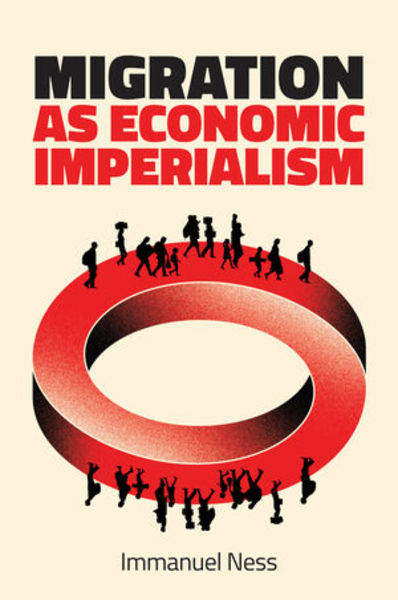
A review of Migration as Economic Imperialism, by Immanuel Ness (Polity Press, 2023)
The problem seems familiar, from news reports of migrant shipwrecks on the Mediterranean and Atlantic, Border Patrol agents and Texas Rangers brutalizing asylum seekers on the Rio Grande. And we know how NAFTA (the North American Free Trade Agreement) allowed US agribusiness to force Mexican farm workers off their land when they could not compete with heavily subsidized US food products or “more efficient” agribusiness methods. Most of us understand that the influx of Mexican job seekers came to find work.
We’re also aware of war refugees—millions of displaced persons flooding out of West Asia, the African Sahel, and Central America, desperately groping for survival after Western militaries tore up their countries to save them.
At least informed and fair-minded people have this awareness. But many people fall for the rightist rhetoric about “illegal aliens invading and stealing our jobs.” It has become politically fashionable in both the US and western Europe to scapegoat the most desperate victims of economic crisis, while continuing to implement the policies that cause the problem.
These images of desperation are shown to be the tip of the iceberg in Migration as Economic Imperialism. Immanuel Ness explains how modern labor migration “perpetuates a global system of economic imbalance, poverty, dependence and the growth of precarious labor.” It is a malignant outgrowth of neoliberalism – a set of policies that impose austerity by privatizing and often eliminating essential public services, like health, education and other essential infrastructure. In the countries of the Global South, these policies are reinforced by the IMF and World Bank, through “structural adjustment” loans that wipe out possibilities for true economic and social development.
Governments across the Global South compete with each other for whatever they can get from multinational corporations—racing to the bottom with low taxation, minimal regulation governing labor and environment, logistics and transport facilities, and much more. Union rights are nearly non-existent, and impoverished workers compete for miserable wages without health benefits or safety protection.
The lack of integration of “special economic zones” with national development plans leaves a majority of poor countries’ populations mired in unemployment, desperate to go anywhere they can find a job, under whatever circumstances. The neoliberal policies also strangle subsistence agriculture in favor of extractive agribusiness, driving millions of peasants off the land, into the slums of over-crowded cities. They become ready and willing to accept any opportunity to work under whatever conditions, hoping their meagre pay in a receiving country will make it possible to send money home to help their families.
Ironically, for the multinational companies and their governments, the migration of these millions of desperate people has tangible benefits—but not for the migrants themselves. Ness writes: “The emergence of remittances as a source of foreign exchange for economic development… has been extolled by the leading international development agencies, including the IMF, World Bank, and free-market advocates.” Remittances have emerged as “a form of economic development in poor countries,” a replacement for significant amounts of foreign aid and private foreign investment. That’s true even though the UN Development Programme (UNDP) reported in 2009 that while remittances “may improve conditions for some,” they “should not be considered as the only path for national development.”
The UNDP viewpoint, as distinct from that of the dominant neoliberal banks and institutions, gives attention to the human side of development, that is, the people who migrate in search of work, and accept whatever miserable conditions are available. For the banks and employers these people fill a need, and are disposable. Their disposability is the problem – both in their countries of origin and the countries they migrate to. Ness writes that “precisely because migrant workers are not granted legal residency, employers… flout wage and occupational safety laws. Migrant workers are constantly at risk of arrest, incarceration and deportation…”
Ness adds that “the socio-economic contribution of migrant laborers to the North American and European economies is downplayed…, yet agriculture, construction, care industries and, more recently, the gig economy would cease to function efficiently without them.” He adds that “it was migrant workers who were enlisted to remove the wreckage after the 9/11 attack in New York, and they have rendered indispensable service during the Covid-19 pandemic.”
Migration by the numbers
In 2019, the UN reported 740 million “internal migrants,” chiefly urban populations residing in urban areas on a temporary basis. There are 281 million “international migrants,” of whom 164 million are temporary migrant workers and the rest are refugees, as estimated by the International Organization for Migration (IOM), an institution which monitors, analyzes and advises governments on migration issues. Global migration increased 45 per cent from 150 million in 2000 to 281 million in 2020, and continues to grow. During that period global international remittances have ballooned from $126 billion to $689 billion (US dollars), a growth of nearly 550 percent.
For perspective, the total of 281 million international migrants constitutes a virtual country population, ranking in size after the United States and ahead of Indonesia and Pakistan. The number may be less important than what it signifies – that “migrant laborers, as never before, are a vital force in global imperialism, and their number has grown rapidly as international capital demands workers to fill essential jobs.” Wherever migrant workers are located, they are a factor not only in their role in production and services, but also as a source of downward pressure on the overall cost of labor. And for their countries of origin they are part of a lost pillar of labor supply for human and national development.
Ness writes that “labor migration is a form of extending the extraction of resources from countries in the developing world.” It “continues the legacy of extraction of natural resources and agriculture” from these countries. And the 740 million “internal migrants” are a reflection of the lack of internal economic control in the poor countries – a waste of resources caused by the lack of productive investment for internal development. This could change, but it would require ending the neoliberal, market-oriented stranglehold that keeps the poor countries poor.
As examples, we can look at India and Nepal. Ness says “more than 90 per cent of all Indians do not have secure work and are compelled to work in the informal sector at low wages without health and pension benefits.” India has a population about equal to China’s, but its development lags far behind China. “Most Indians live in rural areas and urban slums where basic services are inaccessible.” A number of India’s highly skilled migrant workers are educated to travel abroad, working in IT and engineering. “It is astonishing how dependent India is on highly skilled migrant labor for its development. In 2021 alone, remittances to India accounted for US$89 billion, and 15.5 percent” of the country’s half trillion dollars of reserves. But “far more Indians migrate abroad to fill low-skilled jobs in the Arab Gulf, working in construction and domestic labor.” So most of India’s migrant workers “do not have the capacity to generate remittances” to help their home communities.
For Nepal, a mountainous country of 30 million that neighbors India, migrant remittances are the major source of foreign exchange. In the first two decades of this century, remittances have exploded from 2 to nearly 30 percent of the country’s GDP. Visitors to Kathmandu, Nepal’s capital, “notice a stark absence of services… such as public transport, motorways, streetlights and amenities common to most capitals” in the region. “The business districts are dominated by recruitment agencies, banks and ATM machines, vocational training schools, tourist firms catering to foreigners…” The country’s dependence on remittances “has not translated into economic development… The country has yet to spend remittances on building schools, healthcare facilities, transport or major development infrastructure.”
Post-war examples
Vietnam and El Salvador provide examples of the role of migrant labor following US wars. After the US withdrawal in 1975, Vietnam’s population doubled from slightly less than 50 million to 100 million in 2024. That’s positive in terms of the country’s optimism after a devastating three-decade war of liberation. But its leaders faced enormous challenges, especially in the wake of the Sino-Soviet split in the 1970s and ‘80s, and the collapse of the USSR in 1990. When they turned west for help, the IMF and World Bank pushed Vietnam to adopt neoliberal reforms, prodding the state to privatize government agencies which provide services. Ness found that these public agencies set up private divisions to profit through charging migrant workers fees for identifying jobs overseas, providing loans for travel and visa processing. It’s not really a development program, rather a “safety valve” remedy for impoverished workers from several dozen rural districts in the country.
“The IMF and World Bank-imposed privatization of state-owned enterprises has enriched the migrant brokers and recruitment agencies… without tangibly improving the impoverished economic status of migrant workers,” Ness writes. The migrants “left Vietnam for low-wage jobs in Malaysia and beyond, only to find themselves returning home indebted…” Their low-wage international migration “tends to intensify poverty through detachment from family and community, as the time away severs cohesive family and social relationships.” The disruption “has only exacerbated poverty and postponed its alleviation in Vietnam’s poorest districts.”
Overall from 2000 to 2020, Vietnam has had rapid growth, with GDP surging from US$390 to US$2,786 according to the World Bank. This has depended on integration into the globalized economy, with foreign direct investment to produce commodities and parts. Ness observes that “remittances from foreign workers have had negligible benefits to Vietnam’s national development but have operated mainly as a safety valve for workers who cannot find employment.” But over these two decades foreign remittances from migrant workers have grown from 4.3 percent to 6.3 percent of the country’s GDP. In 2023 Vietnam’s national leadership has rebuilt ties with China, which may help to re-balance its economy.
The story of El Salvador is more worrisome. Ness writes that “Salvadorans are the second-largest immigrant population in the United States, only superseded by Mexicans. From the 1980s to the present, Salvadorans have left El Salvador to flee war and, more recently, systemic crime. In this way, migration did not emerge as an intentional development strategy but arose from conflict, the deficiency of living-wage jobs, and absence of social welfare and the unrelenting systemic crime and violence which ensued.” Since the end of the Civil War in 1992, El Salvador’s economy transformed “from export of coffee and cash crops to the export of migrant labor.” Over the past two decades, a third of the 6.5 million Salvadorans has migrated, mainly to the US, for work and settlement. Remittances from the US are the largest source of GDP.
El Salvador has a shortage of workers in all areas. Ness says “the primary beneficiaries of the migration economy are the US economy, which benefits from low-wage workers, and the Salvadoran oligarchy, which profits from controlling remittance spending and displacing class conflict away to low-wage and informal workers and their families.” He adds that “separation of families is a contributing factor in the rise of crime and gang violence in El Salvador, Guatemala, Honduras and other countries highly dependent on migration. For families and communities in origin countries, the social and economic costs of separation, social dislocation and reintegration far outweigh any economic benefit of remittances, which are almost exclusively spent on food and consumer goods.”
Fighting against rejection, and for survival
“Public perceptions,” writes Ness, “do not reflect the reality that migrants are overwhelmingly beneficial to the economics of destination states which are experiencing declining populations and labor shortages.” Noisy politicians and other racists have fostered images of migrants as “an economic, social and violent threat” to receiving societies. Recognition of responsibility – let alone solidarity – tend to be in short supply.
“The failure of the United States to develop a comprehensive temporary migration regime has intensified insecurity for migrants crossing militarized borders and subject to arrest, detention and deportation,” Ness writes. But it doesn’t stop the migrants, or convince them to leave. In fact, he says, “US national policies to deny entry to migrant laborers have the contradictory outcome of creating permanent undocumented workers. Most undocumented migrants risking entry into the United States are sheltered by their social networks, home-town associations and sanctuary cities which welcome foreign workers as a source of low-wage labor.”
Much the same is true for many migrant workers from the Middle East (West Asia), North Africa and sub-Saharan Africa, who do not have legal status in Western Europe.[1] The EU “has only permitted labor mobility among Europeans who reside in the Schengen Area,” which includes 23 of the 27 EU member states, as well as Iceland, Liechtenstein, Norway, and Switzerland. So irregular low-wage migrants from countries south and east of Europe “risk their lives travelling to highly securitized European states without documentation” – and thus “under continuous threat of deportation, even though they fill essential jobs…” It turns out that “when border controls increase, temporary migrant workers continue to travel and work in Europe.”
So restrictions on migration to destination countries “do not correspond to reduced migration to Europe but rather to higher levels of unauthorized migration, as those in Europe tend to stay rather than return.”
As part of his conclusion, Ness writes that “it is essential to advance the rights of international laborers, many of whom are fleeing poverty and violence instigated by imperialist rivalries…” I would add it’s also essential for labor unions and solidarity activists to intervene on behalf of migrants based on our own interests. Wages will continue to fall, and union rights will erode, as long as companies can force desperate people to work in semi-slavery. And of course, the fundamental solution to this global migration crisis will be defeating neoliberalism and imperialism, so the poor countries can launch realistic and equitable national development.
There is reason for hope. The people of Palestine are showing that a united and resolute popular resistance can defeat colonialism. And China’s Belt and Road Initiative, which is helping to foster non-colonial development in countries across the Global South, is pointing the way to collective prosperity and a shared future.
[1] Also see Hannah Cross, “Return of the Atlantic Route from West Africa to Europe: Imperialism and Regional (De-)Integration,” in Monthly Review, May 2024.
