

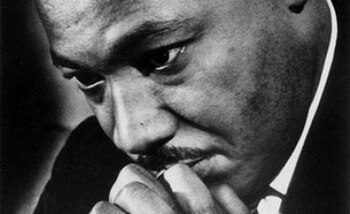
“‘We Have Woke Up’”

Given the persistence of racist violence, what made a child born in a deeply, violently racist society group up thinking he could change it?
Johnathan Eig’s King: A Life, Part I
In King: A Life, author Jonathan Eig’s newest biographical study of Dr. Martin Luther King Jr., recounts the story of a visit through the South taken by none other than writer James Baldwin, a son of Harlem, but a longtime resident of Europe, particularly Paris. It’s 1957 and Baldwin had an interest in discovering not just about the contrite South, but rather the soul of a nation, which, he surmised, refused to “take a ‘hard look’” at itself. He wanted to know more about this American, the one that would rather maintain its obsession with white supremacy.
“‘What it comes to, finally, is that the nation has spent a large part of its time and energy looking away from one of the principal facts of its life. This failure to look reality in the face diminishes a nation as it diminishes a person,’” Baldwin wrote. America is a nation in fear of looking at itself in the mirror, and, as a result, Baldwin ends his visit with a warning: “‘If we are not capable of this examination, we may yet become one of the most distinguished and monumental failures in the history of nations.’”
In that same year, Eig writes of a “similar thought” shared by Dr. Martin L. King Jr. who decided to embark on a six-week trip to Europe and the Middle East, ending up in India. On this visit, King, too, hoped to discover “more about Gandhi and gain a perspective on how nonviolent tactic could help America avoid the monumental failure Baldwin described.” Then, just, maybe, he, King, could do something about it!
This is the King who will understand something about America after Reconstruction. It’s an America, living in the shadows of slavery, and, for the most part, unrepentant. In fact, it’s an America that to this day would prefer to pretend no such contradiction to the idea of a democratic society was ever threatened by the conquest and enslavement, both serving as America’s foundation. In violence! Given the persistence of this violence, Eig is prompted to ask: “‘What made a child born in a deeply, violently racist society group up thinking he could change it?’”
King, as Eig writes, born and raised on Auburn Avenue in Atlanta, a neighborhood that was considered to be “the richest Negro street in the world,” he was still a Black man in America. Despite originating from a “loving” and “stable” Black family, King was still Black in America—an America deeply indebted to the ideology of white supremacy.
As a child growing up in “an urban church,” one, Eig writes, that believed in blending “prayer with calls to attention,” Daddy King considered racism to not merely be “wrong but evil, corrosive to the soul.” He, in turn, made sure his son would be made aware that Black lives mattered because the God of both father and son was one who “believed that Black people mattered no matter what racist white people and government regulations said.” As a result of that teaching at Ebenezar Baptist Church, the future civil rights activist recalled in his autobiography, “An Autobiography of Religious Development,” what would become “‘real’” and “‘precious’” to him: the lessons on “morals” and “ideas.”
The idea that the achievements of Blacks such as Marian Anderson, Jesse Owens, as well as a local Black man, the owner of a gas station on Auburn Avenue and manager of the city’s leading Black baseball team, mattered challenged the morals of racist policies. As Eig points out, while Black Americans made progress, America’s racists policies directed at limiting the mobility of Black lives was (and still is) a presence in the lived experience of Black Americans. It wasn’t long before those lived experiences in general became specific experiences of racism in King’s life.
Public swimming pools were off limits to Blacks. So were public parks. As a young child, Eig explains, King understood that he wasn’t allowed to swim in public pools. Or play in public parks. He would no longer be allowed to play with white children, after a certain age. The white child broke the news to a young Micheal: he could no longer play with him because of “the color of M. L.’s skin.” This was the event, King wrote, that made him aware of “the existence of a race problem.”
From King’s autobiography, Eig cites other accounts of the lived experience of racism the King faced while growing up. It wasn’t long after King secured a paper route for The Atlanta Journal that a white man called him the “n” word. “‘I’m not a nigger,’” King replied. As Eig notes, King soon lost his paper route.
On another occasion, when his father is stopped by the police for “running a stop sign,” the officer called Daddy King a “boy.” On yet another occasion, King recalled shopping for shoes with his father at Rich’s department store when a clerk comes to where father and son are sitting and asks that they remove themselves. They were sitting “in the area reserved for white customers.”
“‘We’re comfortable in these seats,’ Daddy King replied.”
The clerk, once again, told the two to move, and Rev. King told the clerk that if we can’t sit in these seats, then we “‘just won’t buy any shoes.’” The two left the store!
Daddy King taught his son that “evil things” should be fought. In turn, as King noted in “An Autobiography of Religious Development,” there was “a sense of somebodiness within us that always kept us moving toward the sense of dignity and self-respect that any human being should have.”
With Daddy King as father and teacher the younger King, Eig notes that, is “equipped” for oratory mastery by his teen years. but he must pass through a few years in his teens when he wanted nothing to do with his father’s profession. In fact, King wrote that he told his family that he preferred “something more ‘intellectually respectable’ than a preacher.” Maybe a doctor? A lawyer?
But the fifteen-year-old King entered a public speaking contest for Black high school students, traveling 140 miles from Atlanta to Dublin, Georgia, in the company of another student and teacher to deliver the speech. King, adds Eig, showed no “fear of standing on a stage” and speaking since he spent hours practicing as a soloist in his mother’s choir.
When King spoke, he recalled America’s history of enslaving Africans and their descendants:
“‘Negroes were first brought to America in 1620 when England legalized slavery both in England and the colonies and America… The institution grew and thrived… on the backs of these Black men. The empire of King Cotton was built, and the southland maintained a status of life and hospitality distinctly its own and not anywhere else.’” Eig writes that King cited the “promise of the Emancipation Proclamation and its pledge of freedom.” Then King continued: “‘Black America still wears chains… The finest Negro is at the mercy of the meanest white man.’”
On the one hand, King’s speech, Eig suggests, served as a “blueprint” for his future “I Have a Dream” speech, complete with “the use of metaphor, the tone of moral authority, the fast flow of concrete language, and a conclusion that insisted optimistically on change.” Years later, Eig writes, Dr. King would bragged that he won the contest. Unfortunately, however, most of what he delivered that day was lifted from a speech by Henry F. Coleman. “The Philosophy of the Race Problem” won Coleman, “the son of formerly enslaved parents and a junior at Cornell College in Iowa… a statewide intercollegiate speaking contest in 1910.” The speech was reprinted in “a 1928 book” of collected contest speeches, so the young King would have easily come across the book at his high school library. Young King is reading; however, it’s the first time but not the last when he helps himself to the words of someone else.
On the return from Dublin, Georgia, 80 miles outside of Atlanta, the bus with King, his classmate and teacher was stopped. “The white bus driver ordered King and his classmate to give up their seats to oncoming white passengers.” When the two young teens didn’t move fast enough, as King recalled in “An Autobiography of Religious Development,” the driver called them the “n” word and “‘Black sons of bitches.’” King recalled thinking, Eig writes, that maybe he didn’t count. Maybe he was a “‘nobody.’”
Working to become a “‘profound advocate of the social gospel’” at Crozer, the Reverend King would go on to deliver speeches, Eig points out, “that made racial justice sound like an imperative for all, for both sides of the racial divide needed to act.” But as a student of ideas and morals, he studied
“Plato, Aristole, Rousseau, Hobbes, Bentham, Mill, Nietzsche, and Marx. As for Marx, King expressing his doubts about the “fairness of capitalism,” writes Eig, thought communism had its problems too. Troubled by communism’s “secular” and “materialist” foundation, King believed, instead, that history was guided “by the spirit, not by matter.”
King received his Bachelors of Divinity degree from Crozer Seminary, King wins a scholarship to attend the predominantly white and historically Methodist Boston University. Daddy King, writes Eig, reluctant at first, finally agreed to “pay all of M. L.’ s graduate school expenses not covered by the scholarship.” King’s ambition was to study with Edgar S. Brightman whose “philosophical understanding of the idea of a personal God” interested someone wanting to learn about deity, “not impersonal” and not one “lacking human characteristics.” As Eig explains, personalists understand God as a “loving parent,” and His children as “subjects of compassion.” A universe made up of “persons,” therefore, is one in which “all personalities are made in the image of God.” King’s future “indictments of segregation and discrimination,” Eig points out, will be influenced by this belief in “personalism.”
On June 11, 1950, King and a friend, Walter McCall, drove to Mary’s Cafe, a tavern in New Jersey. McCall’s girlfriend and her roommate joined them. It was after midnight, writes Eig. The group asked for two bottles of beer and four glasses. The bartender, a German immigrant, refused to serve the young people. It was against the law, the bartender informed the group, “to sell packaged liquor on Sunday or any day after 10:00 pm.” McCall asked for a draft beer, and, again, the bartender refused. What about a ginger ale? No, said the bartender.
Growing angry, the bartender drew a .45 from its hiding place, and, while the group of young people watched, he steps outside and fires the gun in the air. Returning to the bar, be begins cursing the young people who immediately flee the scene. King, McCall, and the women stopped at a local police station to file a complaint against the bartender “for violating New Jersey’s antidiscrimination laws.” The local chapter of the NAACP represented them, and their story made the front page of The Philadelphia Tribune.
Surprisingly, the bartender was “found guilty and fined $50.” writes Eig, but when customers refused to testify against him, King and his friends were forced to drop the charges of discrimination. Nonetheless, as Eig points out, this incident is Rev. Dr. Martin L. King’s first introduction to the “‘civil rights struggle.’” As an activist! And the incident of racism takes place in the North, among northern liberals. Later, King considered the incident a “sit in,” a painful test of “northern liberalism.”
Rev. Dr. Martin L. King, Jr., the newly appointed head of the Southern Christian Leadership Conference (SCLC), gave an interview to Baldwin. Citing Baldwin’s article for Harper Magazine, “The Dangerous Road Before Martin Luther King” (1961), an account of this interview, Eig writes that the writer was impressed King, the leader. Baldwin wrote that he found in King a man who showed no trace of “‘self-importance’” or of “‘hideous piety.’” Baldwin described King as “‘not like any preacher I had met before. For one thing, to state it baldly, I liked him… King is immediately and tremendously winning…’”
When King preached at Dexter Avenue Baptist Church in Montgomery, Alabama, Baldwin was in attendance. The writer “felt something there he had never felt before in a church.” The parishioners recognized in King “‘the symbol of their struggles,’” and Baldwin watched and observed as King and the parishioners “‘became one.’” Baldwin, cites Eig, added, “‘The joy which filled this church, therefore, was the joy achieved by people who have ceased to delude themselves about an intolerable situation, who have found their prayers for a leader miraculously answered, and who now know that they can change their situation, if they will.’”
Somewhere in Union Spring, Alabama, Eig notes, a grocery store worker smiled and said, “‘We the Negro people are now not afraid… We have woke up.’”
End of Part I
