

White People in Shakespeare


We know that Whiteness is a problem because of the rationalizations and excuses White people make when they defend it.
Arthur L. Little, Jr., a Shakespeare scholar and frequently-cited critical race theory (CRT) contributor, likes provocative titles (see Shakespeare Jungle Fever). In his new book, White People in Shakespeare, Little, an associate professor in UCLA’s English Department, has wrangled a prestigious class of scholars, cultural critics, and theater professionals, each of whom grapples with a formidable ghost: William Shakespeare.
A figure of transcendent literary and profound cultural significance—we feel smart just invoking his name—Shakespeare is an ethereal specter, an eminence blanc whose poetry and plays have, over the past half-millennium (give or take), been mined, refined, packaged, and presented as part of a global enterprise intended (largely successfully) to spread, support, manufacture, market, naturalize and normalize Whiteness and White supremacy.
In “An Aristocracy of Skin,” White People in Shakespeare’s Introduction, Little—who loves Shakespeare warts and all—talks about Shakespeare’s role in “white-people-making”:
White People in Shakespeare isn’t about a Shakespeare or a long list of Shakespearean characters who happen to be white; rather, it examines how Shakespeare’s poems and plays actively engage in “white-people-making” and how white people have used Shakespeare to define and bolster their white cultural racial identity, solidarity, and authority. Shakespeare’s “white skin” has been staring us in the face, literally giving shape and depth to the “human” face for more than 400 years, but relatively little critical attention has been paid to either Shakespeare’s role in the making of white people, or white people’s making, celebrating, and weaponizing a white Shakespeare.
The book’s 19 essays and transcribed conversations address that attention gap, so it is not surprising that White People in Shakespeare has been poorly received in the Conservative realm. You won’t find it on the shelves of the public library in Ronald Reagan’s shining city upon a hill because its core question is, How do you solve a problem like William? Or more precisely, like William’s Whiteness? How, when so many argue so fervently that not only is Whiteness not a problem, it is a blessing to mankind, one that should be preserved, protected, and defended? How, when so many (I’m looking at you Ron DeSantis) are willing to suppress the mere mention of the idea that Whiteness might be a problem? How, when so many (I’m looking at you Donald Trump, Boris Johnson and Steve Bannon) are willing to repress and oppress anyone who proposes a fix for something that, at least to them, is so clearly not broken?

Yet notwithstanding the resistance and resentment of those who benefit directly and indirectly from keeping the status of Whiteness quo and who therefore resist change mightily, violently, and even lethally, Whiteness (and White skin, which functions symbolically as a robe signaling superiority and privilege) is a problem, one that has disfigured the world and broken America. Little alludes to the seriousness of the problem and its real world consequences in his book’s first illustration: a photo of an angry, White mob—intent of reclaiming privilege they feel has been taken away—storming the US Capitol on January 6th, 2021.
We know that Whiteness is a problem because of the rationalizations and excuses White people make when they defend it among which are (most of these are variations of “it’s not me, it’s you”):
You’re being too sensitive.
You have no sense of humor.
You’re being politically correct (which is what White people assert when they can no longer say with impunity whatever they want whenever they want to whomever they want).
You’re judging 16th century poems and plays by today’s standards. (This is facile. We may understand Whiteness differently today than it was understood in 1592, but as White People in Shakespeare demonstrates, White supremacy and the primacy of White skin were well established by the time Will entered the world.)
We know Whiteness is a problem because of the vehemence and fury with which White people deny it is a problem.
We know Whiteness is a problem because of the vehemence and fury with which White people deny it is a problem. Feeling threatened, they insist that race is much ado about nothing, but in places where Whiteness dominates, anyone who is not White will attest that race is much ado about everything.
Still, William the man was not nearly the problem that Shakespeare the icon, the idol, the apotheosized literary god is. Difficult as it is to separate the medium from the message, William the scribbler, actor, theater owner, and producer was merely the messenger. It was his transcendent genius infusing the medium—the poems and plays—that carried the White news as it percolated through first the culture of England, then the world, staining, corrupting, and polluting whomever and whatever it touched, wreaking havoc whenever and wherever it landed on whichever colonial shores.
CRT began as critical legal studies, a discussion among legal theorists initiated by the lawyer and legal scholar Derrick Bell, who was writing about the justice system’s being manipulated to maintain racial unbalance. It spread from law to psychology and psychoanalysis, sociology, English and Shakespeare studies, and stage and film production and performance.
Mainly mining the early modern period—the years 1400 to 1800—CRT is an attempt to unmask and excavate Whiteness. But CRT miners must deal with an additional layer of difficulty, having provoked defensive reactions from White members of bastions erected on foundations of Whiteness—law, government, and finance. Additionally, academics who write about CRT meet active resistance from other academics, those who have embraced Whiteness as a career path, leading them to reject ideas whose implications threaten their stations. (This is among the things that make publishing White People in Shakespeare so brave: Little puts his name on the cover of a book that insists there’s a problem with Whiteness in America—and by extension the world. He names the problem, identifies it as something that needs fixing, and indicts an icon, criticizing the literary god who was and is a major contributor to that problem. In doing so, he infuriates the forces of Whiteness in his own department and university who control his working conditions, promotions, and raises.)
[Trigger-warning: White People in Shakespeare’s essayists occasionally use terms specific to critical theory, i.e. “epistemology,” with which most lay readers (of which I am one) will be unfamiliar; definitions of some of these can be found in LAProgressive.Com’s glossary, others in Wikipedia. Lay readers might do better to first read the book’s second, more accessible part, tackling the first part second. Reading White People in Shakespeare required more effort than the murder mysteries that are my usual fare, but the juice was well worth the squeeze.]
America’s traditional anti-intellectualism throws knee-jerk shade on any academic discourse that gets publically disseminated.
America’s traditional anti-intellectualism throws knee-jerk shade on any academic discourse that gets publically disseminated. Yet despite “it’s only academic” being a put-down and mandatory ridicule of professors as absent-minded, bumbling dwellers of ivory towers—note the color of those towers—critical theories from all disciplines often result in practical consequences. For instance, one effect of CRT is the movement to “color blind casting,” which ignores race when giving roles to actors.
“Raced” casting overlapped with Blackface. The norm in Shakespeare’s time and continuing well into the 20th century, Blackface—giving Black roles to White actors who apply makeup to Blacken their skin—finally died out in America, but it was never limited to Black roles: In West Side Story, based on Shakespeare’s Romeo and Juliet, the lead role of the Puerto Rican Maria was given to Natalie Wood, née Zacharenko, whose parents were Russian. This was an example—only one of many—of an actor working in Brownface. And of course there are myriad examples of White actors made up in Redface and Yellowface to play Native American and Asian parts. Jeff Chandler, nominated as Best Supporting Actor for his portrayal of the Apache leader Cochise in Broken Arrow, was German-American; Sidney Toler and Warner Oland, both best remembered for playing Chinese detective Charlie Chan, were Scottish-American and Swedish-American respectively. These refusals to allow people of color to perform roles for which they match a character’s ethnicity are the stunted offspring of the racial and intellectual inbreeding fostered by White supremacy.
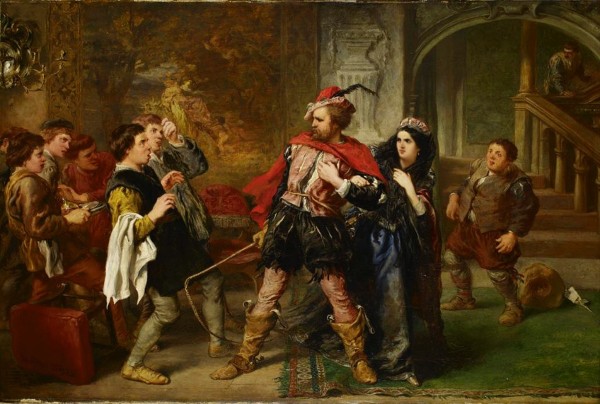 The Taming of the Shrew by John Gilbert 1859-1861
America came by White supremacy honestly: Along with its analogue, organized Christianity, Whiteness arrived on the Mayflower, that good ship carrying, along with Pilgrims, a cargo of Whiteness and a stowaway, a living-dead White male writer who was and remains Whiteness’s greatest champion, its Enabler-in-Chief, a veritable geyser of Whiteness. Allow me to present William Shakespeare: The Bard. (Not a bard. The Bard.)
Mirroring the status of Shakespeare’s work as both literature that is read and studied and plays that are still regularly performed—because Shakespeare’s writing is inescapably and inspiringly brilliant—Little has divided White People in Shakespeare in two parts. The first, “Shakespeare’s White People,” comprises 11 scholarly, close readings of iconic works, including various of the sonnets (the sonnets) and the well-known plays—Measure for Measure, Cymbeline, Othello, Titus Andronicus, Antony and Cleopatra, The Merchant of Venice, Romeo and Juliet, Julius Caesar, Hamlet, and The Tempest—that form the foundation of what participants in the Shakespeare industry call “the western canon.”
The second, “White People’s Shakespeare,” presents teachers’, writers’, directors’, and performers’ thinking about Shakespeare’s role and influence in education and theater and how to change practices so as to, as Jean E. Howard says in her essay “The White Shakespearean and Daily Practice,” lessen Shakespeare’s Whiteness. These contributors seek new ways to broaden students’, audiences’, and scholars’ understanding of Shakespeare, to teach race differently than it has been taught, to (gently) disrupt the Shakespeare Industry so both the message and the medium transcend our life-long indoctrination in White superiority. In the book’s final essay, “No Exeunt: The Urgent Work of Critical Whiteness,” Peter Erickson plows a furrow similar to Howard’s but with a broadened scope, stressing the importance of making Whiteness more visible, amplifying one of the collection’s main assumptions: that we need to learn to see Whiteness and to see it as a race (not the race).
To solve a problem like White William’s Whiteness, you begin by analyzing its particulars (amorphous), then defining its scope (immense), then identifying available resources (limited), then assessing the general will to address and redress it (constrained). You must clearly and without equivocation name it—Racism—and fearlessly present it as it is: inextricably woven into a cloth of dominance dyed in colorism’s most toxic hue (White), then normalized and naturalized by a nearly half-millennium of race-based propaganda both overt and covert.
Yet before you can begin to solve a problem like William’s Whiteness, you first must see it, then acknowledge it, and then accept the task.
Yet before you can begin to solve a problem like William’s Whiteness, you first must see it, then acknowledge it, and then accept the task. But though difficult, that’s not the hardest part. The hardest part is to convince most of the rest of us to agree to work to fix it. However, undermining your efforts to forge a common acceptance that Whiteness is something broken that needs fixing is that your proposed fix—genuine equality—stirs some people to push back, to look for ways to disrupt any such fix. They shake their heads. They don’t—can’t—see a problem. It’s not only that acknowledging the problem threatens their God-given place in the human hierarchy—which of course it does—it’s also that Whiteness is, to them, effectively, invisible. So normalized and naturalized is it, so thoroughly have their worldviews been Whitewashed, that that they don’t see Whiteness at all. They don’t know what the hell you’re talking about; you’re stupid, delusional, or evil. Or all three.
Among Little’s goals in White People in Shakespeare is to demonstrate the ways that Whiteness has, via William and his works, been institutionalized and camouflaged. Since the early 1590s in London, when Shakespeare’s plays were first produced, Whiteness has become the baseline, the standard against which “other” colors are measured and contrasted. Thanks in large part to William, Whiteness was and remains disguised, his genius used as a White-power-tool to lay a foundation of Whiteness, to establish Whiteness as the benchmark—not a benchmark, the benchmark—rendering it culturally unseen.
The use of Shakespeare to spread Whiteness has left many of us not so much color-blind as color-blinded (or color-blindered?), and William Shakespeare the man, the actor, the writer, the icon, the idol, the institution, the literary god has been and continues to be the blindingly bright literary light that color-blinds us. We’ve been told all our lives that Shakespeare is the Fount of Universal Truth, that the Truth is White, and that anything and anyone not White is flawed, is Untruth. So when you claim you’re fixing something, those not already on board hear that as a lie. For them nothing is broken, and you’re creating a problem where none exists; to them the problem isn’t Whiteness, it’s you. Everything was fine until you came along and started complaining, and it will revert to fine when you leave. Go away. STFU.
A thread woven through White People in Shakespeare is, How did this happen? How did we get here? How did Whiteness become the norm? By macro-aggression, of course, infusing Shakespeare, his plays, and sonnets into first British and then American compulsory systems: legal, governmental, and educational. But also by constant micro-aggression, the cumulative disdain of endless small insults. All the essays in White People in Shakespeare are close reads of the steady torrent of subtle, often unremarked-on judging of non-Whites via which the poems and plays of the Shakespearean canon teach and affirm the “natural” superiority of Whiteness and White skin.
White People in Shakespeare’s essayists illuminate Shakespearean macro- and micro-aggression not only in the “raced” poems and plays—the Dark Lady sonnets, Timon of Athens, Othello, Antony and Cleopatra, The Merchant of Venice, The Tempest (all works the self-anointed Oracles of the Canon grudgingly acknowledge are raced because they prominently feature non-white characters)—but also in poems and plays that Shakespeare industry CEOs have decreed to be unraced, works like Hamlet and Julius Caesar that, ironically, even more effectively normalize Whiteness and White skin because on the surface—which is where racializing begins—they fail to declare themselves to be about race.
Among the deep dives in the book’s first part is the late Imtiaz Habib’s “Two Lives I Have of Comfort and Despair: The Circle of Whiteness in the Sonnets.” Habib writes,
Fundamental to . . . beauty is the root sense of the word “fair” and . . . other words that appear in [Elizabethan] complimentary pieces such as “lovely,” “comely,” “graceful,”
“sweet,” “noble,” etc. that do service for “fair” and implicitly refer to it . . . . Edith Snook has shown in a variety of early modern English texts the establish[ment] of “fair beauty” ideologically as a privileged form of whiteness because skin color is made to signify class as well as ethnic difference and because fairness defines the normative healthy state . . . [and] elevate[s] fair skin as a form of natural social power.
Evelyn Gajowski’s “Staging the Blazon: Black and White and Red All Over” looks at the frequent appearance in early modern literature of White/Red and White/Black binaries, with White representing purity the “Other” color stains. The White/Red binary is picked up in Dennis Austin Britton’s “Red Blood on White Saints: Affective Piety, Racial Violence, and Measure for Measure,” which examines the assumed symbolic purity of White skin against which the blood of the saintly shows in high relief.
In “’Envy Pale of Hew”: Whiteness and Division in ‘Fair Verona’,” Kyle Grady reveals Romeo and Juliet’s pervasive racialization. After Romeo sees Juliet, her peers in homogenously White Verona, including her cousin and Romeo’s previous crush, Rosaline, become
comparatively “less fair” . . . through the racializing language of blackness. When he first sees Juliet [he] regards her as “a snowy dove,” differentiat[ing] her from her otherwise fair peers by imagining Juliet “trooping with crows.” Romeo furthers his un-fairing of some portion of Verona’s . . . white women when describing Juliet as “a rich jewel in an Ethiope’s ear.”
So again, how do you solve a problem like William’s Whiteness? One approach is to make Shakespeare’s covert affirmation of race overt. West Side Story is as overtly about Whiteness and race as the tragedy on which it is based, Romeo and Juliet, is covertly about Whiteness and race.
[The story of the creation of West Side Story is itself worthy of dramatization. Initially conceived as “East Side Story” and dramatizing Jewish-Catholic conflict, the final form of the groundbreaking musical—about a neighborhood turf war between the Puerto Rican Sharks and the White Jets—was the product of four White, gay, Jewish men: Jerome Robbins conceived, choreographed, and directed; Stephen Sondheim—in his Broadway debut—wrote the lyrics; Leonard Bernstein wrote the music; and Arthur Laurents wrote the book. Both Bernstein and Laurents had been blacklisted, while Robbins had appeared before the House Unamerican Activities Committee (HUAC) voluntarily and named names. Laurents reflected uneasily on his collaboration with Robbins later in life.]
In “’Shake Thou to Look on’t’: Shakespearean White Hands,” David Sterling Brown details, in Antony and Cleopatra, Antony’s flying into a rage and commanding that Thidias, Caesar’s messenger, be whipped for kissing Cleopatra’s White hand
Henceforth
The white hand of a lady fever thee,
Shake thou to look on’t.
(This is an odd moment because in the play, Cleopatra is Black.)
In “White Anger: Shakespeare’s My Meat,” White People in Shakespeare’s 17th essay, Ruben Espinosa discusses Shakespeare’s many quick-to-anger White, male characters—including Antony—who launch suddenly from sedate to seething. Commenting on the tendency of American media to hype eruptions of Black anger with large-headlines screaming about Black fury after yet another racially-motivated outrage, he notes that that same media rarely mentions White anger. (The coverage of the storming of the Capitol depicted in White People in Shakespeare’s initial illustration is a rare exception.)
In his essay, Espinosa quotes Carol Anderson’s observation that White rage isn’t always obvious. Anderson says it
works its way through the courts, the legislatures, and a range of government bureaucracies. It wreaks havoc subtly, almost imperceptibly. Too imperceptibly, certainly, for a nation consistently drawn to the spectacular—to what it can see. It’s not the Klan. White rage doesn’t have to wear sheets, burn crosses, or take to the streets. Working the halls of power, it can achieve its ends far more effectively, far more destructively.
Espinosa’s examples of real world White-male anger include Boris Johnson and Steve Bannon, both bardolators. Johnson has for years failed to finish a biography of Shakespeare for which in 2015 he reportedly received a substantial advance. Titled Shakespeare: The Riddle of Genius, Johnson eventually tried—and failed—to hire a “co-writer” to help him finish the book. Bannon did hire a “co-writer” to work on adaptations of Titus Andronicus and Coriolanus, the latter intended to be a rap musical.
While both men are consummate buffoons, their buffoonery has if anything enabled their rise to political power—Johnson to British Prime Minister, Bannon to chief political strategist for an unashamedly racist president of the United States—before precipitating their (prat)falls: Johnson ultimately undid himself, and Bannon’s infinite arrogance got him jail time.
About that rap musical: Espinosa writes that Bannon
in the late 1990s co-authored . . . the rap musical The Thing I Am, an adaptation of Coriolanus. The Thing I Am was never produced, but its script exists. Excerpts from the script reveal Bannon’s seeming infatuation not only with Shakespeare but also with racial tensions . . . . The Thing I Am is set during the 1992 L.A. riots, and it imagines Coriolanus’ Romans and Volscians as Bloods and Crips in South Central Los Angeles. Daniel Pollack-Pelzner notes that Bannon’s script “offers a vision of [Bannon’s] Shakespeare-fueled fantasy: a violent macho conflict to purge corrupt leaders and pave the way for a new strongman to emerge.”
After nearly half a millennium of Shakespeare-based macro- and micro-aggression and -propaganda, how pervasive is Whiteness?
After nearly half a millennium of Shakespeare-based macro- and micro-aggression and -propaganda, how pervasive is Whiteness? How deep does it go? Is it “natural” that when you want to make bad things good, you Whiten them? That to correct a typo, you White it out? That to spare someone's feelings, you tell a White lie? That to help yourself sleep you generate White noise? That to save a company from a hostile takeover, you find a White Knight investor? That to protect IT infrastructure, you find a White Hat hacker? That to fight against Black magic, you use a White witch to cast White spells? That when adding a Black superhero to your lineup, you call him Black Adam and make him evil? The White Rabbit’s very important date? Probably with Snow White. Quick: What color is a dust bunny?
How do you solve a problem like William? You address—I don’t say solve—it by articulating it, defining it, analyzing it, researching it, establishing your cultural cred, and encouraging further talk. CRT’s goal is to spread the racial news (which is why Ron DeSantis and his White supremacist cohort ban those discussions). These are tasks that CRT participants—legal theorists; cultural critics; stage, television, and film performers, writers, and directors; social justice activists; and academics have assigned themselves. (An easy to follow trail leads directly from social-justice activism to attacks on tenure and efforts to defund public schools and universities.)
Is this problem solvable? It’s a safe bet that those who would most benefit from reading White People in Shakespeare won’t. (I’m looking at White supremacists like you Donald Trump, Boris Johnson, Steve Bannon, et al.) But, for the rest of us with race work to do—i.e. the rest of us—White People in Shakespeare, provocative title and all, will be a boon companion along the way toward understanding more about how America got to this broken place.
