



Threats abound these days. Topping the list is the threat of Armageddon, as the world ponders possibilities of nuclear disaster on at least three fronts.
Now that Trump and his gang are coming back, it’s a good time to reflect—is the world better off now than it was before? How will things change now? Will Michael Pompeo also come back, still bragging that “we lied, we cheated, we stole—it’s part of the glory of the American experiment”?
Trump has pledged to bring peace in Ukraine, “finish the job” with Israel, and ratchet up the pressure on China. We can remember he blamed China for the Covid-19 pandemic, calling it “the China virus.” Pompeo called the Chinese Communist Party “the greatest threat.” We should ask how and to whom?
Threats abound these days. Topping the list is the threat of Armageddon, as the world ponders possibilities of nuclear disaster on at least three fronts. Who is to blame for this, and how can we pull back from the brink? And is there a way to prevent a meltdown of the global economy if any of these hot spots boils over? Is there a way to get a grip on any of this?
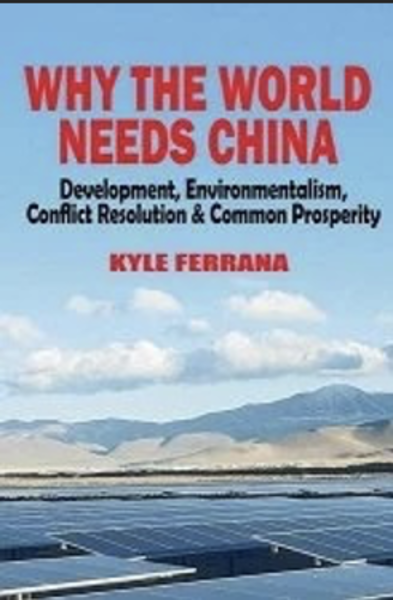
In Why The World Needs China, Kyle Ferrana argues that China today is more of a solution than a problem. It’s not as hard as it may seem to get this. We just need to see things differently than they do in Washington, DC, or in the mainstream Western media. Still, Ferrana takes 350 pages to discuss it, plus 16 pages of appendices and a 20-page bibliography.
Ferrana starts by dissecting “super-imperialism” — a concept made famous by economist Michael Hudson. He explains the “four distinct mechanisms of control,” or “supreme instruments” of Western hegemony: structural adjustment, economic isolation (ie, sanctions), military intervention, and soft power. He then shows “what distinguishes China from other countries… and why it is uniquely situated to facilitate a fundamental change.”
“There is considerable evidence,” Ferrana says, “that [China’s] investment in the periphery, especially Asia and Africa, is working to gradually industrialize and develop these regions, which can only make neocolonialism and unequal exchange more difficult to enforce in the long run.” He adds that China’s “role in the development of Latin America has already become fundamental… A total of twenty Latin American countries have signed on to the Belt and Road Initiative (BRI), and Chinese construction companies are building highways, railways, ports, and power plants throughout the region.”
China gets a lot of credit for the “cracks” that “are at last appearing in U.S. hegemony. One of the most visible is an incipient de-dollarization.” While the BRI is helping to overcome the disastrous impacts of structural adjustment, another pillar of Western hegemony is becoming a lesser threat: “if the rest of the world finally drops the dollar, the U.S. may lose a source of tremendous economic leverage: economic isolation will become virtually useless.”
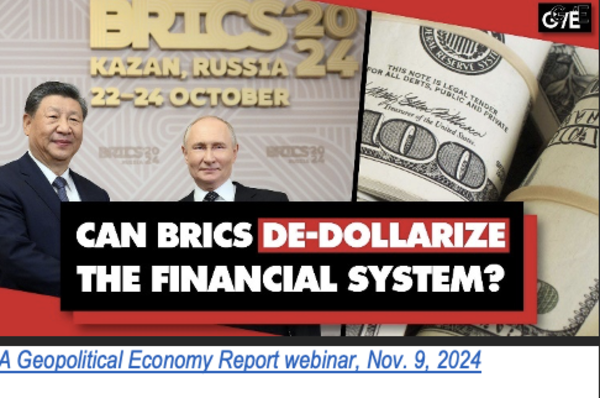
This is already happening, as could be observed in the most recent BRICS meeting in Kazan, Russia. Radhika Desai and Ben Norton of GeoPolitical Economy Report discussed it with Kathleen Tyson, a former New York Fed banker and author of Multicurrency Mercantilism. They reviewed a major document from the Kazan meeting, entitled Improvement of the International Monetary and Financial System.
Tyson said it’s “perfectly clear that the BRICS want local currency trade in their own currencies… And to a great extent, they've achieved that in important ways: 53% of China's trade is now in yuan, and over 90% of trade between Russia and China is either in yuan or ruble. Other countries are making progress as well — 80 countries determined in 2023 to move to local currency trade as a matter of policy… No country wants the constant threat of dollar sanctions hanging over them.
Military Intervention
Ferrana’s third pillar of Western hegemony is military intervention. YouTube analyst Danny Haiphong spoke about this in early November at the Operation Dawn anti-war brunch hosted by Scott Ritter and the Eisenhower Media Network, centered on the threat of nuclear war. He highlighted that “Russophobia and Sinophobia share Cold War roots. At the core, they reflect the same fundamental problem: a government and social system ruled and led by neocon megalomaniacs who flirt with nuclear annihilation in exchange for an all-access pass through the revolving door between government and war profiteering.”
Regarding the so-called Pivot to Asia declared in 2011, Haiphong said “the idea was for the U.S. to form a noose of naval and military assets around China in preparation for a regime change war that would initially be ignited by economic sanctions and soft power ‘containment’ measures.” He noted that “the Indo-Pacific Command is now by far and away the biggest of the Defense Department’s command structures with hundreds of military bases, 60 percent of the U.S. Navy, 55 percent of the Army, and two-thirds of Marine Corps stationed in the Pacific with the principal aim to contain China.”
Taiwan, Haiphong said, “has become a chip in a New Cold War where ‘defending Taiwan from invasion’ has become a common expression and excuse for the U.S.’s hostile approach toward China.” Now, for people who want peace, Haiphong said “The central task is to prevent a war with China, and to allow Chinese people to govern their own country on their own terms. If we fail in this task, then what seems like a far off scenario — nuclear war with China — may come a lot sooner than we think. Just look at how fast things have developed in the Middle East and Ukraine in just two years’ time.”
The U.S. trade war against China hasn’t been going well for the U.S. Despite U.S. efforts to strangle China, Haiphong commented that “China’s economy is growing at around 5 percent, nearly double that of the United States. Its innovative industries are booming, with China now leading the world in producing the most cutting edge smartphones, Artificial Intelligence (AI), and other advanced technologies the world currently has to offer. China is now the leading car producer, electric car producer, and high-speed rail producer in the world. Chinese people live a full two years longer than Americans and extreme poverty is a thing of the past as of 2020.”
Meanwhile, according to Radhika Desai, “U.S. trade with China is now less than 10% of China's trade. So, if there was a war, China could cut the U.S. off, and China would hardly feel it, but the U.S. economy would implode.” She added that “we're seeing the Israeli economy implode right now because you just can't do business with Israeli companies anymore.” Of course a U.S. war against Iran would lead to collapse of the global economy.
Kathleen Tyson added that “China announced two years ago that it’s moving to a war footing, that it sees all the new missile bases the United States has negotiated in Australia, the Philippines, Japan, and Korea, and it sees the missiles being installed. So, China is stockpiling everything, and it has the world’s largest stockpile of grains, and now oil.”
Common Prosperity for a Shared Future
Ferrana cites a report from Xinhua, the Chinese news source, that “during the 2000-2020 period, [China] had helped African countries build 13,000 kilometers of railways, 100,000 kilometers of highways, 1,000 bridges, and 100 ports.” Sierra Leone’s former Foreign Affairs minister was asked to compare China with other foreign donors. “There is a difference, and it is huge,” he said. “What they want to help you with, is what you have identified as your need. With Britain, America, they identify your needs.”
About the western media narrative that China “is a duplicitous money lender, providing loans to poor countries that they cannot afford,” Ferrana calls it “one of the more pernicious falsehoods surrounding Chinese investment abroad.” He cites Professor Deborah Brautigam of Johns Hopkins University, a leading scholar of Chinese foreign development policy, who studied and documented a pattern in Chinese finance that “repayment schedules for several billion dollars’ worth of loans to African countries were extended, often with reduction of interest rates.” Some loans were written off completely. While the IMF, World Bank, and private western banks have strangled African countries for decades, China has in fact rescued Africa from the western debt trap.
“The forces of national liberation,” Ferrana says, “are increasingly betting on [China] as the key, directly or indirectly, to advancing their struggle.” He cites Fidel Castro, in a November 2004 speech, saying “China has objectively become the most promising hope and the best example for all Third World countries.”
Anti-China Propaganda
We don’t really get this in the mainstream media. Ferrana says “through the hegemony of the super-empire, anti-China propaganda has become ubiquitous. The market dominance of Western information technology over the internet ensures that it is the first, and often only, narrative read by the average user. English-language news has become completely saturated with stories demonizing China…” And it’s likely to get worse: in early 2022, the U.S. House of Representatives voted to spend $500 million dollars to produce journalism for overseas audiences that was critical of China.” Then the Senate tripled it, in order to “raise awareness of… the negative impact of activities related to the Belt and Road Initiative.”
Objective and first-hand coverage from China has essentially disappeared. CNN “became a target of a wave of outrage and multiple lawsuits in both China and the United States after one of their news commentators remarked about China that “they” were a “bunch of goons and thugs” on air. But the CNN commentator kept his job. The LA Times dismissed subsequent Chinese demonstrations against Western media bias a “xenophobic.”
In February 2020, the U.S. State Department “revoked protections for all journalists of China’s five largest news agencies, who would henceforth be treated as foreign government operatives. The documentary Voices from the Frontline Cina’s War on Poverty, by China expert Robert Kuhn, was slated to debut on PBS SoCal. But the “mostly-positive depiction” of China’s poverty alleviation was yanked by corporate PBS, which claimed it “did not meet its editorial standards.” PBS SoCal disagreed, confirming that the film had passed their editorial standards. The suppression didn’t work—the film can be seen on YouTube, as well as numerous other sources, including Columbia University and CodePink. In summer 2020 “the U.S. Peace Corps terminated operations in China, and President Trump issued an executive order terminating the Fulbright Program"—ending exchanges of students and academic research cooperation between the U.S. and China. “There were to be no more… first-hand reporting, no fieldwork, and no independent investigations… only anecdote-speculation and propaganda.”
Coverage of Xinjiang and Tibet
Ferrana says that since 2018 “Western press and NGOs have accused [China] of a litany of human rights abuses” in Xinjiang, “many of them quite similar to the accusations regarding Chinese Tibetans decades earlier.” Headlines like “China’s Final Solution in Xinjiang,” from Stanford’s Hoover Institution, and “In China, every day is Kristallnacht” from the Washington Post, and a DC-based NGO alleging that the CPC “had killed millions of people in Xinjiang, imprisoned 8 million Uyghurs…, and forcibly aborted nearly 4 million Turkic babies.”
In 2021, when UN High Commissioner of Human Rights Michelle Bachelet announced plans for an investigation into the allegations regarding Xinjiang, “the Chinese government invited her to visit the region.” The U.S. government pressured Bachelet, “urging her to make a statement condemning [China] over Xinjiang with no investigation at all.” She made the visit, stating that “she hoped to ‘raise concerns’ and ‘pave the way for more regular, meaningful interactions in the future’.” An intense media firestorm followed; numerous DC-based think tanks, NGOs and media figures demanded her resignation and condemned the UN itself. Two weeks later Bachelet announced she would not seek another term as High Commissioner for “personal reasons.”
Legislation to sanction all products from Xinjiang followed, “which included 20 percent of the world’s cotton supply, with the rationale that ‘forced labor’ might have been used to craft them.” The list of attacks on China regarding Xinjiang has grown. Columbia Professor Jeffrey Sachs, who serves as a special consultant to the UN Secretary General, has denounced these attacks, citing lack of evidence. I personally visited Xinjiang a year ago during the cotton harvest, and observed that it was mechanized, with zero evidence of “forced labor.” My detailed report of this visit can be found in my book, A Realistic Path to Peace.
“Democracy vs. Authoritarianism”
Ferrana writes that the “democracy vs. authoritarianism” dichotomy “is perhaps the most tortured and illogical iteration of international relations theory, even though it is the one most favored by the Western press. He reports that credible surveys indicate that “over three-quarters of people in China and Vietnam — two countries considered among the most ‘authoritarian’ in the world by the Western press — considered their own country to be democratic, while less than half in the United States — supposedly the leader of the ‘democratic’ world — believed the same… So many exceptions, asterisks, and qualifications are necessary for the ‘democracy vs. authoritarianism’ model to apply that by comparison, Ptolemy’s reliance on convoluted geometric ‘epicycles’ to justify the theory that the Earth was the center of the universe seems reasonable.”
People’s China at 75: Changes Unseen in a Century
The first of October was China’s 75th national celebration of having “stood up” and ended its “century of humiliation” by neocolonial invaders from the West. The occasion was marked in London and New York with major conferences and a new book, People’s China At 75: The Flag Stays Red, edited by Keith Bennett and Carlos Martinez, founding editors of the Friends of Socialist China. The contributors featured in the book are stellar. Cheng Enfu, President of the World Association of Political Economy, stands out. His essay concludes that “China has continuously transcended hegemonism and nationalism to promote the building of a community of shared future for humanity…, which lies at the core of China’s major global initiatives, namely the BRI, Global development Initiative, Global Security Initiative, Global Civilisation Initiative, and Global AI Governance Initiative.” He highlighted the BRI as “the most vivid embodiment of the effective practice of a community with a shared future for humanity.”
A major contribution by Professor Efe Can Gurcan of LSE and the Shanghai Institute of Global Studies explains China’s “Made in China 2025” strategy, focusing on “green manufacturing and innovation,” indicating “a historical transition from rapid growth to a period of greater efficiency, equity, sustainability and security.” China’s leadership in “green development” has already been achieved, but this plan takes it to a qualitatively new level.
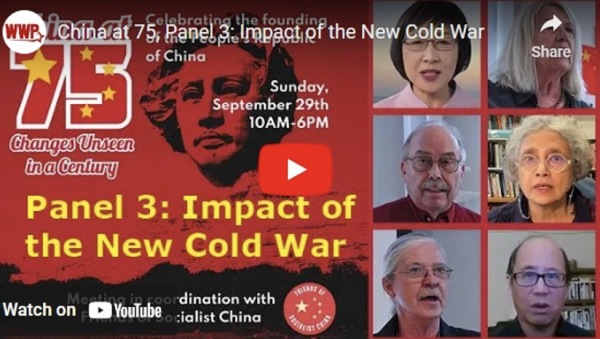 "Impact of the New Cold War" panelists were Julie Tang and Michael Wong of Pivot To Peace, Radhika Desai of GeoPolitical Economy Report, Sharon Black of the Socialist Unity Party, Mick Kelly of Freedom Road Socialist Organization, and Dee Knight, author of "A Realistic Path to Peace.”
Radhika Desai’s contribution on “Patient finance: Beijing’s core challenge to the Washington Consensus,” provides details of China’s alternative to “privatization, cuts in social spending, deregulation, trade liberalization, tight monetary and fiscal policies, rollback of labour and environmental regulation, etc. — that is, to strangulation of people’ needs across the globe. Desai calls the dollar denominated financial system “a giant vacuum cleaner, sucking up capital from the rest of the world and pouring it into…” a system with more or less complete disconnection from productive investment, which is “really little more than a giant casino.”
A complete compilation of the contributions to this double celebration—both in London and New York—can be found online at YouTube.
The East Is Still Red, a new book by Carlos Martinez, is a rich, thorough and convincing explanation of China’s socialist character and achievements. Martinez says, “China can direct investment and resources towards green development precisely because of the socialist basis of its economy. China’s enormous investments in renewable energy, energy efficiency, electric vehicles, afforestation and ‘circular’ waste management have largely been made by state banks, and its projects carried out largely by state-owned enterprises…”
