



While Neuromancer cemented Gibson’s place as a commanding presence in SF, he has consistently sought to position his work beyond the parameters of limiting genre categories.
The Shock of Dysrecognition: William Gibson’s Neuromancer
At a historical moment in which cyberspace and the application of artificial intelligence have become ubiquitous features of American life, it’s astonishing to realize that it’s now been 40 years since William Gibson published his visionary first novel, Neuromancer. Yet, Gibson was far from being a newcomer to the science fiction scene as he’d been honing the hard-boiled delivery of his unique brand of “techno-fetishism” that would became synonymous with “cyberpunk” from his earliest writings. Such is already prevalent even in his first published work from 1977, “Fragments of a Hologram Rose,” depicting a borderless world careening into the heat death of entropy, choked by the ruins and refuse of the past.
Gibson would continue his probing of these themes over the next several years, articulating his vision through a noir aesthetic in subsequent stories including, “Burning Chrome,” “New Rose Hotel,” “Dogfight” and “Johnny Mnemonic,” all published in Kathy Keeton’s Omni. Featuring Gibson’s first utterance of “cyberspace,” a term he is credited with coining, along with the adoption of “the matrix” as slang proxy, these stories carry the SF DNA of the bounteous garden of virtual delights that would find their full expression in Neuromancer. Cyberpunk 0.1, if you will.
In one of the earliest reviews of Neuromancer, appearing in The Washington Post, Charles Platt hailed Gibson’s work as a “flashy and decadent” heir to Alfred Bester that “transmutes category fiction into fine art.” He went on to praise Gibson’s injection of fresh energy into SF, a genre long dominated by writers with “middle-aged tastes and style” and lacking “any real contemporary awareness.” Much more than delivering a fantastic story, Neuromancer brought a renewed sense of urgency and social relevance that was “in every sense, state-of-the-art.”
Seeing in this bold, young writer the harbinger of a long-awaited break from the tedium and stagnancy of ossified tradition and the status quo, a reviewer for the Times Literary Supplement in December of 1984 hailed Gibson’s interrogation of the burgeoning computer age for its “technical wizardry,” executed “with panache and without tedious explanation.” Gibson won additional praise for a silky delivery that “stimulates the requisite adrenalin without bypassing the intellect.”
Celebrating Gibson’s work with zeal, this reviewer concluded by saying Neuromancer displays “the glamour of Samuel Delany and the vertigo of Philip K. Dick, and better organization than either.” Bestowed with such praise, Gibson found himself, almost overnight, lifted from relative obscurity into the company of two of SF’s most respected and innovative voices. What a start, but also what pressure!
While Neuromancer cemented Gibson’s place as a commanding presence in SF, he has consistently sought to position his work beyond the parameters of limiting genre categories. In fact, Gibson claims a stronger sense of affiliation with writers such as Jorge Luis Borges, Thomas Pynchon and J.G. Ballard, known for their unruly experimentations and audacious styles.
His work has been widely hailed for the way it turns a mirror back to the spectacle and detritus of techno-industrial society, while reveling in the playfulness of intertextuality and pastiche. At the same time, Gibson’s work excels in eliciting what Philip K. Dick saw as vital to SF, “a convulsive shock in the reader’s mind, the shock of dysrecognition.” Yet, rather than springing from a mind attentive to the facts, data and the cold logic of an apathetic universe, Gibson’s inspiration owes itself more to the chaos of the heart and the vexations of lived experience.
Celebrated by critics and readers alike for “visualizing the human impact of high technology,” Neuromancer, draws explicitly from these writers while offering dire warnings on humanity’s misplaced faith in the ideology of progress and religious explanation. In this sense, Neuromancer can be read as a postmodern, neo-western framed through the perspective of its main character, Henry Dorsett Case, a retired “cyberspace cowboy” reduced to the obscurity of “just another hustler.” Case is accompanied by Molly, a virtuous razorgirl who flashes “ten double-edged, four-centimeter scalpel blades from their housings beneath her burgundy nails,” in her first encounter with Case.
Far from getting bogged down on technical details, as was common to much SF of the era, Gibson strived in Neuromancer to focus not only on the thoughts, motives and actions of Case, Molly and other characters, but to show how they were influenced by the context of the settings where their interactions took place. This is just one of the qualities that propelled the force of this narratives, along with his penchant for transcending the thematic limits and creative boundaries imposed upon genre fiction.
His success in these contexts is owing in large part to his capacity to imagine not only the ways in which the past and present can lead us to a particular future, but in the relentless demand that readers consider the how? and why? of it, as well. The reasons and motives, desires and dreams, the fears and nightmares that propelled Gibson’s narrative interventions is the substance he utilized to shape and redefine the fragility of human life within the frames of agency and responsibility in a new virtual reality.
Case and Molly are joined in the story by characters who take us beyond the bounds of SF and into the realms of the neo-western and hardboiled fiction alike, exposing the bloody dues required by “progress.” These include Case’s (deceased) former lover, Linda Lee; Julius Deane, a dealer of stolen goods; the mysterious operative, Armitage/Corto, harboring a secret special forces background; along with an anarcho-Rasta collective known as the Panther Moderns, “mercenaries, practical jokers, nihilistic technofetishists,” cast as virtuous outlaws fighting the sprawl of empires.
These and numerous minor characters infuse the story with equal doses of cynicism and play, melding with an almost insatiable, self-destructive craving for adventure. Taken together, the collective actions of these characters and the scenes they conjure accentuate Gibson’s sharp-edged critique of institutional authority as the primary source of abuses of power, senseless violence and rampant injustice. Through these elements Gibson recalls and leverages an array of literary and artistic associations, while simultaneously rejecting the implicit Western binaries that support systems of dominant ideology and knowledge.
Hence, beyond the outlaws, miscreants and non-conformists who emerge from the neon-lit alleys and shadows to disrupt order, we find tyrannical governments, plundering corporations and morally bankrupt institutions, accompanied by their secret police and hired assassins. These include teams of so-called Turing detectives, along with the hitman, Peter Riviera, and cyber-ninja, Hideo. Rouges and villains all, driven by a pathological death-drive, intoxicated by voracious excess and the lure of power, unable and unwilling to consider the future.
The setting whereby Gibson frames his characters and sets the events of the story into motion begin in the vice-ridden Chiba City, across Tokyo Bay, giving further emphasis to the chaos and oblivion that is befitting of Neuromancer’s post-apocalyptic context. These resonances are artfully conveyed to readers in the novel’s famous opening: “The sky above the port was the color of television, tuned to a dead channel.” That he chose Chiba City—the sister city of Gibson’s hometown at the time of Vancouver—for the novel’s starting point, drawn wholly from personal associations, reveals a willingness to give himself over to the forces of chance, free association, play and inspiration.
In dispensing with any engaged cartographical framing and reliance upon historical details, Neuromancer initiated the reterritorialization of a post-apocalyptic world wiped clear by catastrophe through the creation of an ephemeral reality in which humanity clings to life in the “Sprawl.” Beyond this nebulous American metropolis, other cities appearing in the novel whether Tokyo or New York, Istanbul, Paris and Bonn, are merely incidental sites within a story that resists any centering linked to the people or cultures of specific nations. Rather, a primary concern for Gibson is how humanity might come together to survive and endure in what he envisioned as an “infinite datascape.”
Moving beyond the blues of Chiba City, where the desolation of modern urban life has given way to the frenetic static of human activity, readers are driven to wonder how such a future can take hold in a present already stretched by the tremendous speed of ongoing technological advances. Using this site as his anchor, Gibson enacts another vital function Dick attributed to SF writers as “criers of doom,” in imagining the force of movement propelling society forward into an everchanging reality where the vanishing point seems to portend only catastrophe, forcing us to face our own inescapability from detachment and despair.
Following Gibson into the Matrix, Before The Matrix
Features of Tokyo and other megacities reflecting such impressions are precisely what prompted Andrei Tarkovsky’s use of its confining spaces and spiraling traffic as the setting for the famous highway sequence in Solaris. That this ultramodern, heavily populated city was also attacked by Godzilla prompts us to ask where, really, does the actual monster in that film’s scenes of mayhem and destruction reside? As places marked with a fervent embrace of the promise of technological and computer advancement, Tokyo serves as a natural backdrop for the action of a novel that explores these possibilities while speculating on their gravest dangers.
Gibson’s intricate blending of dystopian elements infused with anxiety and dread, in an age increasingly suspended between the forces of isolation or despair, are artfully rendered from the novel’s opening scenes, with Case haunted by “the matrix” of cyberspace:
"A consensual hallucination experienced daily by billions of legitimate operators, in every nation . . . A graphic representation of data abstracted from banks of every computer in the human system. Unthinkable complexity. Lines of light ranged in the nonspace of the mind, clusters and constellations of data. Like city lights, receding. . . ."
This, and similarly suggestive characterizations, foreshadow Case’s wanderings across the Sprawl and off-world space stations, with mercenary jaunts into the virtual abyss of the matrix. A centerless site that echoes with the “war of technology . . . the language of machines,” an image evocative, perhaps, of Front Line Assembly’s track, “Mindphaser,” from Tactical Neural Implant.
Prominent among the off-world places is an extranational space station given over to leisure and vice dubbed, Freeside, “brothel and banking nexus, pleasure dome and freeport, border town and spa.” The decadence of this interstellar locale is further highlighted by comparisons to “Las Vegas and the hanging gardens of Babylon, an orbital Geneva.” Further, as “home to a family inbred and most carefully refined, the industrial clan of Tessier and Ashpool,” Gibson constructs this no place in the image of the novel’s antagonists who reside at a compound there known as Villa Straylight.
In Neuromancer’s story world, such sites serve as convenient interzones through which characters journey beyond the desert of the real. In Case’s example, this is reflected in the way he views his corporeal self as little more than “meat,”—his essential self trapped within “the prison of his own flesh.” Indeed, here, the virtual realities of cyberspace and the matrix become what Philip K. Dick termed, “the true core of being.” For Case, the transfiguration beyond the confines of the flesh is accomplished when “jacked” into the digital evanescence of the matrix by Dixie Flatline, a computer construct consisting of the downloaded mind of Case’s deceased friend, McCoy Pauley.
Gibson’s version of the matrix encapsulates the virtual placelessness of a limitless cyberspace where Case is tasked with breaking through the “ice” of virtual security, setting the stage for his “encounter” with the AI entities Wintermute, along with the more elusive titular program, Neuromancer. A big part of what made Neuromancer such a groundbreaking text in 1984 was Gibson’s ability to render these inhuman entities, conjured of pure speculation, with such lucid descriptive skill and brilliant anticipation of their perils in the future.
Gibson’s initial description of Wintermute as “a simple cube of white light, that very simplicity suggesting extreme complexity,” creates a dazzling image that merely hints at the menace lying beyond our vision. The narration continues suggestively, with this AI taking on the appearance of a mechanized killing machine, “cold and silence, a cybernetic spider slowly spinning webs. . .”
In a similarly audacious style, the titular entity Neuromancer is cast in an even more portentous light as “the lane to the land of the dead.” Drawing upon associations with mortality and afterlife, its ineffable presence is further endowed with the aura of sorcery: “Neuro from the nerves, the silver paths. Romancer. Necromancer. I call up the dead.” Attributes that anticipate the declaration: “I am the dead, and their land.”
The posthuman networks Gibson establishes between his human characters and AI entities, forming the core of the novel’s action and meaning, culminates in a mission that leads Case and Molly, paradoxically, to “Nowhere. Everywhere.” Only when AI’s transcendent singularity is revealed to be a presence as absence encapsulating “the sum total of the works, the whole show,” can we appreciate the depth of Gibson’s extraordinary literary vision. A triumph of the imagination that helps explain why Neuromancer came to be seen as heralding the emergence of a full-blown literary movement.
William Gibson: the Reluctant Cyberpunk
The term “cyberpunk” itself was coined by Bruce Bethke and utilized as the title for a short story published in Amazing Stories a year before Neuromancer’s release. Yet, it was its association with Gibson’s text that imprinted it upon the public’s consciousness. In the wake of Neuromancer’s wild success, becoming the first novel to win the triple crown of SF awards (the Nebula, Philip K. Dick and Hugo), it would be cast as the movement’s originating text—much to Gibson’s irritation.
Owing to the immense praise Neuromancer received for its literary innovation, cutting-edge style and a taut “urban sensibility,” by the end of 1986 Gibson would be anointed as the “leader of the cyberpunks” by Platt in a review of Bruce Sterling’s collection, Mirrorshades. Despite Gibson’s misgivings for the term, Sterling, who would go on to co-author the steampunk novel, The Difference Engine with Gibson, saw the inherent appeal of the catchy title and was all-too-happy to market his collection as “the first anthology of ‘cyberpunk’ science fiction.”
Despite having his work newly adorned in the attire of leather and latex, wires and circuitry, chrome and impenetrable glass, Gibson had not materialized out of thin air like so many SF spectres of days past. Given the tangled nature of such origins, it’s not difficult to see why the so-called birth of cyberpunk threatened to displace and conceal what Gibson saw as the true inspiration of his work, making the label a sustained source of aggravation.
Even as his association with the cyberpunk movement has only become more emphatic in the years since, Gibson’s resistance hasn’t weakened. If anything, he’s simply grown reticent in expressing his distaste for the label, seemingly out of fatigue rather than acceptance. Foremost among his criticisms is that the term itself amounts to little more rather than a slick marketing label. In the years since Neuromancer’s publication, Gibson has rarely spoken of cyberpunk in complimentary terms, instead variably casting it as a ”flavor” and “pretentious,” while claiming it gave him the “heebie-jeebies” from the start.
More revealing, perhaps, is his own consistent avoidance of the term in his own prose. An act of literary and intellectual independence underscoring the seriousness and care he takes in protecting his work’s legacy, deferring from the use of an instantly recognizable label he'd rather not have on his “tombstone one day.”
Elaborating on associations that recall the moribund and the irrelevant—representing in his mind a brand of SF he has worked hard to distinguish himself from—Gibson sees in these labels a reflection of the stultifying limitations imposed upon genre categories. It’s a view writers such as Stephen Graham Jones and Tananarive Due have reiterated more recently in respect to contemporary horror.
When asked by Takayuki Tatsumi in 1996 if he had “a specific sense of what the cyberpunk movement is,” Gibson reacted with an audible groan before saying, “not that word.” Clarifying his reaction, he continued: “labels are death for things like this. I think that the fact these labels exist heralds the end of whatever it was. As soon as the label is there, it’s gone.”
Despite these objections and maybe also because of them, since readers and critics also play a role in defining a work’s significance and a writer’s legacy, the critical and commercial success of Neuromancer was like pouring gasoline on a movement ready to take popular culture by storm. At the same time Gibson was trying to distance himself from the cyberpunk label, an array of other neon-dystopic infused works from writers including Bruce Sterling, Pat Cadigan, Walter Jon Williams, Jeff Noon and Rudy Rucker, along with their share of copy-cats, were seeking to cash in on the hype. And who can blame them?
Underscoring cyberpunk’s global appeal, while delineating Gibson’s place within its development, the anime of Katsuhiro Otomo’s Akira (1982-1990) and Gakuryū Ishii’s film, Burst City, stand as influential predecessors. Ridley Scott’s transformation of Dick’s Do Androids Dream of Electric Sheep? into Blade Runner, helped propel a litany of similarly-themed films spanning James Cameron’s The Terminator (1984) and Paul Verhoeven’s Robocop (1987), to Steve De Jarnatt’s Cherry 2000 (1987) and Richard Stanley’s Hardware (1990), further lifting cyberpunk’s profile.
With the release of The Matrix, the Wachowski’s elevated cyberpunk to the heights of popularity, emphasizing, perhaps, the way such movements often transcend their creators, becoming different in the process. The wild success of the cyberpunk movement as a global phenomenon with this iconic film’s release reveals the inherent ironies common to much avant-garde art, as its resiliency and reproducibility seems to reflect the elusiveness of the labels from which they draw influence.
Yet, however we may define cyberpunk, one must acknowledge that the label carries its own force and sounds pretty freaking cool. This is especially so for a writer with a reverence for bands such as the Sex Pistols, Dead Kennedys, GBH and the Misfits. This perspective underscores how, then, the provocative associations carried by this elusive, slippery term are also a major source of its appeal.
With such labels, however, the order of reference vanishes into mere façade behind which lies only endless replication. The artistic rendering of an idea thus simulated and commodified into an avatar that is more style than substance, leading to the reduction of cyberpunk into a copy of a copy of a copy in following Jean Baudrillard’s “precession of the simulacra.”
The accumulation of copies and the increasing detachment from the original as elaborated through Baudrillard’s renowned concept returns us to its cinematic representation in The Matrix. The scene in question occurs early in the film and has Thomas Anderson (Keanu Reeves), returning home after his first encounter with the agents. Shaken by the encounter, he retrieves a hollowed-out book bearing the title Simulacra & Simulation, which is simultaneously revealed to be a simulation of a simulation of Baudrillard’s book as it is both an empty vessel and a fake with an excess of pages that far exceed the slim dimensions of the 164 page original.
Emptied of the content promised by the title embossed onto its cloth cover and, ironically, the last chapter, “On Nihilism,” that holds the hidden compartment, Anderson utilizes the void as a place for keeping secrets. Instead of knowledge and ideas, however, the book holds a band of $100s and computer code burned onto discs, further highlighting the elusiveness of cyberpunk’s meaning and associations.
Another kind of emptying of ideas in this realm is reflected in Billy Idol’s synth-infused 1993 album, Cyberpunk, which Gibson dismissed as “very silly.” More recently, numerous musicians contributing to the synthwave scene have been apt to vaguely cite cyberpunk as an influence. One prominent example is the Hungarian electronic musician who performs as Lazerpunk, offering music tenuously described on their Bandcamp profile as “cyberpunk influenced bass music for movies, video games and dystopian underground clubs.” Others paying homage to Gibson’s influence include LA’s Panther Modern, and numerous groups working under the name of Wintermute from places as distant as Osaka and Leeds.
It's All Fun and Games Until the Cops (or Tech Bros) Show Up
But wait, there’s more! Videogaming has been an especially fertile site for the integration of cyberpunk tropes and features as a prominent character aesthetic and inspiration for dystopian world-building. The 1988 game, Neuromancer, released by Interplay Productions and directly inspired by Gibson’s vision, presented players with an immersive video game blueprint of the novel complete with characters and settings from the book. Underscoring cyberpunk’s influence on music, the game included an integrated soundtrack composed by none other than Devo.
Asserting that “computers are the LSD of the 80s,” Timothy Leary had already been working to develop his own video game version of the novel upon its release through his studio, Futique, Inc, which produced his previous game Mind Mirror. Although Leary’s version never came to fruition, he contributed ideas to the Interplay release, promoting the project as well.
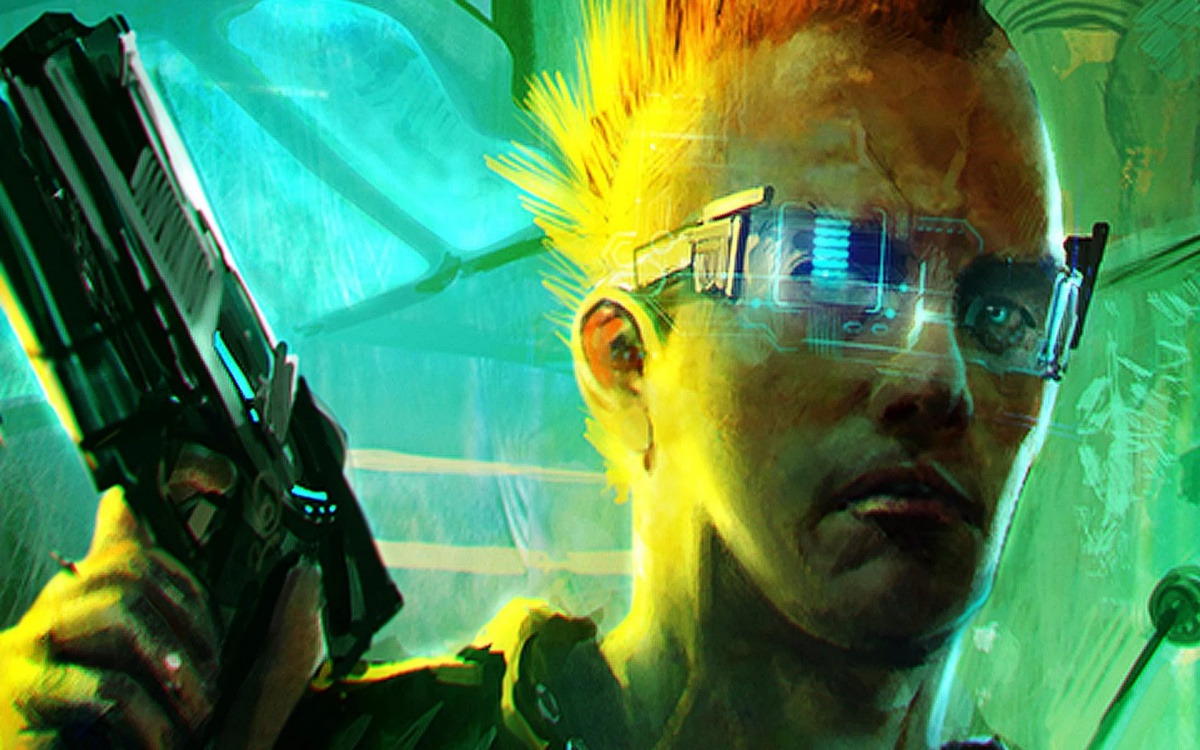
The most extensive utilization of cyberpunk themes in the realm of gaming to date is found in the wildly popular CD Projekt Red open world role-playing video game, Cyberpunk 2077, released near the height of the COVID-19 pandemic in December 2020. While Gibson has called this representation “generic,” it is, nonetheless, pertinent to the present discussion for its integration of the voice and likeness of Keanu Reeves reprising the role of Neo, no, Johnny Mnemonic, sorry, I mean Johnny Silverhand.
Other notable examples include an earlier series of tabletop board games based on the novel, with the first iteration released in 1988. Another game that warrants mention here is GURPS Cyberpunk, which was accompanied by a module created by another company, Steve Jackson Games, as a universal role playing system in 1990. In a truly bizarre turn of events, this project became the subject of a Secret Service investigation culminating in a raid that appears as a cheap parody of Gibson’s fiction.
The reason behind this law enforcement operation, as detailed in an article published in the August 1990 issue of Omni, was, now get this, because the investigating agents considered the module and game software a “handbook for computer crime.” Jackson’s response is as hilarious as it is exasperating in his observation that such a claim was “like saying that Dungeons and Dragons is a handbook for breaking into dungeons.” Emphasizing the government’s reckless obliviousness, he went on to lament, “these people didn’t understand the technology they were policing.”
In their commentary on the affair, Omni’s staff writers opined, “sounds like computer ignorance in high places is a greater threat to our national security than cyberpunk.” While this comical episode now serves as just another obscure example of government and law enforcement idiocy and ineptitude, it also seems to confirm that the cyberpunk movement, far from representing a revolutionary association of underworld hackers and digital anarchists personified by the group led by Morpheus in The Matrix, in reality, it mainly consists of white, middle class computer enthusiasts. Yeah, nerds.
Herein, perhaps, lies the source of Gibson’s dissent. For aside from all he has revealed about the writing of Neuromancer, and his earlier stories, he has been adamant in denying any kind of expertise on technology, while maintaining that he didn’t even own a computer during the time of the novel’s composition.
Thus, despite whatever inspiration those embracing the label of cyberpunk draw, or not, from Gibson’s work, the critique he issued in a 1993 interview, in which he asserted that whatever its virtues, the cyberpunk label became little more than a “saphrophyte that piggy-backs on the main stem of SF,” still holds. In case you’re wondering about that word, it’s a reference to a fungus or microorganism that lives off dead and decaying matter. Ouch!
Cyberpunk, then, like the revolutionary spirit of punk music and subculture, which is also threatened with being reduced to a cheap imitation and endlessly reproduced as commodity fashion detached from its DIY origins, signals another attempt to exploit the subversive reputation of a once vital and feral movement as mere image. With the mainstream’s embrace of punk, the core of Gibson’s critique lies in cyberpunk’s reduction to a meaningless signifier:
"The label enabled mainstream science fiction to safely assimilate our dissident influence, such as it was. Cyberpunk could then be embraced and given prizes and patted on the head, and genre science fiction could continue unchanged."
Recent advances in Artificial Intelligence through the launch of ChatGPT in 2022 by Sam Altman’s OpenAI, along with a procession of competing programs brought online since by the likes of Google, Meta and Apple, have made this once mystic technology a popular tool embraced by millions. Never mind that it recalls Neuromancer’s AI entities Wintermute and Neuromancer, but also, perhaps, 2001’s HAL 2000 or The Terminator’s SkyNet. In spite and because of such associations, it seems the legacy of Gibson’s work, and the cyberpunk movement that spawned from it like an unwanted side effect, will continue to have relevance in popular culture for years to come.
As society becomes ever more reliant upon computers and artificial intelligence, there are no shortage of bad actors and corporations working to claim a position analogous to the infamous fictional despots modeled by Tessier-Ashpool S.A., as well as the Rosen Corporation of Philip K. Dick’s Do Androids Dream of Electric Sheep? and Blade Runner’s rendering as the Tyrell Corporation, to The Terminator’s Cyberdyne Systems.
Likewise, with tech bros including Sam Altman, Elon Musk and Mark Zuckerberg rushing to position themselves at the forefront of AI enamored by the enormous concentration of wealth and power such technology makes possible, while oblivious to their aping of the fictional characters within this context (psst, you’re Lady 3Jane Tessier-Ashpool, you’re Eldon Rosen and Eldon Tyrell, dudes), the stakes of Gibson’s warnings about the future and the nature of the relationships being forged between humans and the technologies being created have never been higher.
So, while we watch as such figures race to complete their self-refashioning from awkward, goofy techies into wannabe SF villains—I’m thinking Gary Oldman’s Zorg from The Fifth Element as a fitting model—driven, perhaps, as much by an insatiable desire for fame and wealth as by the acceptance and adoration of the erstwhile bullies who, no doubt, haunt their childhood memories—we may reconsider the choice Neuromancer offers Case to stay with a simulation of his love, Linda Lee, at the event horizon it has programmed to appear as a virtual beach at the edge of an indistinct sea.
Given what we now know, maybe this admittedly artificial sanctuary was Case’s best option, as Neuromancer reminds, “if your woman is a ghost, she doesn’t know it. Neither will you.” After all, as Daniel C. Dennett observed in Consciousness Explained, to do the same job “artificial hearts do not have to be made of organic tissue, and neither do artificial brains.” So, the alternate ending suggested here for Case might not be as far out as it seems, while also being in line with the conclusion the AI implementation Helen arrives at in Richard Power’s, Galatea 2.2.
At the very least, such considerations prompted by a reevaluation of whether Gibson’s vision of a future in which artificial intelligence has triumphed over humanity, with all means of escape from the simulation closed off and no possibility of existence outside the spectacle, may lead us to meditate if such a fate represents anything other than a profound hopelessness. Or, rather, if it might point us towards a kinder means of deliverance from the reality and world doomed to the whims and control of small, petty, evil men.
