


What may have propelled Iago to become the dramatic arts’ über-traitor of all time, a Quisling for the ages, is that he was a white supremacist.
OTELLO: Opera Review
As leaders of the Oath Keepers and Proud Boys are convicted of seditious conspiracy for their roles in the failed Jan. 6 insurrection, LA Opera revives the production about the most malicious traitor in the entire history of the stage and screen. Sure, Judas betrayed Jesus in The New Testament and Jesus Christ Superstar, and Major General Benedict Arnold attempted to double-cross George Washington (and the cause of American liberty) by plotting to turn West Point over to the British, who he went on to fight for as a counterrevolutionary brigadier general.
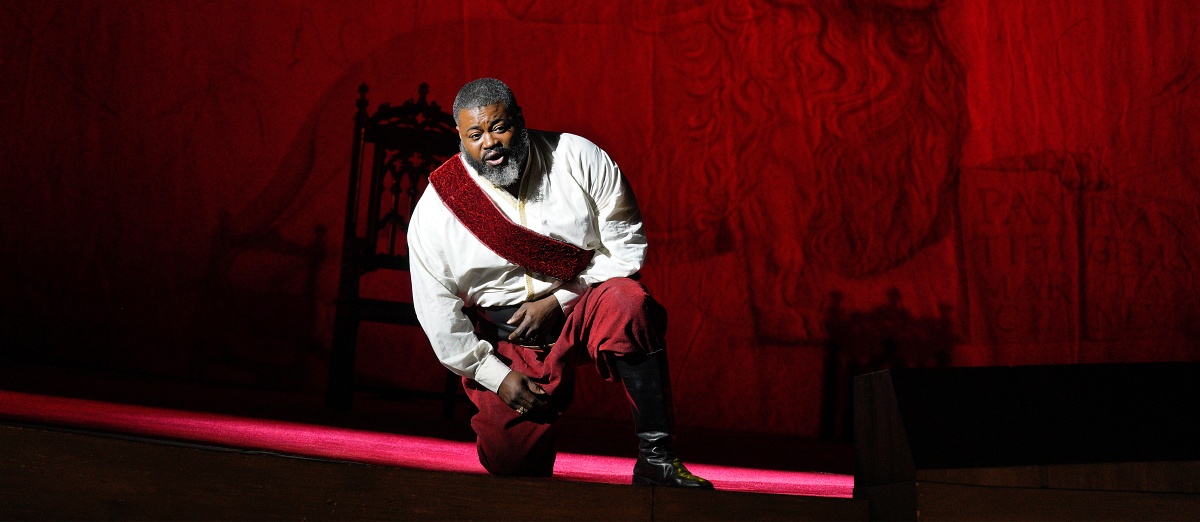
But William Shakespeare’s conniving Iago (played to the hilt by Moscow tenor Igor Golovatanko in Giuseppe Verdi’s operatic adaptation of the Bard’s tragedy) is in a class by himself when it comes to treachery. For not only does he stab Otello (Miami tenor Russell Thomas) in the back, he conspires and painstakingly manipulates Otello to be the unwitting author of the Moor’s downfall, which is carefully choreographed by the scheming Iago every step of the way. In this specific sense, Iago is more than a mere traitor, he is the puppeteer who masterfully pulls the strings that leads to Otello pursuing a course of action that causes his own undoing.
Verdi’s adaptation opens with a raging storm as Otello’s vessel braves the pounding waves and heaving seas to safely make it ashore at Cyprus to announce a military triumph by the Venetian forces over the Turkish fleet (ironically, the day I saw Otello, the authoritarian president Recep Tayyip Erdoğan was reelected in a tight runoff race). This tempest does not appear until Act II of Shakespeare’s play, as his Act I actually opens in Venice. By Verdi’s cutting to the proverbial chase, he presents a far more action-packed first act than the Bard did and in so doing provides a portentous start to this stormy saga about star-crossed and sea-tossed lovers in this opera where the music ranges from the heady and soaring, to sweet arias lightly sung by Rachel Willis-Sørenson who plays Desdemona.
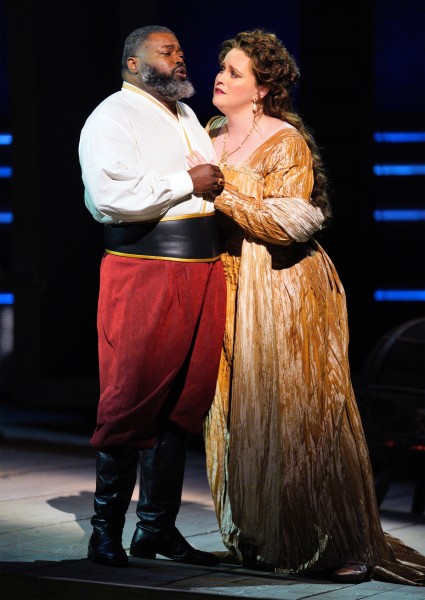
Now, in this version of Englishman John Cox’s original production with scenery by South African Johan Engels, the director of the work currently on the boards at the Dorothy Chandler, Canadian Joel Ivany, presents what may well be the most visually compelling tableaux I’ve ever seen in an opera. Deftly utilizing scrims and fellow Canadian Jason Hand’s evocative lighting, the scene looks like a 3-D movie – except, it really is three dimensional. Most provocative of all is the angle of the set; indeed, all of the sets seem askew, shown at odd angles, as if to emphasize how off-kilter this fever dream which Iago plunges poor Otello into is.
I believe the cinematic zest of Act I and all of the subsequent unusual angles of the opera’s various sets and scenes are due to the iconoclastic influence of that visual virtuoso Orson Welles, who helmed and played Othello in his 1951 masterpiece. That film won (in a tie) the Grand Prize at the Cannes Film Festival and the uncanny eye of Orson composed striking compositions of the picture’s locations, including Venice, elsewhere in Italy and Morocco. The location shooting looms as a virtual character in his movie. Welles’ classic is full of dazzling optical opulence, and I sense that Ivany and the Otello team are striving to emulate Orson’s impeccable pictorial panache with an onstage version of it, rendering some of the finest mise-en-scène this reviewer has ever seen at an opera.
(Note: Viewers may find it offensive that, despite their stratospheric stature in the arts, the white thespians Welles, Sir Laurence Olivier in 1965 and Sir Anthony Hopkins in 1981, among others, portrayed Othello in blackface.)
And what makes the sick Iago tick? Both Shakespeare and Verdi note that Otello the general has, due to his nautical victory over the Turks, risen in rank to become Governor of Cyprus. But in doing so, he has in turn overlooked Iago and promoted Cassio instead (Florida tenor Anthony Ciaramitaro), while Iago remains a mere ensign.
But the astute observer can surmise that something else is afoot besides failing to be promoted. Sure, this act can inspire treachery – when Nixon failed to make J. Edgar Hoover’s second-in-command the FBI chief after Hoover’s death, Mark Felt became the celebrated “Deep Throat” insider source who fed Washington Post investigative reporter Bob Woodward inside info that helped expose the Watergate break-in and coverup, leading to Nixon’s becoming the first U.S. president to resign that office.
But in Iago’s case, something else is also afoot: Race. Not only has the Moorish Otello risen in the military and political ranks of the Venetian Republic, but he has dared (against her father Brabantio’s express wishes and dire warnings, in Shakespeare’s original) to marry Desdemona (Washington State soprano Rachel Willis-Sørenson), who is not only years younger than the Moor (and lusted after by the Venetian gentleman Roderigo, whom Iago likewise hoodwinks and manipulates, played here by California tenor Anthony León), but is Caucasian.
Thus, what may have propelled Iago to become the dramatic arts’ über-traitor of all time, a Quisling for the ages, is that he was a white supremacist who objected to Otello and Desdemona’s true love and interracial marriage. Like LA Opera’s 2023 production of Omar by Rhiannon Giddens and Michael Abels (see: https://hollywoodprogressive.com/music/new-opera-opposes-white-supremacy), racism is at the heart of Otello, making this version of Shakespeare’s circa 1603 play and Verdi’s 1887 opera all too timely. Iago is arguably the prototypical, primal, ur, white racist of letters.
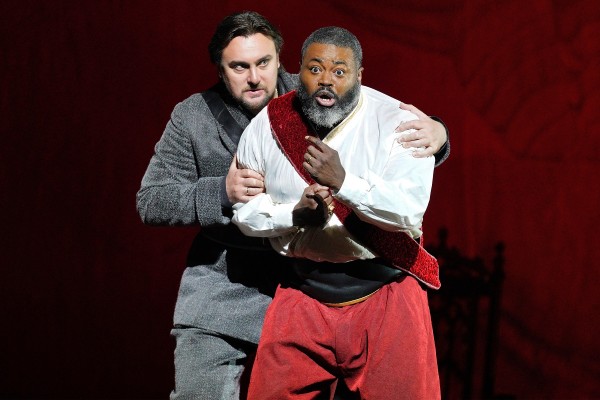
Although the play and opera is named after the Moorish general, the real protagonist of Otello is arguably Iago, because with all of his scheming and string-pulling, this traitor is really the character who is propelling the action forward in the drama. Strangely, during the curtain call following the three-and-a-half-hour opera with two intermissions, Golovatanko did not join his fellow cast members and conductor James Conlon onstage to accept their kudos. This clearly perplexed members of the audience who had wanted to express their appreciation to him for his fine performance and caused much comment and even consternation.
According to another member of the cast, this was because Igor Golovatanko had recently performed Otello for students, who booed him during the curtain call. This upset the Muscovite, as booing performers – even those who play villains – apparently is not the custom in Russia. The boos are likely also complicated by the current state of tension between Moscow and Washington, although I presume that most Americans (including this reviewer of Ukrainian ancestry) do not hold all individual Russians accountable for the war with Ukraine. What Golovatanko didn’t realize is that booing and hissing of bad guys at the end of a show is aimed at the character they play, not the artist, and that it is often a way of showing appreciation, in a lighthearted way, for a stellar performance. It is, in essence, a complement.
Be that as it may, in the denouement there were some unsatisfactory departures from Shakespeare and perhaps even Verdi in how Otello actually kills Desdemona and where. Furthermore, Iago heads for the hills, making a getaway, which is definitely not the case in the Bard’s original. But coming at the end of a tour-de-force, these are mere minor quibbles. Sadly, Otello marks the last opera of the current season, so to paraphrase Ann-Margret: “Bye Bye, Verdi!”
This being the case, opera lovers are still in for a treat, as An Evening with Renee Fleming is being mounted at 7:30 p.m., June 10 (see here.).
There are still two performances of LA Opera’s Otello left, at 7:30 p.m., Thursday, June 1 and Sunday, June 4, at 2:00 p.m. See: here at the Dorothy Chandler Pavilion, 135 N. Grand Avenue, Los Angeles CA, 90012; (213)972-8001.
