


As Black History Month came to a close, LA Opera opened its 2024/25 season with two Black-themed one-act operas.
HIGHWAY 1, USA & THE DWARF: Opera Review
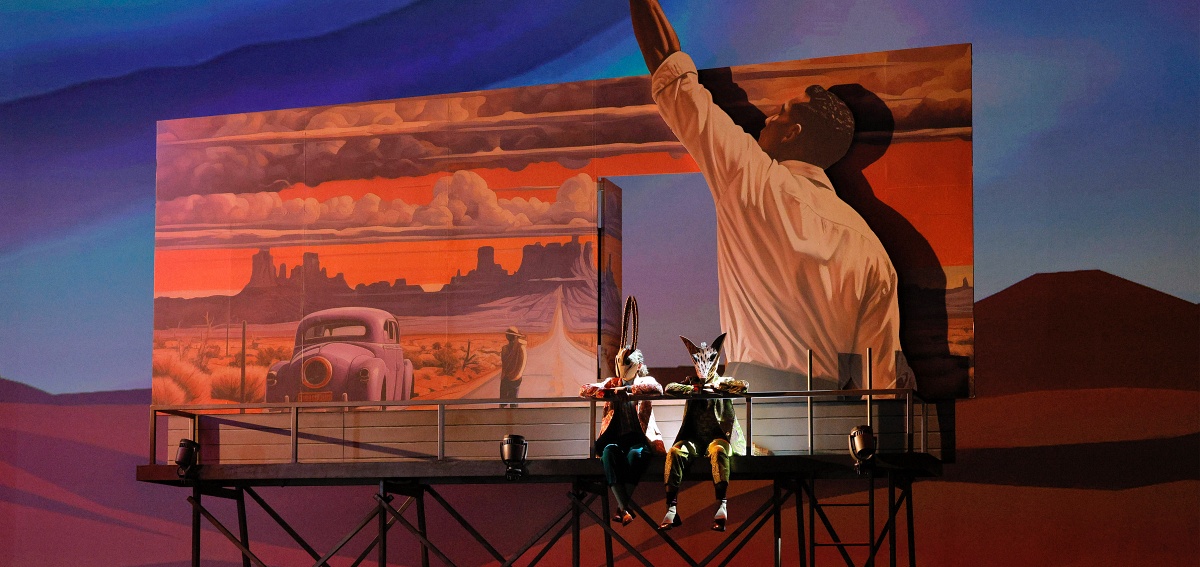
Composer William Grant Still’s little performed one-act Highway 1, USA with a libretto by Verna Arvey has a basic plot. Bob (Texan baritone Norman Garrett, who’d debuted at LA Opera’s 2022 Omar as Abdul) and Mary (Chicagoan soprano Nicole Heaston, whose LA Opera debut was in 2007 as Musetta in La Boheme) are a hard-working African American couple operating a gas station in an indeterminate locale, although a mural in the set (co-designed by Amy Rubin and Cheyanne Williams) suggests that the story takes place someplace out West, such as perhaps Arizona. The time period is likewise unspecified, although Still wrote the opera’s music during the 1940s, and one can readily imagine Highway 1, USA occurring in postwar America and into the 1950s or early 1960s.
Bob had made a solemn deathbed pledge to his ailing mother to take care of his younger brother, Nate (Missouri tenor Chaz’men Williams-Ali in his LA Opera debut). The sacrifices Bob makes to raise and put his supposedly intellectually gifted sibling through university has cost Bob and Mary much. All of their scrimping and saving has set the married couple back with their own life plans. But once Nate graduates, instead of ending his being a burden on Bob by getting a job with his hifalutin’ degree, he moves in with the couple, making matters even worse. Now this archetypal “Minnie the Moocher” is impinging on the couple’s privacy, as well as their pocketbook.
The course of events eventually spark tragedy with an act of betrayal. As played by Williams-Ali, Nate’s hair is coiffed like that of many prominent Blacks of the era, with what looks like apparently straightened – or what Malcolm X called “conked” – hair. The kind of hairstyle that members of the Black bourgeoisie, such as Congressman Adam Clayton Powell, wore at the time. I couldn’t help but feel Highway 1, USA contained a critique of the Black elite, “intelligentsia” and upper class dandies who sponge off of and exploit hard working Black salt of the earth proletarians like Bob and Mary.
I couldn’t help but feel Highway 1, USA contained a critique of the Black elite, “intelligentsia” and upper class dandies who sponge off of and exploit hard working Black salt of the earth proletarians like Bob and Mary.
The one-act opera includes interesting stylized mask motifs depicting a fox (dancer Kiara Benn, who choreographed LA Opera’s 2022 Omar) and a rabbit (Cheyanne Williams in her LA Op debut), symbolic figures derived from African American/African folklore. For instance, the Brer Rabbit character is a trickster whom the crafty Brer Fox always wants to capture and eat in oral tradition and so-called “Uncle Remus” tales. Highway 1, USA’s costumes are designed by Charles Antoinette Jones, who garbs other members of the largely all-Black cast in period apparel.
Co-scenic designers Amy Rubin and Cheyanne Williams have rendered mobile, nimble sets with realistic details depicting the gas station, Bob and Mary’s home, a barbershop and a backdrop that may be a mural or billboard evocative of Monument Valley, with the figure of a man pointing, for some reason, towards the heavens. (If this show was called Area 51, USA instead of Highway 1, USA, he might have been pointing at flying saucers.) The production design is by Christopher Myers, and Kaneza Schall helms her large cast and all of the moving sets adroitly.
Librettist Verna Arvey, who was of Russian Jewish ancestry, was composer Still’s wife at a time when interracial marriages were rarities. The story of Highway 1, USA at times put me in mind of the Gershwins’ far more frequently staged Porgy and Bess – the sung dialogue between Bob and true-blue Mary reminded me of Porgy’s declaration: “Bess, you is my woman now,” although Highway’s characters speak grammatically correct English. The music, conducted by James Conlon, and the singing of this long-neglected opera are high quality, and although Arvey’s lyrics are sung in English, there are also English language supertitles.
According to press notes, “William Grant Still (1895-1978) [was h]ailed as ‘the dean of African-American composers’… the first Black composer to have a symphony performed by a major American symphony orchestra (Symphony No. 1, ‘Afro-American,’ at the Rochester Philharmonic in 1931) and the first to have an opera produced by a major American opera company (Troubled Island at New York City Opera in 1949). He became the first Black conductor to conduct a major American symphony orchestra when he led the Los Angeles Philharmonic in a 1936 concert of his own compositions at the Hollywood Bowl. He wrote more than 150 works, including operas, ballets, symphonies and chamber pieces. Despite his successes… his operas became less frequently performed over time. Composed in the 1940s, Highway 1, USA wasn’t performed until 1963 and received its professional premiere only in 1972. The opera didn’t have a major professional production until it was presented by Opera Theatre of Saint Louis in 2021.”
Highway 1, USA proves that, to paraphrase an old saying: “Still water runs deep.” The audience gave the cast and crew of this Los Angeles premiere a rousing standing ovation and I’m confident most of my fellow operagoers share my hardy sentiment to as part of the opera’s “Recovered Voices” initiative, shower LA Opera with laurels for rescuing Still’s Highway 1, USA from obscurity, driving down the highway to operatic oblivion by producing it and giving Angelenos an opportunity to enjoy it.
THE DWARF: MONSTER’S BALL
The second one-act production on LA Opera’s double-bill presented after an intermission could be called part of a “creature feature,” as the title character of Alexander Zemlinsky’s The Dwarf is a stunted hideously deformed hunchback with crooked legs. On the surface, the plot of The Dwarf seems as straightforward as Highway 1, USA – but beneath its exterior, this opera, which adapts Oscar Wilde’s short story The Birthday of the Infanta, is redolent in metaphorical meaning.
Here’s an outline of the plot: Courtiers, servants and celebrants are gathered in a sumptuous hall in 17th century Spain to salute the 18th birthday of the beautiful Donna Clara, the Spanish Infanta (Rhode Island soprano Erica Petrocelli), a royal title similar to princess. To mark this auspicious occasion a splendid party is to take place, with guests bearing special gifts sent far and wide by monarchs around the world. Borne aloft in a chest on poles carried by bearers carrying a litter is the title character (New York tenor Rodrick Dixon reprises the role he played in LA Opera’s 2008 The Dwarf), a gifted musician who is clad in gaily colored exotic garments.
However, the troubadour is woefully unaware of his short stature and misshapen appearance. Those who have surrounded the Dwarf have covered mirrors so he can’t see how ugly and ridiculous he appears to others. Thus he assumes that when people laugh at him it is a sign of how friendly they are, as opposed to being the derisive mockery it really is. Realizing that the Dwarf has absolutely no idea how he looks, the narcissistic, privileged blonde Infanta rather wickedly leads him on as a jest at the expense of the poor misbegotten creature. The rest of the court plays along, with the exception of Ghita, the Infanta’s favorite maid (New York soprano Emily Magee), and the cruel ruse has tragic consequences.
Such is the bare bones of the story, but one can read deep meanings into this sad saga. As I recall, in the 1981 Barbra Streisand movie All Night Long, Gene Hackman’s character invents a unique mirror that lets one see him/herself as others see you, not as a reflection in a conventional mirror that actually reflects a reverse image. In other words, one can see one’s self as one really is, not as the illusion we often imagine ourselves to be. For instance, the deranged Donald Trump may jump through psychological and ideological hoops to delude and con himself (and his Trump chumps) into believing he is some sort of Alexei Navalny, the recently deceased Russian dissident who Putin imprisoned in a Siberian gulag, instead of the privileged, pampered owner of the resplendent Mar-a-Loco and other hoity toity chateaus and clubs. In The Dwarf, the eponymous creature has a rather rude wake up call that shatters his self-image and esteem.
But on a much deeper level, this production of The Dwarf is an allegory about racism. All of the cast’s major characters are Caucasian – except for the eponymous Dwarf, who is Black. In the opera, which has a libretto by Georg C. Klaren, the title character is identified as being a gift of a “Sultan,” which suggests a present from a potentate in the “exotic East” (today, the formal title of sultan is only bestowed upon hereditary rulers from Brunei, Malaysia and Oman). In Oscar Wilde’s original short story which this opera adapts, The Birthday of the Infanta, some of the princess’ presents are brought by “Egyptians – as the gypsies were termed in those days” (today they are called “Roma”).
It’s important to remember that the Irish poet and playwright Oscar Wilde, author of the 1891 (the same year Wilde wrote Infanta) leftwing essay The Soul of Man Under Socialism, was one of – if not the most – prominent individuals publicly persecuted and imprisoned for homosexuality. To make a long story short, byy 1895 Wild Oscar was charged with indulging in “the love that dare not say its name” and convicted, serving two years behind bars for the “crime” of being gay.
The composer of the adaptation of Wilde’s short story, Alexander Zemlinsky, also knew a thing or two about and oppression. An Austrian Jew, when Hitler came to power, Zemlinsky fled Germany in 1933 moving to Vienna and as the Nazis ascended across Europe he escaped to New York via Prague, dying in obscurity in 1942 America.
By casting a Black performer to play the tortured, deformed protagonist, who is so cruelly mistreated by the predominantly white court and nasty princess, this production makes a profoundly powerful commentary.
So, creators of The Dwarf experienced persecution firsthand, and by casting a Black performer to play the tortured, deformed protagonist, who is so cruelly mistreated by the predominantly white court and nasty princess, this production makes a profoundly powerful commentary. To be clear, this is not to say that being Black is analogous to deformity, but rather that personal bigotry and systemic racism are crippling phenomena that can reduce somebody into being what Herbert Marcuse eloquently called “one-dimensional man.” One may not perceive oneself to be “handicapped,” but what happens when this is how others view and treat you? How can one then be equal or beautiful or three-dimensional in a flattened-out, bigoted paradigm prejudiced against you?
In addition to great, sonorous music and stellar acting, New York scenic designer Ralph Funicello renders a palatial, sumptuous set, that looks like one of those grand royal halls Viking Cruises takes passengers to visit. When the curtain lifts, we get a tantalizing glimpse of a magnificent hallway lined with glass doors wherein the Dwarf may get a glimpse of himself, and see how others view him. It is simply among the most splendid sets this longtime reviewer has ever laid eyes upon on any stage, gorgeous to partake of. The image seen on the show curtain at the start of the opera, is the 1656 painting Las Meninas (or “The Ladies in Waiting”) by Diego Velazquez, the greatest dauber of the Spanish Baroque style, who depicts two dwarves plus himself within the painting in a self-portrait beside an easel.
The visuals are also enhanced by lighting designer Pablo Santiago of Chiapas, Mexico. When the performers sing about blood orange colors, the set is bathed in that exact hue. New Yorker costume designer Linda Cho’s raiment pulls one right into 17th century Spain with period thread, bestowing some realism on a most unreal, surreal scene. Bill Burns’ choreography also gives us a sense of how Spaniards got down and boogeyed in the 17th century. From eliciting intricate, tearful performances to pulling all of the visual and aural elements together, Serbian director Darko Tresnjak does admirable, yeoman’s work, as James Conlon’s baton works its magic, expertly guiding LA Opera Orchestra. And in both of the evening’s operas, chorus director Jeremy Frank of Montana harnesses the soothing sounds of his legion of lyrical singers.
If you have a heart The Dwarf shall surely break it. The multi-culti audience at the Dorothy Chandler gave the opera and Rodrick Dixon, for his towering portrayal of the diminutive Dwarf, a well-deserved, thunderous standing ovation. With this curtain raiser on the 2024/25 season, LA Opera is off to a promising, thrilling start. Bravo!!!
Highway 1, USA and The Dwarf is being performed through March 17 on March 3, 2024, at 2:00 p.m., March 6, 2024, at 7:30 p.m., March 9, 2024, at 7:30 p.m., March 14, 2024, at 7:30 p.m., March 17, 2024, at 2:00 p.m. at the Dorothy Chandler Pavilion, 135 N. Grand Avenue, Los Angeles CA, 90012. For tickets and info, go here; (213)972-8001.
