

Agog at Puccini’s Gong Show

If the plot in this opera—with plenty of sharpening of the executioner’s scimitar on the grindstone sparks a-flyings—Puccini’s music is glorious.
TURANDOT: Opera Review
So, let’s get this out of the way first: Giacomo Puccini’s Turandot, which is set in medieval China, has so much “orientalism” in it that the late scholar Edward Said likely rolls over in his grave every time this opera is performed. The issue of Performances Magazine devoted to LA Opera’s production of Turandot includes something I haven’t noticed before in any of the programs for operas staged at the Dorothy Chandler Pavilion before: a disclaimer. It states: “Turandot is a masterpiece that contains imagined, outdated and inaccurate representations of Asian culture. LA Opera has worked in consultation with the Asian Opera Alliance, who have offered input on how to present the work with greater consciousness, care and context while maintaining fidelity to the original opera…” Turandot’s caricaturish other-ization of Asians led to the opera’s being banned in China and is enough to make ethnically aware and sensitive theatergoers slap their foreheads in disbelief and exclaim in disbelief: “Holy Mao!”
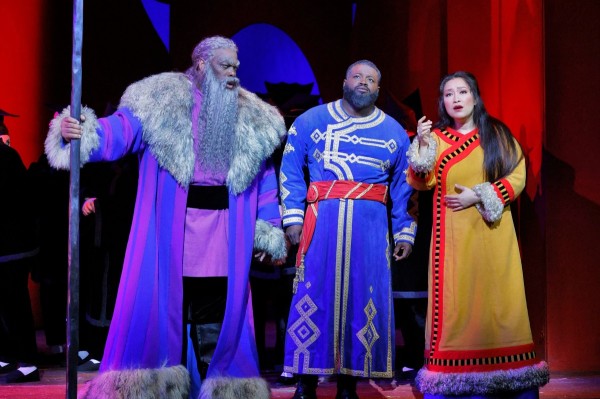 Morris Robinson as Timur, Russell Thomas as Calaf and Guanqun Yu as Liu in LA Opera's 2024 production of "Turandot"
Puccini, who also composed the Japan-set Madame Butterfly, probably never visited China (or Persia), and I doubt the Italian composer conducted extensive historical research into what Peking (now Beijing) was like during the Middle Ages. He reportedly did look into traditional Chinese music, which Puccini incorporated into his score. The story for Turandot was derived from several sources: Persian poetry, Middle Eastern folklore and plays, including one by Friedrich Schiller (who also wrote the lyrics for the “Ode to Joy” in the final movement of Beethoven’s immortal Ninth Symphony). They influenced Puccini and his librettists, Giuseppe Adami and Renato Simoni (Puccini died before composing the third act’s final duet, which was completed by Franco Alfano).
Seventeen months after Puccini’s death, Turandot premiered at La Scala in Milan, during the period when fascist dictator Benito Mussolini ruled Italy. I doubt that the play’s racial politics troubled Il Duce and his followers. Having noted Turandot’s cultural misappropriation and misrepresentation of the “Orient” by Europeans in its contents, let’s move on to this version of the opera’s stellar style and formidable form.
Puccini’s sophisticated orchestration for Turandot is noted for its tonality. The opera opens on ominous notes that are similar to the soundtrack for a film noir-ish crime thriller. The “crime” being performed in the opera is that suitors from around the world travel to Peking to woo the title character (played by Washington-state soprano Angela Meade), daughter of Emperor Altoum (LA tenor Ashley Faatoalia, whose name sounds Samoan). In order to win Turandot’s hand in marriage, the would-be beaus must provide the correct answer to three riddles that the princess announces. However, this is a high-stakes game, as failure to do so results in execution. Three severed heads hang from rooftops in the opening scenes, and so far, in the year this fanciful story is set, 13 men have died trying to crack the code of Turandot’s verbal puzzles and were executed, including the most recent, the Prince of Persia (Sung Bong Kim).
This curious contest reminded me of those insipid TV game shows/reality shows, such as The Bachelorette or The Bachelor. Although Turandot’s competition can have an outcome far deadlier than being humiliated on coast-to-coast television.
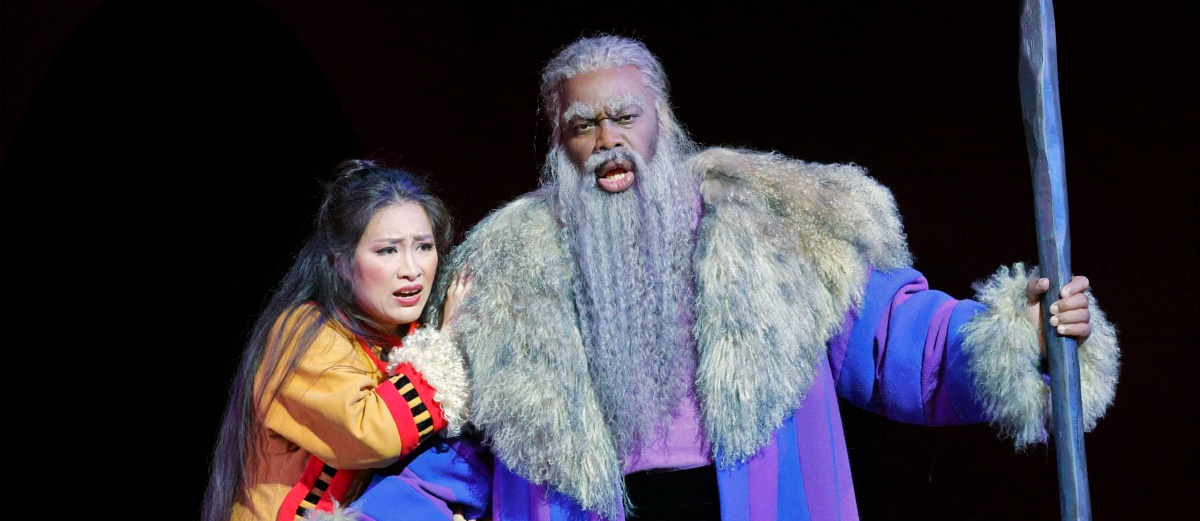
Nevertheless, one ardent young man, so smitten by Turandot’s ravishing beauty, decides to risk all and seek her favors. He is secretly Calaf, the Unknown Prince (Miami tenor Russell Thomas, an LA Opera regular whose many roles have included the title character in 2024’s Otello by Puccini’s fellow Italian, Verdi), whose father is Timur (Atlanta bass Morris Robinson, another LA Opera veteran), the blind and aging dethroned King of the Tartars, who is guided by the enslaved woman Liu (Shanghai soprano Guanqun Yu).
It turns out that Turandot has a beef with Tartars—according to the opera, they are enemies of China who ravished the princess’ grandmother Princess Lo-u-Ling. Nevertheless, enraptured by Turandot, like in the logo for the Rank films, Calaf literally bangs the gong to get it on and pursue the princess, even considering all of the hazards (such as losing one’s head, literally) this entails. Without revealing any plot spoilers, from a Freudian POV, the rape of Lo-u-Ling has turned Turandot off to men, and this idiotic contest to win her affections seems to be a psychological ruse for the emperor’s daughter not to lose her clothes and “virtue.” How will that saucy Tartar Calaf overcome Turandot’s objections?
If the plot in this opera—with plenty of sharpening of the executioner’s scimitar on the grindstone sparks a-flying, executions and torture is chillingly weird, as well as full of cultural tropes—Puccini’s music is glorious. Calaf’s aria “Nessun Dorma,” sung in Act III, is simply some of the most sublime singing in world history, and Russell Thomas acquits himself well, under the baton of the redoubtable James Conlon.
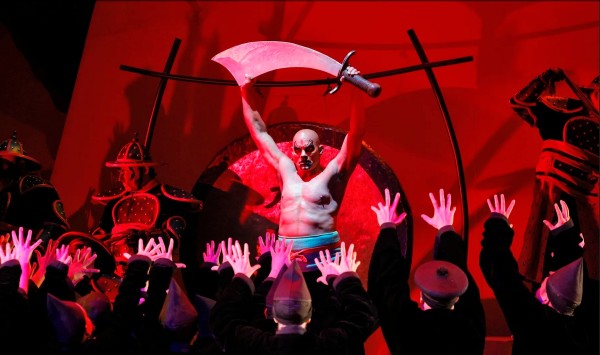 Lawrence Dillard as the Executioner in LA Opera's 2024 production of "Turandot"
The sets by scenic designer David Hockney are anything but hackneyed. They are extremely stylized and were originally rendered in 1992 by the great English painter, proving he can do much more than merely daub swimming pools. There is a not-to-be-missed exhibition of photos of Hockney’s sets for various operas on the third floor of the Dorothy Chandler, displayed free of charge for operagoers.
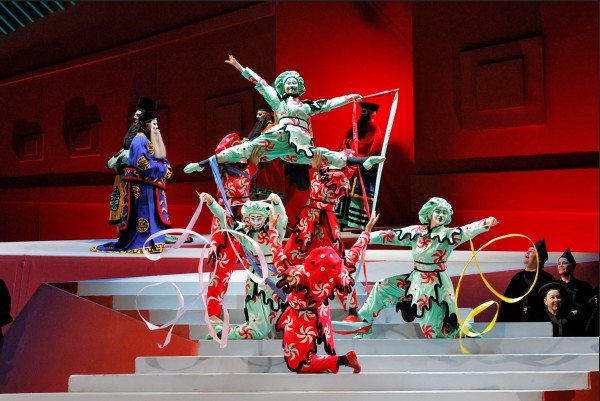
Connecticut costume designer Ian Falconer’s outrageous apparel for his cast is eye-catchingly radiant. Some of the outfits seem like a cross between Harlequins’ garb and the late-in-life cut-outs Matisse made of Polynesia. They confer comic panache onto the opera’s three court officials, Ping (Illinois baritone Ryan Wolfe), Pong (Korean tenor Julius Ahn) and Pang (Florida tenor Terrence Chin-Loy). In this production, the amusingly (if, perhaps, culturally insensitively) monikered Ping, Pong and Pang are played mostly for laughs, like the way Westerners who have never set foot in Asia might imagine Chinese Three Stooges to behave.
The lighting by original lighting designer Thomas J. Munn and revival lighting designer Gary Marder is often moody, and in the first scene of Act II, when Ping, Pong and Pang meet, the light beautifully illumines a Chinese painting depicting a landscape with bamboo. Director Garnett Bruce of Washington, D.C., has a sort of bird’s eye view, in the sense that he adroitly pulls all of the disparate elements together. Ohioan choreographer Kitty McNamee also adds some whimsy, including a number of skilled acrobats.
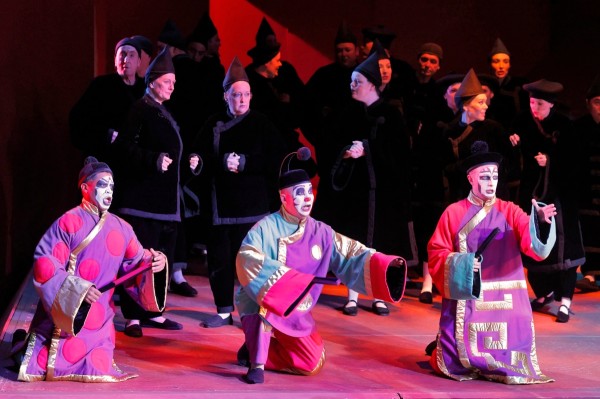 Terrence Chin-Loy (Pang), Julius Ahn (Pong) and Ryan Wolfe (Ping) in LA Opera's 2024 production of "Turandot"
Despite reservations due to the cluelessness about Chinese culture and history (Puccini really seems to be working out his own critique of sexual repression and setting his theme in an exotic, faraway land), this production of Turandot may well be the greatest mass spectacle I’ve ever had the pleasure and privilege to behold at an indoor space. At the final curtain the sold-out audience—which included many Asian ticket buyers—gave a long, standing ovation punctuated by many “bravos” to the cast and LA Opera Orchestra. It almost seemed like the applauding throng was shouting, almost 100 years after his death: “WE STILL LOVE YOU LONG TIME PUCCINI!”
Turandot is sung in Italian with English supertitles and being presented June 2 at 2:00 p.m. and June 5 and June 8 at 7:30 p.m. at the Dorothy Chandler Pavilion, 135 N Grand Avenue, Los Angeles CA, 90012. For tickets: go here; (213) 972-8001.
