

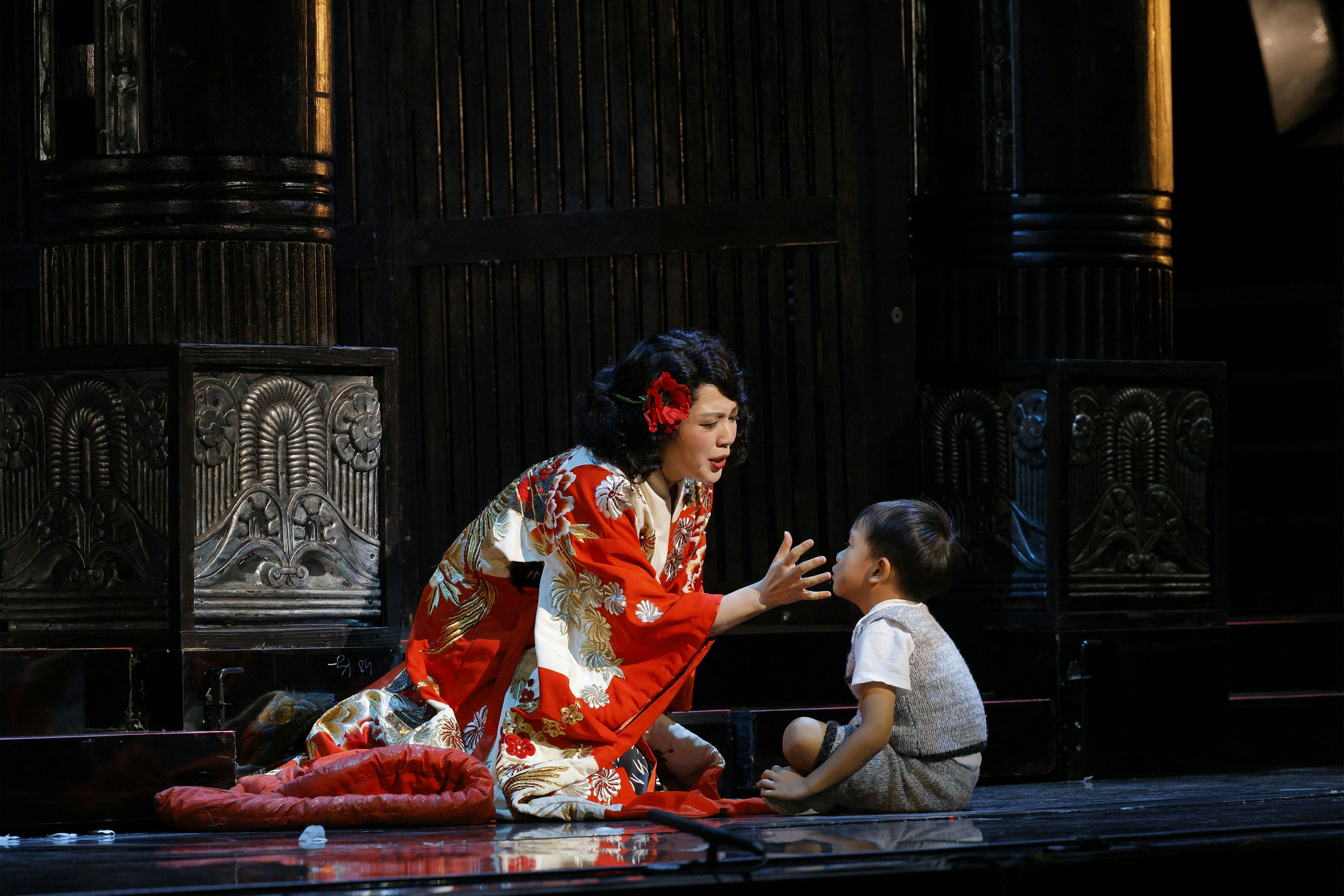

The offbeat production conceived by Uruguayan/Spanish creator Mario Gas presents the drama unfolding on the soundstage of a Tinseltown movie studio, with the footage of the onstage live action actually being shot by a visible camera crew
MADAME BUTTERFLY: Opera Review
East meets West productions without interracial hanky-panky are like Aunt Jemima’s pancakes without the syrup, and Giacomo Puccini’s legendary Madame Butterfly – which kicks off LA Opera’s 2024/25 season – epitomizes this dramatized trend of cross-cultural romance.
This version of Puccini’s tragedy, with a libretto by Giuseppe Giacosa and Luigi Illica, has “a Hollywood twist,” according to an LAO press release. For some reason, the offbeat production conceived by Uruguayan/Spanish creator Mario Gas presents the drama unfolding on the soundstage of a Tinseltown movie studio, with the footage of the onstage live action actually being shot by a visible camera crew. The cinematic imagery is simultaneously projected in glorious black and white on a screen above the stage and the supertitles translating the lyrics from Italian into English.
Otherwise, Puccini’s racially and gender fraught story is much the same since it premiered 120 years ago on February 17, 1904 at La Scala, Milan. U.S. Naval Lieutenant Benjamin Franklin Pinkerton (Chilean tenor Jonathan Tetelman, who resembles pillow salesman Mike Lindell) decides to indulge his lust by taking a Japanese “bride” while he is stationed in Nagasaki. Money-grubbing marriage broker Goro (Filipino tenor Rodell Aure Rosel) arranges for Pinkerton to “wed” the kimono clad Cio-Cio-San, who is nicknamed “Madame Butterfly” (South Korean soprano Karah Son in her LAO debut), and a ceremonial “wedding” takes place at the Japanese-style house with sliding shoji and a glorious view of Nagasaki harbor Pinkerton has rented on the cheap also from Goro, like the American’s “marriage” to the “wife” he’s essentially renting is inexpensive.
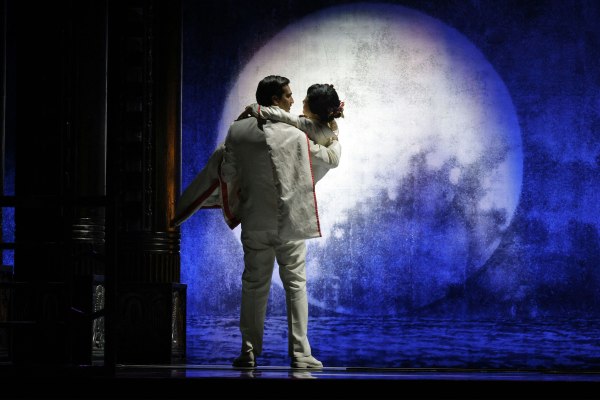 Jonathan Tetelman as Pinkerton and Karah Son as Cio-Cio-San. (Photo: Cory Weaver)
Their wedding party is crashed by Cio-Cio-San’s uncle the Bonze (Chinese bass Wei Wu), a Japanese priest infuriated that his niece is forsaking her age-old religion (which is unidentified but may be Buddhism), and hence, he contends, her ancestors and culture, by marrying the Yankee Doodle Dandy and adopting Pinkerton’s Christian religion and lifestyle. The Bonze renounces and denounces Madame Butterfly and along with most of her relatives, abandons her, and Cio-Cio-San turns to her American “husband” for comfort.
What makes Cio-Cio-San tick and Madame Butterfly’s wings flutter? She may be wildly naïve and unknowing of the ways of the world: She’s only 15 years old. After her patrician father lost his position (and, it’s implied with portentous music, committed hara-kiri), Cio-Cio-San confesses to being subjected to genteel poverty, and having to make her living as a geisha.
In some Third World societies, an American passport is considered by part of the poverty-stricken populace as the “sexiest thing in the world,” and the young Japanese woman-child may view Pinkerton as a way out of traditional patriarchal Japan and her ticket to the “modern” USA. Given their age difference – the lieutenant seems to be anywhere from his twenties to mid-thirties – Cio-Cio-San may have “daddy issues,” which may play into her infatuation with Pinkerton. Another possible motivation for Madame Butterfly besides materialistic and status concerns may be that she genuinely desires Pinkerton – a case of “opposites attract.”
The American’s motives seem clearer. Away from home (on Uncle Sam’s dime and time), Pinkerton appears ready to take a walk on the wild side, to satiate his lotus blossom fixation by romancing a woman from the “mysterious East.” If Spike Lee called white-Black relationships “Jungle Fever,” lusting after Oriental females, the US Naval officer may have a case of “yellow fever.” The sexual correlative to the conquest of colonialism and imperialism is “conquering” the women of the subject people by bedding them. Like his lease on the home, the blithe Pinkerton’s “nuptials” can also be annulled on a monthly basis. He confesses to the US Consul Sharpless (Texan bass-baritone Michael Sumuel) that eventually he’ll make a “real” marriage when he settles down with an all-American wife (translation: Caucasian, not Asian). The character appeals to Western male chauvinists because Pinkerton was only a lieutenant, not a captain or admiral, nor was he rich, but nevertheless he could still possess an “Oriental” woman and even drive her mad with sorrow, because he was white.
Poor Cio-Cio-San knows nothing about Pinkerton’s opportunism and appears to be under the impression that her “husband” is truly in love with her. In any case, one thing seems sure: By today’s standards, given the lieutenant’s sexual affair with an underaged minor, he would likely be considered a pedophile. The racial and sexual politics of Madame Butterfly are quite eyebrow-raising, and LAO’s website includes this “note”: “LA Opera acknowledges that many classic works in the operatic repertoire depict racial and gender stereotypes, and Madame Butterfly portrays inaccurate representations of Asian culture. Our presentation of this opera has been prepared in consultation with the Asian Opera Alliance, which encourages companies to continue producing these works with care and appropriate input to examine, acknowledge and mitigate potential harm.” (As I noted in a previous review: “Puccini’s Turandot, which is set in medieval China, has so much ‘orientalism’ in it that the late scholar Edward Said likely rolls over in his grave every time this opera is performed.”).
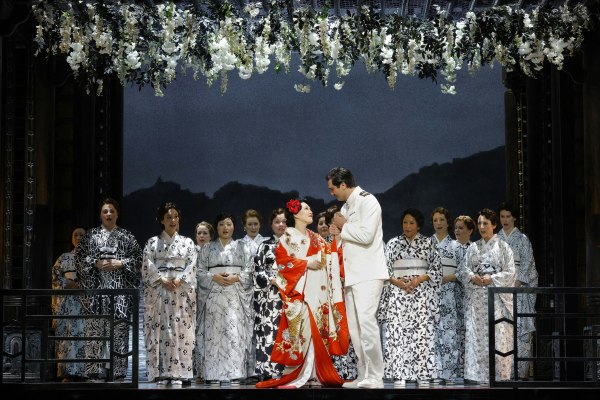 Karah Son as Cio-Cio-San and Jonathan Tetelman as Pinkerton. (Photo: Cory Weaver)
The considerate Consul has counseled Pinkerton to be careful in his dealings with Madame Butterfly. Tellingly, in this production Sharpless is Black – presumably he knows the ways of white privilege. Of course, the Naval lieutenant shrugs off the diplomat’s warnings, and inevitably, his callow behavior leads to tragedy in Nagasaki – just as Nagasaki was plummeted into the nuclear abyss about 40 years later on August 9, 1945 when other American servicemen dropped the “Fat Boy” plutonium bomb on the port city, vaporizing and irradiating tens of thousands of Japanese.
Of course, in 1904 Puccini had absolutely no way of predicting the atomic bombing of Nagasaki. But one does wonder what his intention was in depicting the East meets West romance of Cio-Cio-San and her guileful lieutenant? Did Puccini intend to critique American meddling in Asia, just at the point in US history when Washington became a global, imperial power and empire? For instance, why was the male protagonist named “Benjamin Franklin Pinkerton”? Obviously, for the Italian composer and his librettists, the first and middle name were redolent with Americanism. But the Pinkerton detective agency had already been around for half a century. In any case, that was already the name of the lead male character in the one-act play David Belasco adapted from John Luther Long’s short story Madame Butterfly, which served as the basis for the opera. So, were Long and Belasco making some sort of sly reference to the Pinkertons, who were also notorious strikebreakers?
I have no idea, but I do know that Cio-Cio-San’s divine aria, “Un bel di,” is one of the most beautiful artistic evocations of longing ever rendered. Karah Son’s flawless rendition of Puccini’s beloved, famed aria caused the near-sold out crowd at the Dorothy Chandler Pavilion to erupt in rapturous applause, accompanied by multiple well-deserved cries of “BRAVO!” Truly, a moving moment few but Puccini could ever conjure up, as channeled through the voice and acting of the exquisite Karah Son. Although this isn’t the case with all operatic performers who are selected more on the basis of their voices than on their looks, but Karah Son’s personal beauty is a real-life counterpart to the character she’s portraying. This was all the more important because of Mario Gas’ close ups of the dramatis personae on the screen above the stage.
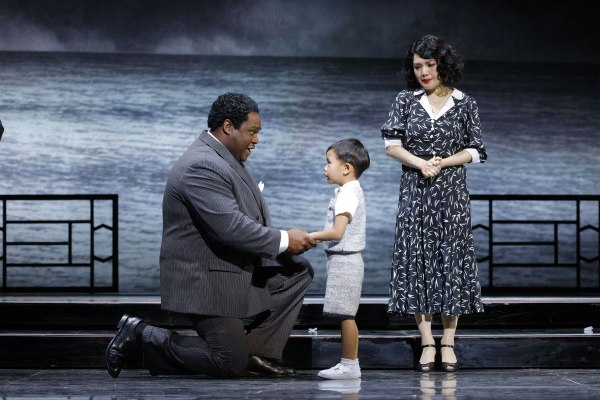 Michael Sumuel as Sharpless, Enzo Ma as Cio-Cio-Son's Child, and Karah Son as Cio-Cio-San.
Although Jonathan Tetelman’s Pinkerton comes across as callow, the genuine grief he expresses at Cio-Cio-San’s fate was convincing – maybe it wasn’t just a casual fling for him but true love, albeit with a nonwhite woman, which segregated Jim Crow America would never accept circa 1904.
As the scheming marriage broker Goro, Rodell Aure Rosel delivers a sly, scene stealing comic performance that includes an amusing sight gag. Although he has little stage time, Wei Wu’s Bonze makes an indelible impression. Is his character an Asian “Yankee go home” type of nationalist, resisting “whitey’s” encroachment of his niece, the Americanization of Cio-Cio-San, as a form of her being a “race traitor”? Is he fighting for the pride and dignity of the Japanese people vis-à-vis the Western invaders/intruders? (One can’t help but wonder if the name of the movie chimp Bonzo, who costarred with Ronald Reagan in a 1951 comedy, was derived from this nationalistic character in an effort to demean him? Inquiring minds want to know.)
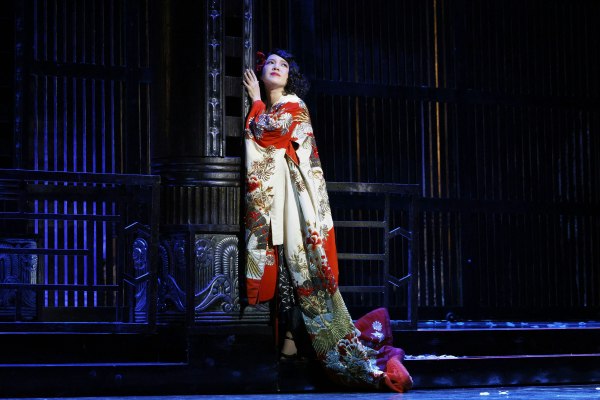 Karah Son as Cio-Cio-San. (Photo: Cory Weaver)
Italian scenic designer Ezio Frigerio’s optically opulent Japanese-style sets are eye-candy, as are lovely backdrops of Nagasaki harbor, of the moon, etc. Italian costume designer Franca Squarciapino, who won an Oscar for 1990’s Cyrano de Bergerac, enhances the sense of time and place with her “Oriental” apparel and Navy uniforms for this period piece. Atlanta’s Brenna Corner’s stage direction has an overall visual sense of where all the pieces of the puzzle go and with chorus director Jeremy Frank, an unerring ear for the sounds evoked from the cast. And conductor James Conlon energetically twirls his baton like a magic wand, eliciting aural enchantment from Puccini’s peerless score.
As for Mario Gas’s wedding of the cinematic image above to the live action below, it’s an interesting, innovative technique which I’ve seen (at least partially) in some plays, but never before in opera. The close ups are evocative and some of the black and white cinematography is reminiscent of film noir. But why the mise-en-scene is set in a Hollywood studio’s soundstage is head scratching. LAO’s playbill contends that under the Hays Code, “such a film would never have been allowed because of its depiction of an interracial romance” during the 1930s. But as a film historian I’m not so sure this is true re: “Occidental” and “Oriental” characters during that era. Cary Grant and Sylvia Sydney costarred as Pinkerton and Cho-Cho-San in a 1932 adaptation of Belasco’s play Madame Butterfly and in 1915, “America’s Sweetheart,” Mary Pickford played Cho-Cho-San (presumably, like Sydney, in yellowface) in an adaptation of Long’s short story. During the 1930s there were also interracial love affairs between Westerners and Polynesians, notably in 1935’s multiple Oscar-winning Mutiny on the Bounty, with Clark Gable.
Does Gas’s filmic conceit add another dimension to the opera being performed live onstage? Or is it just a gimmick to jazz things up, to try and sell a 120-year-old opera as something “new”? Does it enhance the opera, or merely distract from and intrude upon the time-tested action down below, live on the boards? It all may be in the eye of the beholder, but in the ear of the operagoer, Puccini’s sonorous music still rings true. Even if its racial and sexual politics raise serious questions, with this production of Madame Butterfly featuring the magnificent Karah Son, LA Opera’s new season is off to a promising start.
Madame Butterfly is sung in Italian with English supertitles and being presented Thursday, September 26 at 7:30 p.m.; Sunday, September 29 at 2:00 p.m.; Saturday, October 5 at 7:30 p.m.; Wednesday, October 9 at 7:30 p.m.; Sunday, October 13 at 2:00 p.m. at the Dorothy Chandler Pavilion, 135 N Grand Avenue, Los Angeles CA, 90012. For tickets: go here; (213)972-8001.
For more on the subject of stage and screen stereotypes about racial and sexual politics see:
