

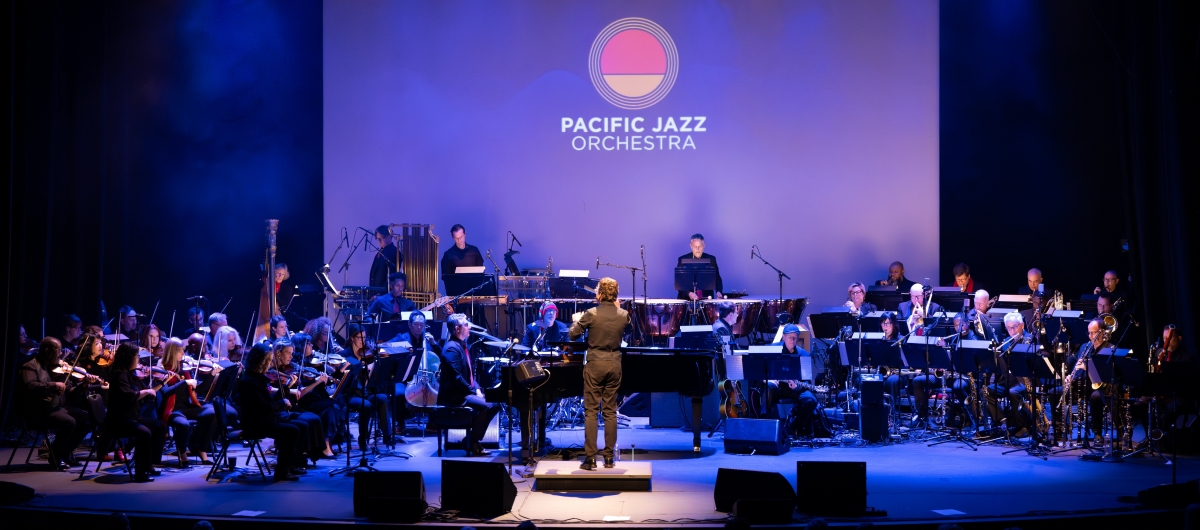

Pacific Jazz Orchestra’s set at the 500-seat Bram Goldsmith Theater blasted off with Jones blowing Davis’ upbeat, positively jaunty, toe tapping “Milestones”.
MILES & TRANE AT 100: Concert Review
To pay – or rather, play – tribute to the 100th anniversary of the 1926 births of trumpeter Miles Davis and saxophonist John Coltrane, Pacific Jazz Orchestra swayed Beverly Hills on May 28 with a concert featuring many of these jazz trailblazers signature pieces plus standards they’d covered in their inimitable ways. A 40-piece hybrid big band and string orchestra, PJO was joined in its Miles & Trane at 100 homage by special guests pianist Emmet Cohen, trumpeter Sean Jones and saxophonist Jacob Scesney.
According to press material, “Davis and Coltrane created a seismic shift in jazz during their fertile five-year musical collaboration from 1955 to 1960. They are hailed for producing landmark albums infused with a then-novel style of jazz called modal improvisation, which focuses on color and tonality for the harmonic framework, rather than chord progressions, providing the soloist greater freedom when improvising.”
Andrew Synoweic • Sean Jones
Pacific Jazz Orchestra’s set at the 500-seat Bram Goldsmith Theater of the Wallis Annenberg Center for the Performing Arts blasted off with Jones blowing Davis’ upbeat, positively jaunty, toe tapping “Milestones”. During the course of the 90-ish minute concert, the songs ranged across the sonic spectrum, to Trane and Miles’ moody, contemplative “Kind of Blue” (in addition to Coltrane, Davis’ sextet for the 1959 album of the same name included legendary bop saxophonist Cannonball Adderley:). Davis’ stature as an avatar of and king of the cool and jazz fusion was also evinced by numbers such as “Seven Steps to Heaven”.
Coltrane recorded “A Love Supreme” in 1964 with a quartet so experiencing PJO’s version, with literally ten times as many musicians is similar to how record producer and arranger George Martin transformed the sound of the Beatles on songs such as 1966’s “Eleanor Rigby.” Drawing upon his classical music background, Martin added a string octet to flesh out Paul McCartney’s harrowing song about “all the lonely people.” The orchestration enhances and adds layers to the composition; like Coltrane’s crew, the Fab Four were also a quartet (although McCartney sang its lead vocal with John Lennon and George Harrison crooning harmonies, none of the Beatles actually played instruments on “Rigby”). One imagines that in sharp contrast to McCartney’s Father MacKenzie, who realizes in his “Rigby” eulogy at Eleanor’s funeral that “no one was saved,” Coltrane held out hope that listeners would indeed be salvaged and elevated with “A Love Supreme.”
Just as some pop “purists” may have objected that the Lads from Liverpool were moving too far away from their rock ‘n’ roll roots with “Rigby’s” eight-piece string section, jazz sticklers may likewise kvetch that PJO’s big band and string orchestra vibe diverges from the essence of Trane’s more pared down sound in order to make it more accessible for crossover audiences. Be that as it may, my Caucasoid, untutored ears loved PJO’s rendition.
The nearly-sold out crowd of “hep cats” and “cool chicks” was also regaled by standards, such as Duke Ellington’s 1935 “In a Sentimental Mood,” which Duke recorded again almost 30 years later with Trane in 1963. Another favorite performed by PJO was the wistful “Someday My Prince Will Come” from the 1937 Disney animated feature Snow White and the Seven Dwarfs, which Davis recorded for a 1961 album named after that dreamy song. (There’s a touch of irony here – in the 1812 Brothers Grimm Fairy Tale and Disney screen adaptation, Snow White is awakened from her slumber by the prince who’s referenced in the song, and Miles Davis’ nickname was “the Prince of Darknes.”)
David Benoit • Nyanna Holley
In between numbers, PJO’s German-born founder and conductor Chris Walden, a seven-time Grammy nominee, cited Quincey Jones as his “mentor” and provided commentary stressing the history of the innovative African American jazz pioneers being honored by this concert and the importance of perpetuating their jazzy sound. In an encore, Walden played the flugelhorn during “Stella by Starlight,” a jazz standard that was, interestingly, derived from – of all things – a horror movie, 1944’s The Uninvited, composed by Victor (no, not Frankenstein) Young, who was posthumously awarded an Oscar in a music category for 1956’s Around the World in 80 Days. In any case, “Stella by Starlight” proved so popular that jazz greats, including Charlie Parker, Stan Getz and Chet Baker, all performed versions of it, as did Miles Davis on his 1958 Jazz Track album.
Sy Smith • Brenda Whitaker
This reviewer relished the Miles & Trane at 100 tribute by PJO, would could be nicknamed “Walden’s Pond.” I look forward to Pacific Jazz Orchestra’s return Sept. 19 for its 2026-27 season, entitled “Four & More,” to be performed at various SoCal venues. The new season includes an Oct. 18 homage to Chris Walden’s guru, A Tribute to Quincy Jones featuring Adam “Aejaye” Jackson and Nayanna Holley as part of the Ventura Music Festival at Rancho Campana Performing Arts Center, 4235 Mar Vista Dr., Camarillo, CA 93010. Other 2026-27 shows include:
- An Evening of Broadway and Beyond featuring Broadway legend and seven-time Tony winner Sutton Foster;
- A Holiday Spectacular headlined by vocalists Billy Valentine, Sy Smith, and Brenna Whitaker;
- The Music of Charlie Brown & Peanuts featuring Pianist David Benoit;
- A Celebration of Jazz and Soul with special guest singer/pianist Kandace Springs on Feb. 29, 2027, at The Bram Goldsmith Theater of the Wallis Annenberg Center for the Performing Arts, 9390 N Santa Monica Blvd, Beverly Hills, CA 90210, for info: (310)746-4000; .
For details about Pacific Jazz Orchestra and its 2026-27 season see here.
