

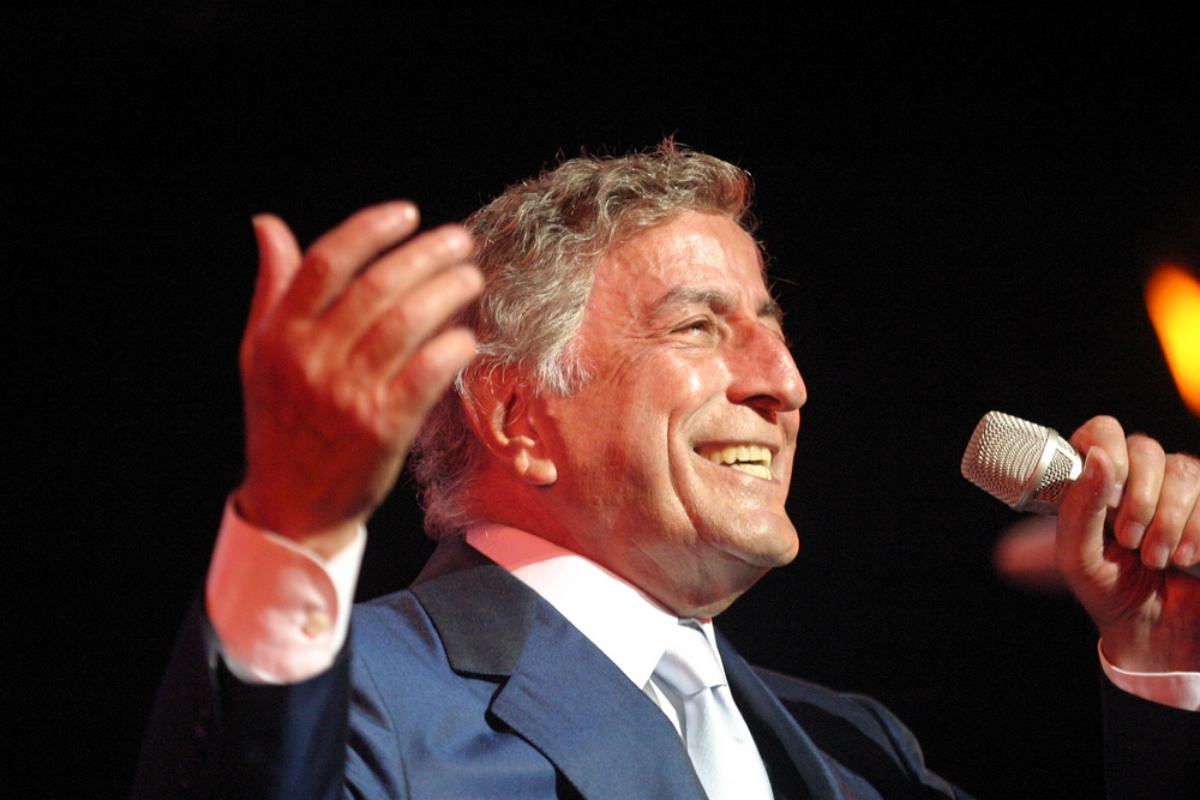

Never has there been a more gracious man. The warmth he exuded on stage and in the studio was genuine from his heart and soul.
Tony Bennett’s passing just short of his 97th birthday is a huge marker in my life. His music has been a part of my life soundtrack, beginning in childhood. My dad was a big TB fan and often played his records. He also played Brubeck, Gilberto-Jobim, Sinatra, MJQ & similar jazz. As a bonus my parents turned me onto Louis Armstrong before I even KNEW about Rock ‘n’ Roll, though I grew up in Memphis and Sam Phillips (Sun Records) was a family friend.
TB’s iconic “San Francisco” (George Cory and Douglass Cross) was heard often from the record player, radio and my dad’s fairly decent crooning. I got to sing it along with Tony and 100,000 others in front of SF City Hall at the end of the SF Giants 2012 Victory Parade. He also performed it at the final 49’ers game at Kezar Stadium in 1970; the 50th-anniversary celebration of the Golden Gate Bridge in 1987; and at the reopening of the Bay Bridge after the 1989 Loma Prieta earthquake.
It was also my highest honor as a broadcaster to engineer his Memphis interview in 1992 with my boss Fred Cook at WREC, when he played at the Orpheum. I had like 5 seconds of conversation with him before I put him on the air, and that was it. The show the next night was a deeply fulfilling musical experience with just Tony and his great accompanist Ralph Sharon.
Never has there been a more gracious man. The warmth he exuded on stage and in the studio was genuine from his heart and soul. In the interview he talked about young Anthony Dominick Benedetto as a singing waiter in Queens, his love for painting and dedication to the Civil Rights Movement. He also talked about marching with MLK at Selma in 1965. In WWII, he saw as much destruction, death and violent combat as any soldier, and had planned dinner and a church service with one of his Black squad members. When his redneck, bigoted CO SCREAMED at the men for being in public together, Tony began a lifelong devotion to pacifism and the Civil Rights Movement.
On Thanksgiving Day in 1945, Tony ran into Frank Smith, a Black friend from Queens he’d sung with before. Smith invited Tony to his Baptist church service, and then Tony invited Smith to join him for Thanksgiving dinner for American servicemen. In the lobby of the building, they were intercepted by an irate officer, who berated both men. In those Jim Crow days, even military men were not allowed to be seen with each other at a military function, much less share a meal together. He said, “Our sergeant was an old-fashioned southern bigot, and he had it in for me right from the start because I was an Italian from New York City. I wasn’t the only one who experienced prejudice — it was just as bad for other ethnic groups, especially the Blacks and Jews.”
“San Francisco” was first played at the Venetian Room of SF’s Fairmont Hotel in December 1961. That song earned him two Grammys and two years on the charts. There is a statue of Tony in front of the Fairmont on Nob Hill, dedicated in 2016 on his 90th birthday.
Tony grew up poor in Queens and lost his dad at age 10, quit school and joined the Army at 16. His music models were Sinatra, Crosby, Stan Getz and Louis Armstrong. Pearl Bailey “discovered” him and got him involved with one of Bob Hope’s shows, who supposedly gave him his stage name.
He revived his career in 1986 after a battle with cocaine, under the management of his son Danny. Yet he also advocated legalization of drugs after the deaths of Amy Winehouse and Whitney Houston.
Along with all the great music, he should be remembered for saying, “My life experiences, ranging from the Battle of the Bulge to marching with Martin Luther King, made me a life-long humanist and pacifist, and reinforced my belief that violence begets violence and that war is the lowest form of human behavior. I don’t care what anybody says: no human being should have to go to war, especially an eighteen-year-old boy.”
