


This triumphant iteration of La Bohème is a tour de force about artists and their romances set in Paris as Tour Eiffel was being built.
La Bohème: Opera Review
The action of LA Opera’s current mounting of Giacomo Puccini’s 1896 masterpiece La Bohème takes place in Paris, sometime between 1887-1889. A graphic clue informs us of this, because those are the years the Eiffel Tower was under construction, and in this La Bohème’s backdrops, the only partially-built Parisian landmark appears. Upon reflection, this unfinished erection could be a Freudian symbol visually commenting on the turbulent romances of the poet Rodolfo (Italian tenor Oreste Cosimo) and the painter Marcello (South Korean baritone Gihoon Kim), who are in and out of love with their lovers, Mimi (Illinois soprano Janai Brugger) and Musetta (Rhode Island soprano Erica Petrocelli). And by implication, these Bohemian artistes are literally in and out of their tumultuous, inconstant, sexy lovers.
Setting this original production by Hollywood producer/director Herbert Ross at this time and place is significant, as it’s roughly the period when the Impressionists and Post-Impressionists were creating, mainly in France, the non-realistic paintings that would come to upend the art world. The private lives of those painters who lived artsy, unconventional – or Bohemian – lifestyles and sex lives has been highly romanticized.
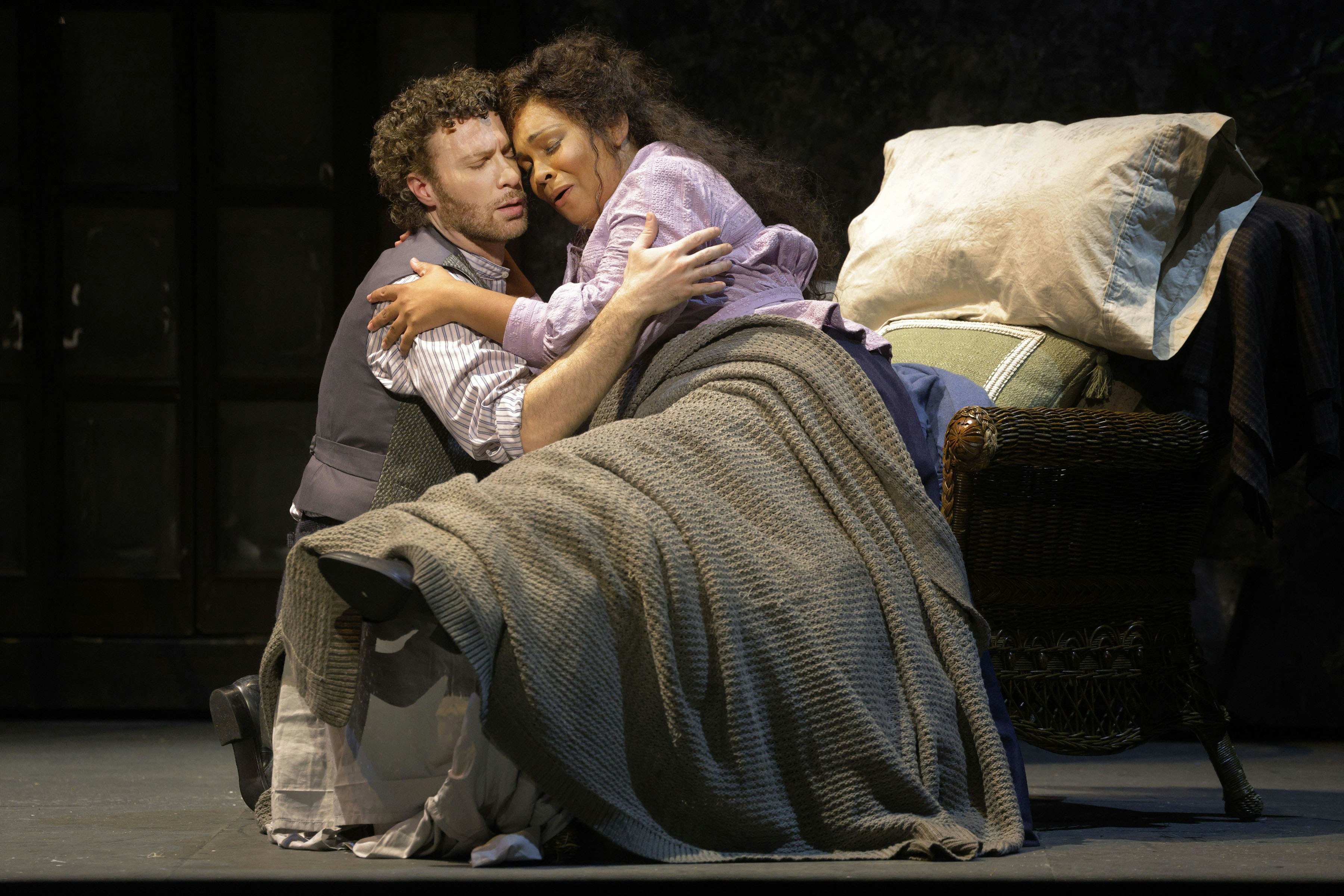
Janai Brugger as Mimi and Oreste Cosimo as Rodolfo (left). Rod Gilfry as Alcindoro and Erica Petrocelli as Musetta (right)
The very first scene of La Bohème captures the struggle of these artistes to make a living while they pursue their aesthetic visions, as the opera opens in the top floor dwelling place shared by Rodolfo, Marcello, the musician Schaunard (New York baritone Emmett O’Hanlon), and the philosopher Colline (Beijing bass William Guanbo Su). It is a freezing Christmas eve, and the four musketeers have no money for firewood to feed their stove for warmth nor the rent (the title, but of course, of that 1990s rock musical inspired by Puccini’s opera) in the attic they reside in. London set designer Gerard Howland perfectly captures the archetypal artist’s garret, and the scenery throughout this Bohème is thoroughly evocative and stellar.
Another mainstay of Parisian bohemians is café life, and Howland rises to the occasion again in his visualization of Café Momus in the Latin Quarter. But instead of a debate about existentialism, as it is the holidays, the scene’s mood is buoyant. Exuberant children are bowled over by toy vendor Parpignol’s (North Dakota tenor Nathan Bowles) novelties. An (ahistorical, slightly premature) old-fashioned automobile rolls across the stage. Later a French military band (perhaps they are Zouaves?) arrives, waving the tri-color (I expected the LA Opera Orchestra, conducted by Colombian conductor Lisa Gonzalez-Granados, to burst out playing La Marseillaise). The mise- en-scène of this complex mass sequence is superbly, agilely helmed by Atlanta, Georgia director Brenna Corner, and the crowd’s jubilation sets the stage (literally) for the reuniting of the estranged lovers, Marcello and his muse, Musetta.
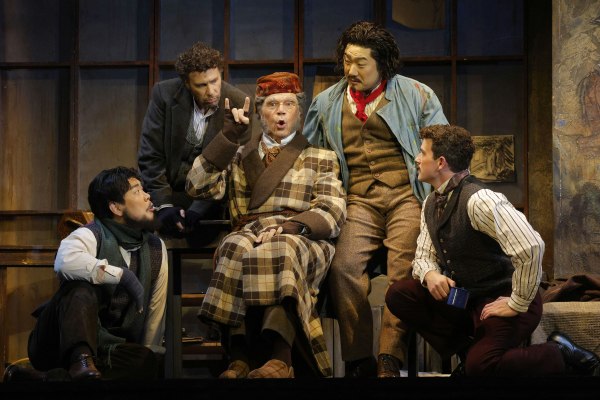 Rod Gilfry (center) as Benoit, with (left to right) William Guanbo Su as Colline, Oreste Cosimo as Rodolfo, Gihoon Kim as Marcello and Emmett O'Hanlon as Schaunard in LA Opera's 2025 production of La Bohème. Photo: Cory Weaver.
As haughty, horny Musetta sings her showstopping aria, “Quando me’n vo soletta per la via,” the music swells and reaches a level of transcendent splendor that almost made me cry. This waltz is not only the best single piece of music in La Bohème, but one of the most expressive, sonorous delights performed in any opera, by Puccini or anyone else. In the lyrics as translated into English, the coquettish Musetta extolls the virtues of her own sensuality:
“When walking alone on the streets,
People stop and stare
And examine my beauty
From head to toe
And then I savor the cravings
which from their eyes transpires
And from the obvious charms they perceive
The hidden beauties.
So the scent of desire is all around me,
It makes me happy!...”
Musetta is so pleased and enthralled with her own sexuality that she almost drools all over herself. But before an audience member can shout, “Hey Musie! Get over yourself!” or “Get a room!” the aria goes on to become more than a mere celebration of Musetta. It turns into a rapturous, musical evocation of Musetta being reunited with Marcello, their lost love being found and reignited again. A rhapsodic homage to the ec-static electricity of true love, and the rekindling and rediscovery of what once had vanished.
One minor complaint here is that the sugar daddy Alcindoro – whom Musetta stiffs and abandons at Café Momus when she rejoins Marcello – is played by SoCal baritone Rod Gilfry, who appears to be too young for the role. And the reason why Alcindoro disappears briefly did not seem explained adequately. Also, in between scenes, words appear on a scrim or backdrop with exposition about the storyline, which I don’t recall from LA Opera’s 2016 presentation of La Bohème (over the years, this is the seventh or eighth time this opera has been performed at the Dorothy Chandler).
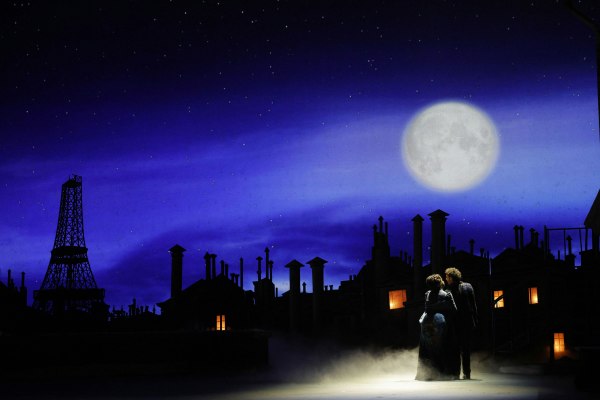 Janai Brugger as Mimi and Oreste Cosimo as Rodolfo
Nevertheless, in the second act, Puccini’s tragedy inevitably unfolds. Musetta and Marcello, as well as Rodolfo and Mimi, have their ups and downs, break-ups and make-ups. As Mimi meets her fate, her friends loyally reunite around her, as it should be: Loved ones sticking together and up for one another, especially when one is laid low. When his beloved’s end inescapably comes, Rodolfo loudly cries out: “Mimi! Mimi!” As I have argued before, I believe this is the origin of the phrase “the screaming Mimis,” defined by the Merriam-Webster Dictionary as “a heightened state of panic or anxiety.”
Although at one point Marcello rhapsodizes, “Ah, youthful idealism!”, La Bohème gives little sense of what motivates these Parisian bohemians and what they’re trying to artistically achieve. The Impressionists and their successors showed the world a whole new way of seeing, just as the Existentialists created a different way of thinking about the nature of existence. La Bohème’s impoverished countercultural quartet and their lovers seem mainly intent on living lives unfettered by bourgeois conventions. Sex, of course, has been important to other out-of-the-box artists and thinkers, but they were also resisting the status quo by striving to create new modes of expression. There was more to their rebellion than mere self-indulgence. This missing piece of Puccini’s puzzle may be the fault of the librettists, Giuseppe Giacosa and Luigi Illica, who derived the book and lyrics from Henri Murger’s 1851 book Scènes de la vie de Bohème.
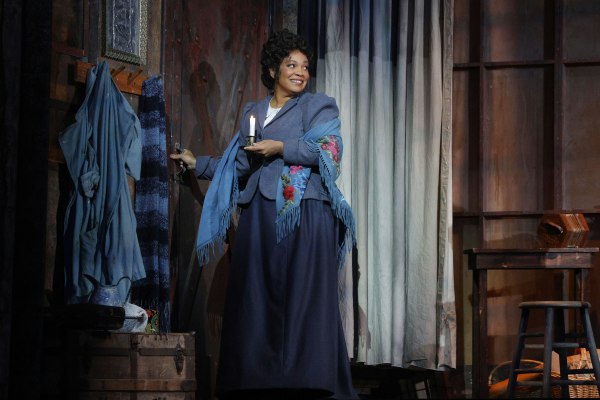 Janai Brugger as Mimi.
Despite a few quibbles, this triumphant iteration of La Bohème is a tour de force about artists and their romances set in Paris as Tour Eiffel was being built. For an experience of sheer exuberance – and, BTW, to enjoy operagoers divinely clad in beautiful haute couture – don’t miss this musical musing about joie de vivre, youth, love, lust, plus the loss of them. As Lord Alfred Tennyson wrote, “’Tis better to have loved and lost than never to have loved at all.” Bring someone you love to savor this treat, all the more.
After the final curtain call, departing the Dorothy Chandler, a theatergoer noticed a service dog and pondered aloud, wondering if our four-legged friends enjoy opera. I replied: “Yes, they do, and their favorite composer is ‘Pooch-ini.’” And so it is, with we two-legged fans as well.
La Bohème is being presented November 30 and December 14 at 2:00 p.m.; and December 4, December 6, and December 10 at 7:30 p.m. at the Dorothy Chandler Pavilion, 135 N Grand Avenue, Los Angeles CA, 90012. The opera is sung in Italian with English supertitles. For tickets go here; (213)972-8001.
