

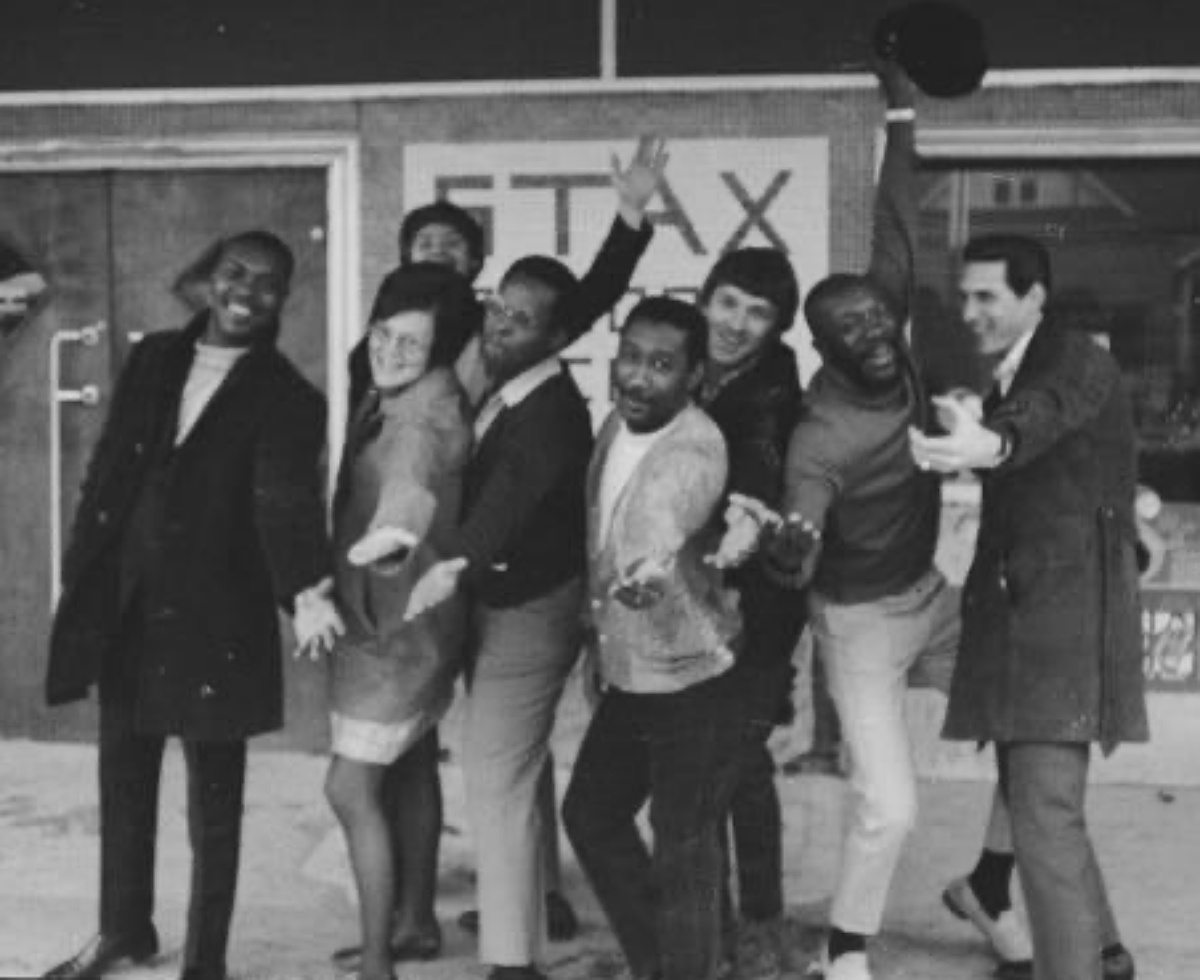

The story of Stax Records in Memphis is about Black and White; not just the role it played for integrating music and culture in Memphis and beyond, but also in terms of heroes and villains.
The documentary STAX: Soulville, USA is both a feel-good story with a tragic ending, and a tragic story with feel-good elements. The writers and producers, Jamila Wignot, Kara Elverson NAILED every element to perfection. My personal connections may run deeper than most people not from that neighborhood. I was privileged to visit the studio in 1972 as part of a high school summer enrichment program. Deane Parker, a Stax original, was our gracious hostess, and gave us all cool press packets with some beautiful, glossy 8 x 10’s. We got to not only tour the studio, but provided background party noise for one of the records. I was surrounded by 25 other folks my age on the slanted floor of the studio (It was originally a movie theatre), laughing, smiling, making party noises while the music played.
The story of Stax Records in Memphis is about Black and White; not just the role it played for integrating music and culture in Memphis and beyond, but also in terms of heroes and villains. The story has many heroes who made and produced beautiful, template-setting music: Jim Stewart and Estelle Axton, who founded Stax Recording in an old movie theatre in South Memphis, as an adjunct to a record store; Rufus and Carla Thomas, who recorded the label’s first hits, Otis Redding, who was so unassuming when he first showed up that Stewart “thought he was a roadie;” Booker T. Jones and David Porter, who wandered in from Booker T. Washington High School (BTWHS) to become the creative foundation for the label; Deanie Parker, Stax’s first and last employee, Steve Cropper, who became de facto A&R Director and Producer, and the great Al Bell. Al came on as a promotions man; then willed, crafted and manipulated Stax Records into a global success. Then there were the main hitmakers, led by Isaac Hayes, Otis Redding, Booker T. Jones and his MG bandmates Cropper, Duck Dunn and Al Jackson. They were the house band for most of the sessions. Hayes and Porter, as well as Cropper wrote many of the great hits for the entire roster. When I asked Hayes in a 1992 interview, “Who produced Otis?” he said, “Otis produced himself...Otis would be running back and forth between the production room and the studio to get things just like he wanted it.”
 Steve Cropper, listening to the final mix of "Dock of the Bay," a few days after Otis Redding's death. (Photo: Terry Manning)
First, they got screwed by Jerry Wexler, but recovered and worked with him again. Wexler HAD been a friend to Stax, and referred Sam Moore and Dave Prater to the label for a new sound. Stax recovered from the Atlantic catalogue piracy, after Wexler’s “screw without a kiss,” as Parker phrased it. The label not only was left without any of its previously released catalog but also lost its number one artist, Otis Redding, in a plane crash! Stewart and Bell ordered a 24/7 non-stop production schedule for three months, which generated 20 successful albums. Then they again got screwed, this time by CBS....and recovered. CBS A&R man Clive Davis offered Bell a generous contract that seemed too good to be true. When Davis was fired, the CBS executives voided the contract, and Bell had to re-negotiate under an unfair suzerainty covenant. With each outrage or tragedy, Bell motorized the Stax label to produce and generate more “product.”
The story also has three well-defined villains: Jerry Wexler, CBS-Columbia Records, and Union Planters Bank in Memphis, managed by CEO Bill Matthews. (Matthews was reputed to “hate” Stax and the music it generated.) All three had a hand in marginalizing and then destroying Stax. Wexler was a mercenary music biz guy, who also had a wonderful side to him. He facilitated and promoted a lot of great music as A&R Director at Atlantic Records, along with Atlantic's engineer, Tom Dowd. When Stax came onto his radar, Wexler offered Stewart a predatory distribution contract, the result of which was Stax losing its entire catalogue of published music when Atlantic was sold to Warner Brothers-Elektra.
In the end, Stax got totally destroyed by Union Planters National Bank, with gratuitous, bogus criminal charges against the great Al Bell. Consider the origin of Union Planters Bank. It was founded as a "collective" of plantation owners, thus the name. Killing Stax was an act of economic colonialism. It's even sadder that Terry Manning, who worked as a producer, engineer, songwriter and session player at Stax, did his best to solicit financial rescue from wealthy white Memphians, whom he rightfully expected to know better. Nobody stepped up.
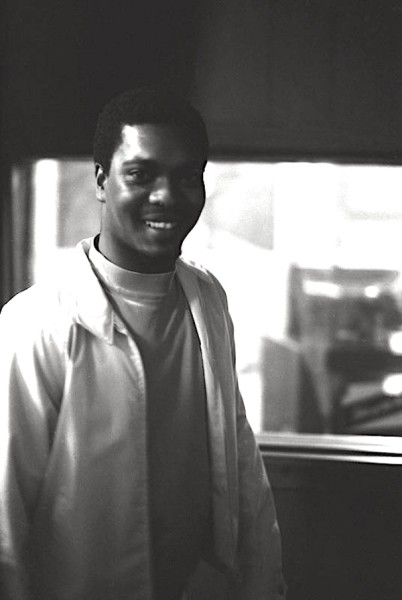 Booker T. Jones, 1967 (Photo: Terrry Manning)
The assassination of Dr. Martin Luther King in Memphis was a shattering event for the world. In Memphis and Stax in particular, the impact was seismic. King was killed at the Lorraine Motel, one of the few places in Memphis where Black and White people could socialize comfortably. The motel was the after-hours hang-out for the Stax musicians and production crew, and a secondary “home.” That this happened in their personal spaces dramatically elevated the impact of this global tragedy. Willie Hall, drummer for the Bar-Kays, recalled being just a few blocks from the motel when he heard the single shot.
While fulfilling in many ways, it’s also deeply sad to relive the deaths of Otis Redding and the Bar-Kays, and the assassination of Martin Luther King in a brief sequence. And to hear and feel what their bandmates and close friends experienced. Redding’s death just months before MLK’s, along with almost the entire band of the Bar-Kays, had already left the Stax community in a state of grievous shock. Imagine seeing all the waterlogged equipment returned to the studio, still dripping with the wet chill of Lake Monona, WI. Imagine having to attend a funeral for a close friend and creative partner every day for a week or more. Seven young men, fresh out of BTWHS on a creative path to global stardom were suddenly gone. Episode 2 has the viewer re-living both tragedies in painful detail. When I was privileged to interview Carla Thomas for a Black History program on WEVL-Memphis in 1993, I prompted her to discuss that sad night, but was careful not to probe too deeply. Seeing Booker T. Jones weep over the loss of the young Bar-Kays got me going too. I lost it once in each episode.
But much of the film is very gratifying. Isaac Hayes became a force and cult of personality all his own as “Soul Music’s first superhero.” When he was contracted by filmmaker Gordon Parks to write the soundtrack for Shaft, he earned a Grammy and an Oscar, the first for any Black man. Though Stax had its own wardrobe and costume department, Hayes bought many of his clothes for shows and streetwear from Alan Abis. The sighting of his gold-rimmed, Blue Cadillac was always a big neighborhood event. On my visit, the Caddy was on display in the secure lot behind chain-link and barbed-wire.
I was also privileged to work with promotion and advertising ace Larry Shaw in his ad agency in the 1990’s. Along with promotion master Al Bell, Shaw is the man who made the great 1972 Wattstax the success it was. He made the executive decisions to NOT have the rabid LAPD manage security, and hired a private security firm. Also to hire young Black film students from UCLA, rather than proven Hollywood documentarians, for the Wattstax ’72 film. When I worked for him, I was embarrassed to not fully realize who he was until I saw all the pictures of him at Wattstax, in his fabulous Rogues Gallery of music and Civil Rights history. In our meetings he mumbled a lot, but I hung onto every word.
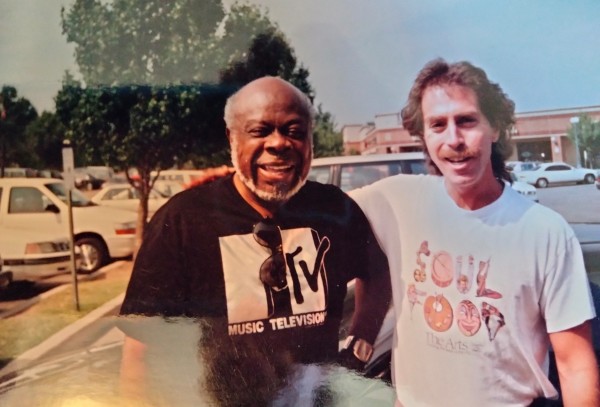 Rufus Thomas with writer H. Scott Prosterman
Al Bell is the tragic hero in this epic. That he was framed and packaged into the criminal charges faced by UP banker Joe Harwell, was a gross act of racism, and selective Abuse of Process. Terry Manning, said, “Al was totally exonerated. Joe Harwell, UP employee who had actually done the terrible things (forging signatures and documents, etc.) was convicted and sent to prison. Al could NOT get attorneys in Memphis to help him!! He was really down about it, but James Neal, a (white) former Watergate Prosecutor and civil rights attorney from Washington heard about the desperate situation, and came to defend Al, pro bono! He was a Saint and really helped justice be served.”
This tragic story has a happy epilogue: In 2003 the Stax Music Academy was constructed on the original site of the studio and record shop. It continues to nurture a new generation of music to create new music and legacies. The Stax: SOULVILLE documentary, is a masterpiece fabric of music and Civil Rights history. The Black music of the 1960’s and 70’s was a vital part of the Civil Rights narrative, and Memphis was at the center of it for better and worse.
