

Waiting for Gounod


A Shakespearean Opera About Ancient Antipathies for Our Own Polarized Period
ROMEO AND JULIET (ROMEO ET JULIETTE): Opera Review
LA Opera’s production of Charles Gounod’s Romeo and Juliet – which premiered at Paris’ Théâtre-Lyrique shortly after America’s War Between the States and shortly before what Marx dubbed in the title of his Paris Commune pamphlet The Civil War in France – opened on the eve of what threatens to be a highly contested U.S. election. As the curtain lifts on Ohioan director/ choreographer Kitty McNamee’s version, the feuding families of the Montagues and Capulets are street fighting in Verona (New Yorker Andrew Kenneth Moss presumably worked overtime as fight director for this action-packed show). Given today’s polarization, are the combatants metaphors for Republicans vs. Democrats? Proud Boys/Oath Keepers vs. Antifa/BLM?
The question posed by William Shakespeare in his tragedy Romeo and Juliet that debuted circa 1597 and in the 1867 adaptation by Gounod and librettists Jules Barbier and Michel Carre, is whether the love between the title characters, who are each from opposing families, can heal the breech between the warring clans and so end the great divide of the factional warfare? The romance between Romeo (South Korean tenor Duke Kim) and Juliet (Egyptian soprano Amina Edris) is deeply invested with the promise of peace that their proposed union offers, so the young couple’s relationship has much higher stakes at hand than the lovers merely being Dion DiMucci-like “Teenagers in Love.”
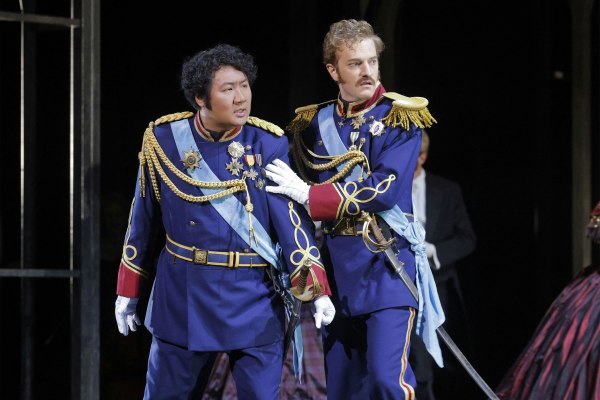 Yuntong Han as Tybalt and Ryan Wolfe as Count Paris Photo: Cory Weaver)
Indeed, what has arguably made Romeo and Juliet one of the top 10 plays of all time is Shakespeare’s existential inquiry into which is stronger: Love or hate? As the plot of Romeo and Juliet is so well-known over the ages, I won’t go into details about the operatic adaptation’s storyline (except below, when noting deviations from the original). First of all, the splendid leads fully capture the glamor, youth and beauty of the beloved characters they are depicting and are sensational singers who each earned ovations from the aud throughout the two-act show. The fact that the performers are interracial lovers from different ethnic/racial backgrounds enhances Romeo and Juliet’s unity of opposites.
In Act II the amorous adolescents enact a scene in bed (Angeleno Sara E. Widzer is the intimacy director). During Romeo’s bedroom romp with dazzling Juliet, Duke Kim emerges from beneath the sheets in the era’s equivalent of BVDs, while Amina Edris is clad in an overly modest white nightgown. Out of bed, during the performance Mr. Kim also demonstrates his athleticism by repeatedly lithely climbing up ladders to Juliet’s famed balcony (which was rather brilliantly transformed into a Manhattan fire escape in Arthur Laurents’ 1957 West Side Story, likely the best adaptation of Romeo and Juliet in 427 years).
The opera’s supporting cast is likewise stellar. Thirty-something German-born baritone Justin Austin captures the aptly named Mercutio’s mercurial personality. Mercutio’s fateful joust with the temperamental Tybalt (tenor Yuntong Han) dooms the two star crossed lovers and their noble aspiration to bring peace to the conflicting clans. Austin, the son of international opera singers, appears to be Black; he attended the Fiorello H. LaGuardia High School of Music & Art and Performing Arts and the Manhattan School of Music, while Han is from China. Again, the different ethnicities of the dueling protagonists heightens the story’s theme of divisiveness.
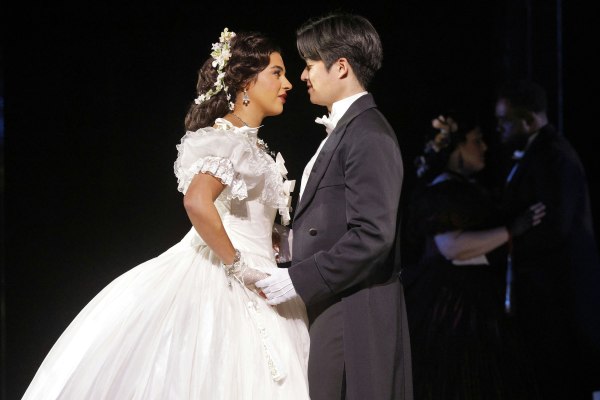 Amina Edris and Duke Kim in the leading roles (Photo: Cory Weaver)
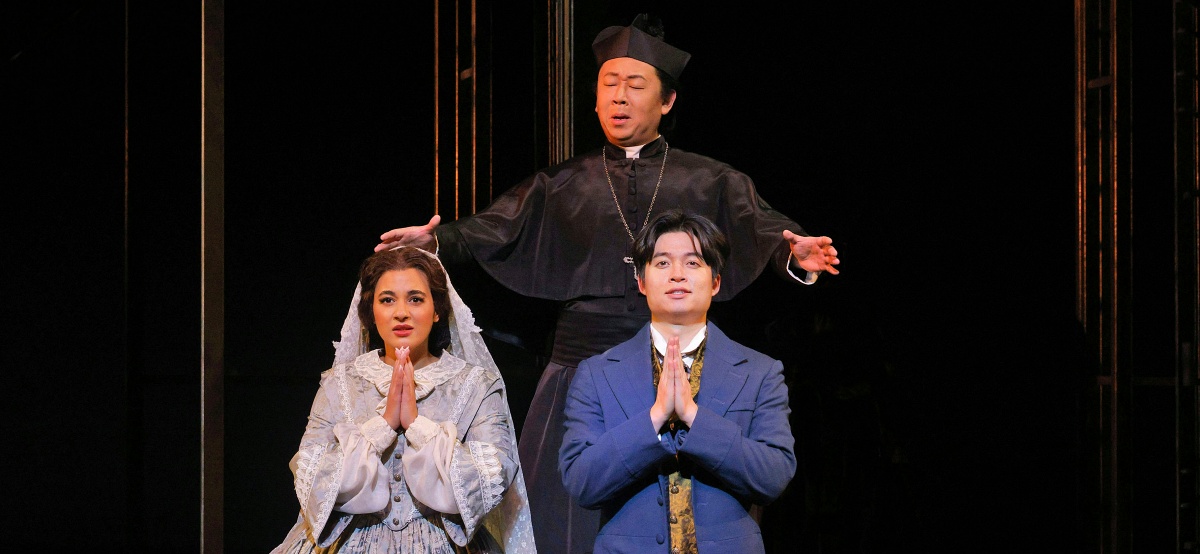
As Juliet’s nurse Gertrude, Illinois mezzo-soprano Margaret Gawrysiak provides a lighter tone, while Beijing bass Wei Wu as Friar Laurence injects an element of wisdom and wistful reconciliation into this tale of frayed nerves and hotheaded “Italian-on-Italian” violence. Brazilian bass Vinicius Costa is authoritative as the Duke of Verona, who, without fear and favor strives to stifle the mad faction fights between the quarreling Capulets and Montagues.
McNamee adroitly helms the mise-en-scéne of her rather large cast with a keen eye and hand. U.K. Scenic designer John Gunter deserves a special shout out for his mobile sets, which appear to the untutored eye to be something like scaffolds that are moved around onstage from scene to scene, creatively conjuring up plazas, palaces, dancehalls, balconies, bedrooms, mausoleums and more. Wisconsinite lighting designer Duane Schuler ibues the spooky ambiance of this tale (partially) from the crypt with spectral red and white lights. Venezuelan conductor Domingo Hindoyan conducts LA Opera Orchestra with verve, eliciting the exciting sound of Gounod’s often energetic music. (Colombian conductor Lina Gonzalez-Granados takes the baton Nov. 20-23.)
Now, I want to have a word regarding English costume designer Tom Goodchild’s costumes for this production, which seems to be set in 19th century Italy; his duds strike me as realistic period apparel, although I’m no fashionista. This critic’s quibble with not the obviously able Goodchild but is with whoever decided, for some reason that’s beyond this reviewer’s limited ken, to transplant Shakespeare’s saga from 14th century Verona to centuries later (presumably in Italy, although the lyrics are sung in French)? According to Louis Biancolli and Robert Bagar’s authoritative The Victor Book of Operas, it seems that Mssr. Gounod and his librettists, like Mr. Shakespeare, likewise set their adaptation in 14th century Verona.
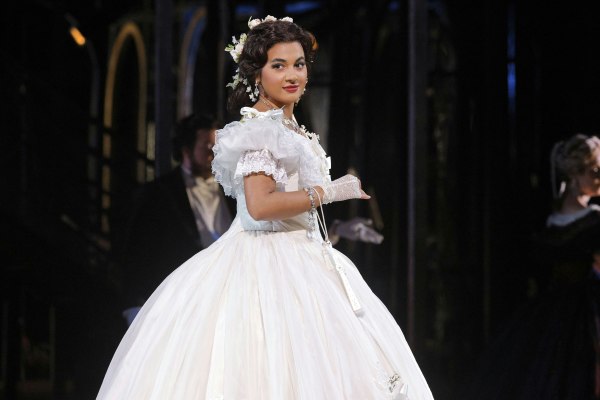 Amina Edris as Juliet (Photo: Cory Weaver)
“O Renaissance, Renaissance, wherefore art thou, Renaissance?” What POSSIBLE reason on Earth would one have for tampering with the Bard’s immortal work in such a way? Can you please explain to this dunce how this POSSIBLY improves upon the original temporal and spatial setting in both Shakespeare and Gounod of Romeo and Juliet? (Englishman Ian Judge has a credit in the playbill for “original production.”) Unlike, say, Laurents’ transition of the plot to the Caucasian and Puerto Rican gangs in 20th century Manhattan, which was truly a stroke of genius (with memorable music to match), unlike West Side Story, the switcheroo now onstage at the Dorothy Chandler Pavilion does nothing whatsoever to enhance a sense of relevancy.
Before the curtain lifted, in Dr. Kristi Brown-Montesano’s informative pre-show talk at 6:00 p.m. in Stern Grand Hall the opera expert pointed out that Gounod and his librettists took liberties with the finale inside of the Capulets’ mausoleum. They also inserted a marriage that never takes place in the playwright’s original, etc. Of course, William Shakespeare was long dead and gone and unable to enforce copyright protection over his intellectual property to prevent Gounod and whoever woefully willy-nilly decided to pilfer from his text and change when the story HE wrote took place in the current production (which also, I may add, includes gunplay). I strongly suggest that whoever re-set the Bard’s saga in the 19th (or was it the 18th?) century instead of the Renaissance should simply write their own opera and set it then with a new name, instead of exploiting the brand of Shakespeare (and Gounod).
Having gotten that off this writer’s chest, to be fair, while LA Opera’s production isn’t always true to the letter of Shakespeare’s tragedy, it generally is true to the spirit of the playwright’s original. Putting the above concerns aside, LA Opera’s current version is quite timely and well worth seeing (and listening to). Given the impending election and the sure to be disputed results, will Romeo and Juliet’s lofty aspiration for love to triumph over hate come to pass, or will it prove to be just another one of Queen Mab’s delusions?
After Tuesday, will the tens of millions of Americans who are independents and people eligible to vote but unmotivated by the two-party system to bother to cast any ballots, be clamoring for a contemporary Duke of Verona (in the form of a Cornel West, Jill Stein, and/or Claudia De la Cruz) to chastise the feuding Republicans and Democrats by proclaiming “A plague upon both your houses” if there’s yet another debacle at the polls?
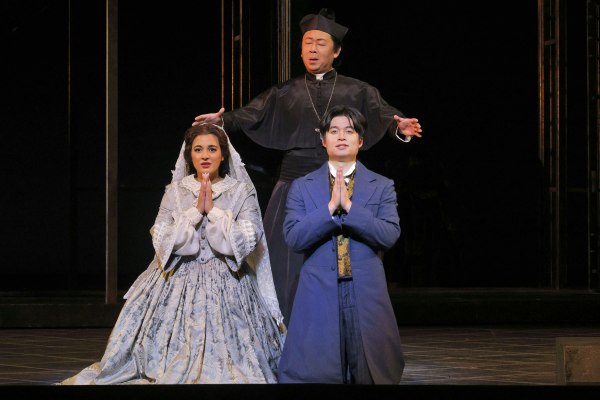 Amina Edris (Juliet), Wei Wu (Friar Laurence) and Duke Kim (Romeo) (Photo: Cory Weaver)
Romeo and Juliet is sung in French with English supertitles and being presented Sundays November 10 and 17 at 2:00 p.m.; November 14, 20 and 23 at 7:30 p.m. at the Dorothy Chandler Pavilion, 135 N. Grand Avenue, Los Angeles CA, 90012. For tickets, go here or here (213)972-8001.
Ed Rampell has been nominated for three National Arts & Entertainment Journalism Awards in these categories:
- Obituary/In Appreciation, Film Personalities
- Personality Profile, Film Personalities
- Film Feature, Filmmakers
Kathy Bates is being honored with the Legend Award at the NAEJ ceremony, and Melissa Etheridge, Tiffany Haddish and Kevin Frazier are also receiving awards.
