

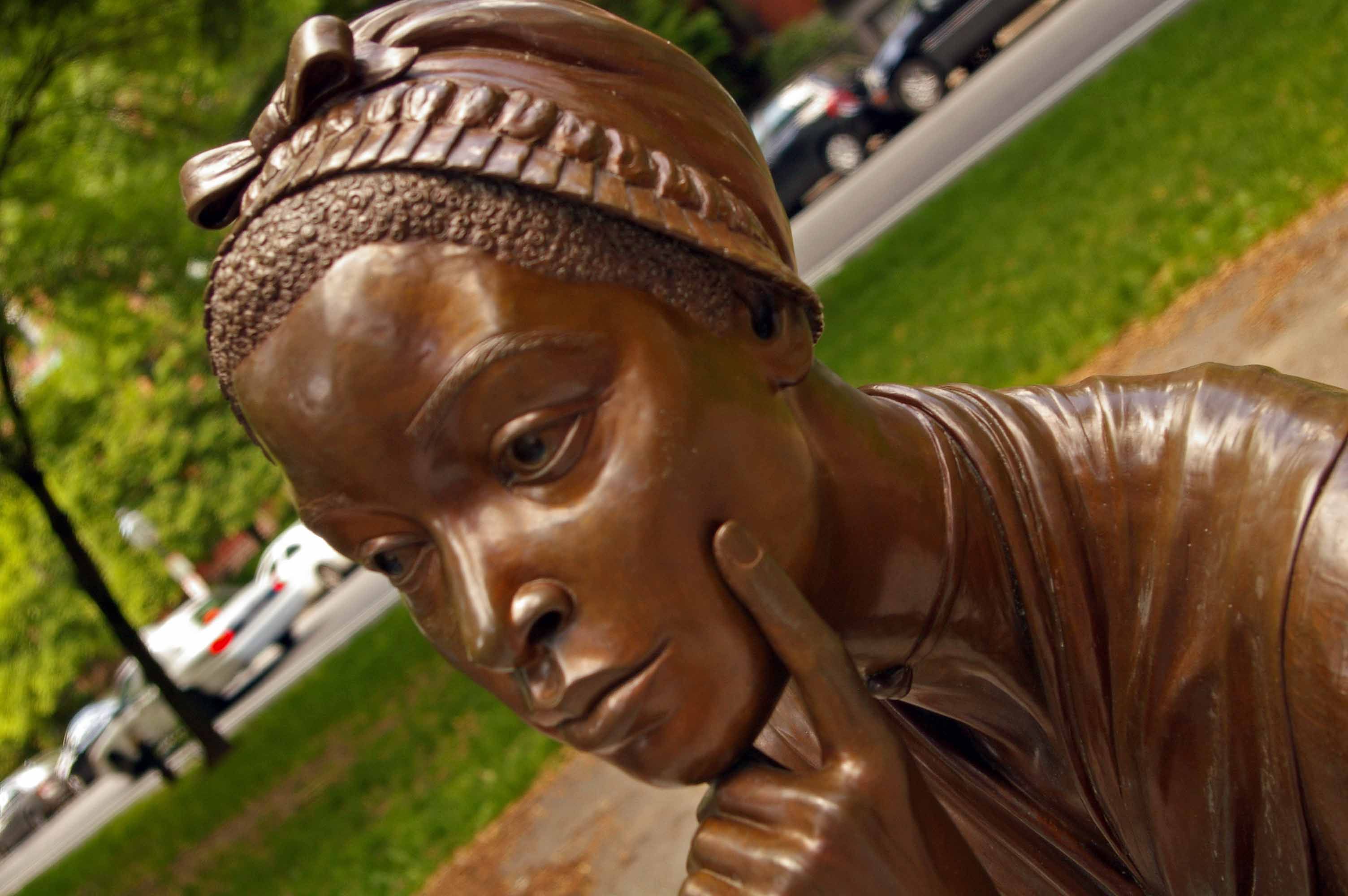


Wheatley may well have been thought of as an oddity, a curiosity, a fluke of nature to be marveled at, a one-in-a-million miracle.
In 1990, I spent a semester as the Visiting Professor of War and Social Consequences at the University of Massachusetts at Boston. My office was in a building named for Phillis Wheatley. I’d never heard of her, but discovered that she was an African-born slave whose Boston owners had brought her up as a “house servant” and allowed her to learn to read and write. She had even published a book of her poems.
I tracked down some of her work, but didn’t find it very interesting. Like so much of the poetry written in English in the later 18th century on both sides of the Atlantic, it was loaded with Christian piety, redemption, and resurrection as well as frequent references to Greek and Roman literature and mythology. And much of it was dedicated to or inspired by people who may have been famous in the 1760s and ‘70s, but who are remembered now only by early American experts and historians.
Still, years later, when I created a course at the Haverford School for Boys called American War Poetry, I did include her poem “To His Excellency General Washington” because, even if I didn’t find much inspiring in her poetry, the very fact that she was able, as a Black woman slave, to write poetry was itself inspirational.
Finally, only this year, I went to see the world premier of a play called Written by Phillis by Paul Oakley Stovall and Marilyn Campbell-Lowe, and staged by the Quintessence Theatre Group of Philadelphia. I also bought a new book, published in 2023 by David Waldstreicher titled The Odyssey of Phillis Wheatley.
This renewed interest in Wheatley, it turns out, is typical of her fate since her death in 1784 at the age of 31, and even before her death. At various times over the past 240 years, she has been praised as a literary genius and proof that racial inferiority was merely a fabricated justification for enslaving millions of human beings, or vilified as a traitor to her race and a sellout to those who enslaved her because she wrote poems in praise of the very whites who participated in or tolerated slavery.
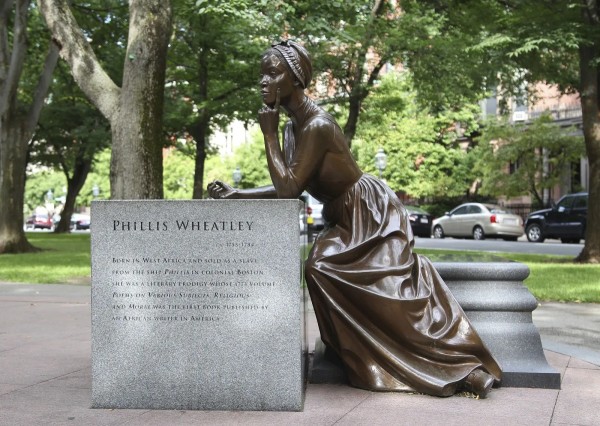
Adding fuel to the latter view, in 1772 Wheatley traveled to Britain with the son of her owner to arrange for publication of her book, Poems on Various Subjects Religious and Moral. She was already well known by then, and was feted by many members of the British nobility and literary community, including prominent members of the growing abolitionist movement. Benjamin Franklin, the most famous American in the world and then living in London, even paid her a visit.
In the wake of a recent case called Somerset v. Steuart, the British courts had ruled that a slave brought to Britain could not be forcibly returned to any part of the empire that permitted slavery, and Wheatley’s abolitionist supporters urged her to remain a free woman in Britain. But she chose to return to Boston, where her mistress Susanna Wheatley was in poor health and needing care.
Phillis had by then developed a deep personal bond with Susanna, but she may already have known that the Wheatleys were planning to manumit her, which they did soon after her return, and which muddies the argument that she had succumbed to what today we might call Stockholm Syndrome.
She nursed her mistress until Susanna died, and continued to live in the Wheatley house for some time thereafter. But when John Wheatley died, Phillis discovered that the entire Wheatley estate would be inherited by the Wheatleys’ two adult children, and Phillis would get nothing. Moreover, without the patronage of Susanna Wheatley, who was well-connected and influential, Phillis was having great difficulty earning a living from her writing.
Being a free Black woman with connections was not easy. Without connections, life was difficult in the extreme. Even for someone as famous as she had become in both Britain and the new United States—she had met Franklin, had had an audience with George Washington, was known to Thomas Jefferson, Benjamin Rush, John Hancock, and dozens of other luminaries who had read and even owned her book—she struggled with poverty.
In 1778, only weeks after John Wheatley died, Phillis married a man named John Peters, also a former slave now free, but their life together continued to be a struggle. They gained and lost ownership of both homes and businesses. While she continued to write, her hopes of a second book never materialized. She bore—and lost—at least one child, and maybe as many as three. And at the time of her death, her husband may even have been in debtors’ prison.
One can’t help but wonder if her brief time as a famous and celebrated poet had little to do with her literary genius—a word so often applied to her—and everything to do with her being a slave. That a slave, a black female slave at that, could acquire the knowledge and skill to write authoritatively about Homer and Terence and Milton and Shakespeare was surely a wonder in the 18th century when millions of whites in America and elsewhere thought Africans were savage, stupid, and sub-human, fit only to labor in the tobacco fields of Virginia and the sugar cane fields of Barbados.
Thus, Wheatley may well have been thought of as an oddity, a curiosity, a fluke of nature to be marveled at, a one-in-a-million miracle. But a free Black woman was something else. A threat. A true equal. Competition. Taking the humanity of Blacks one step too far.
I don’t know. I’m only speculating. Maybe it was just bad luck. There was a serious post-Revolutionary War economic depression that made life difficult for a lot of people (think Shays’s Rebellion). And her poor health had long been an issue, which may have something to do with her difficulties in childbirth and her early death. But it does seem odd that once Wheatley was emancipated, her life seemed to wither like a plant without water.
Whatever the case may be, I am glad that Phillis Wheatley—her first name is the name of the slave ship that brought her from Africa as a seven-year-old, and her last name is the name of the people who bought her—is remembered to this day, and is celebrated and honored in 2023 with both a play and a biography.
And I am sad that thousands, perhaps hundreds of thousands, of human beings with Wheatley’s potential never got the chance to demonstrate or make use of it.
*The words are Thomas Jefferson’s, written on the flyleaf of his copy of Wheatley’s poems, now in the Library of Congress.
To His Excellency General Washington
Celestial choir! enthron’d in realms of light,
Columbia’s scenes of glorious toils I write.
While freedom’s cause her anxious breast alarms,
She flashes dreadful in refulgent1 arms.
See mother earth her offspring’s fate bemoan,
And nations gaze at scenes before unknown!
See the bright beams of heaven’s revolving light
Involved in sorrows and the veil of night!
The goddess comes, she moves divinely fair,
Olive and laurel binds Her golden hair:
Wherever shines this native of the skies,
Unnumber’d charms and recent graces rise.
Muse! bow propitious2 while my pen relates
How pour her armies through a thousand gates,
As when Eolus3 heaven’s fair face deforms,
Enwrapp’d in tempest and a night of storms;
Astonish’d ocean feels the wild uproar,
The refluent4 surges beat the sounding shore;
Or thick as leaves in Autumn’s golden reign,
Such, and so many, moves the warrior’s train.
In bright array they seek the work of war,
Where high unfurl’d the ensign waves in air.
Shall I to Washington their praise recite?
Enough thou know’st them in the fields of fight.
Thee, first in peace and honors—we demand
The grace and glory of thy martial band.
Fam’d for thy valour, for thy virtues more,
Hear every tongue thy guardian aid implore!
One century scarce perform’d its destined round,
When Gallic powers Columbia’s fury found;
And so may you, whoever dares disgrace
The land of freedom’s heaven-defended race!
Fix’d are the eyes of nations on the scales,
For in their hopes Columbia’s arm prevails.
Anon Britannia droops the pensive5 head,
While round increase the rising hills of dead.
Ah! cruel blindness to Columbia’s state!
Lament thy thirst of boundless power too late.
Proceed, great chief, with virtue on thy side,
Thy ev’ry action let the goddess guide.
A crown, a mansion, and a throne that shine,
With gold unfading, Washington! be thine.
—Phillis Wheatley, October 26th, 1775
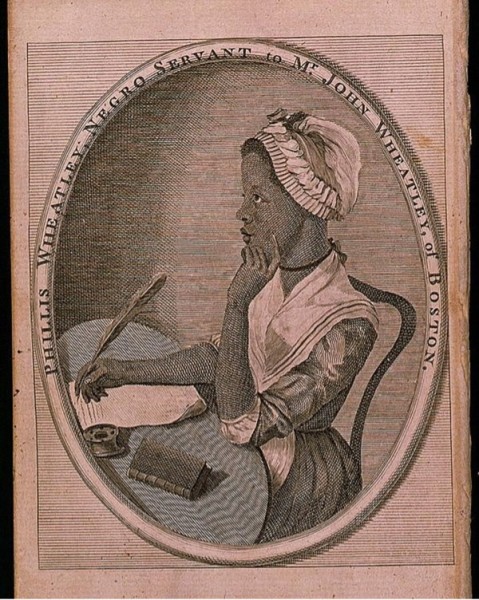
"Phillis Wheatley, Negro servant to Mr. John Wheatley, of Boston." Engraving in Wheatley's book. Library of Congress https://www.nps.gov/people/phillis-wheatley.htm
