


Working Class Poet


As Liebler explains it, his childhood—though unconventional in his being raised by “parents” who were a generation older than his friends’ parents—was something straight out of television’s The Loretta Young Show and Leave It to Beaver.
“M.L. Liebler is the poet laureate of America’s working class.”—Michael Moore
Along with poetry, even before poetry, music has been integral to who and what M. L. Liebler is. The child of an unwed teenaged mother, Liebler was raised in the suburbs of Detroit by his grandparents. His grandfather worked on a Motor City automobile manufacturing assembly line. His grandmother worked parttime in an ice cream shop. And they—he called them “Ma” and “Grumps”—had him dancing to Elvis Presley by the time he was four years old.
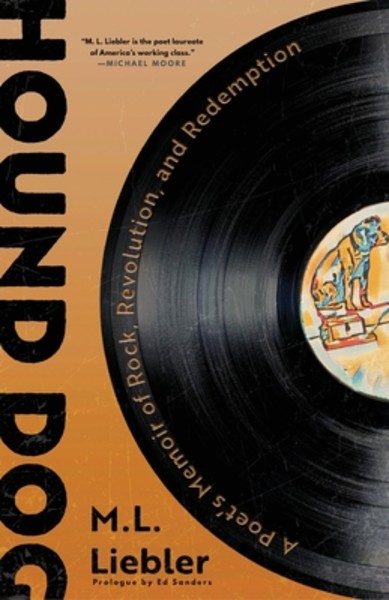
The whole fascinating story is now available in his 2026 book, Hound Dog: A Poet’s Memoir of Rock, Revolution, and Redemption (Cornerstone Press, University of Wisconsin–Stevens Point), from growing up in St. Clair Shores in the 1950s and 60s to M.L. Liebler & the Coyote Monk Poetry Band.
In keeping with Liebler’s intimate connection to music, each chapter of the book is titled with the name of a musician or band beginning with “Elvis” and ending with “Eminem.” The chapters proceed along roughly chronological lines with Liebler relating events occurring in his own life along with how the various artists impacted and influenced him.
As Liebler explains it, his childhood—though unconventional in his being raised by “parents” who were a generation older than his friends’ parents—was something straight out of television’s The Loretta Young Show and Leave It to Beaver. Like so many suburban—or in my case, smalltown—white kids, he was unaware of the millions of gays, Blacks, Browns, women, and people with other-than-mainstream political beliefs who were excluded, discriminated against, and persecuted.
But eventually, as both the Civil Rights movement and the Vietnam War became ever more visible and ugly and divisive, Liebler began to see another America. And like many young people, he turned to marijuana, LSD, and alcohol. But also, like many other young people, music became an escape, a haven, a refuge. He describes, in chapter after chapter, the influence and impact on his life of the Beatles, Bob Dylan, Jimi Hendrix, Al Kooper, and others (continuing, in fact, to this day).
Somehow, he also managed to finish high school, attend community college—his zany tales of a group of friends there who became The Ridgeway Artists Collective are hilarious—go on to bachelor’s and master’s degrees, and end up by age 25 getting hired to teach at Detroit’s Wayne State University, where he is still teaching 46 years later.
He also, somewhere along the way, began writing poetry. For a long time, he inhabited the fringes of Detroit’s literary scene, but with his boundless energy—I know this guy, and I have always been amazed and awed by how much energy he brings to everything he does; I don’t even know how he does all the stuff he does—people began to notice him.
He has always been committed to expanding the audience for poetry, and with his love of music, he eventually developed a kind of performance poetry directly involving music that became M.L. Liebler & The Magic Poetry Band. The next thing he knew, he and the band were the lead story in The Metro Times, Detroit’s weekly arts and culture magazine. From that point on, Liebler developed into the heart and soul of poetry in Detroit.
This was in the mid-1980s. Soon, Liebler’s reputation as both a poet and a performance artist began to reach far beyond Detroit. The Magic Poetry Band went through multiple iterations, various members leaving and others coming aboard, but soon they and he were taking “road trips,” performing everywhere from New Orleans to Woodstock, Los Angeles to New York City.
Somewhere along the way, Liebler married his childhood sweetheart—they’re still married fifty years later with two children and multiple grandchildren—quit drinking and drugging, and became a Catholic (his wife having been raised Catholic), though he is quick to point out that he’s part of the left-oriented Catholic Worker Movement.
He also began to develop not just a national reputation, but an international following. He has performed with one or another of his bands—as I said, there’ve been many versions of the Magic Band and the later Coyote Monk Band—or as a solo poet in Canada, England, Wales, Germany, France, Spain, Czechia, Russia, Hong Kong, Macao, Israel, Palestine, and even Afghanistan.
The chapter detailing his sojourn to Afghanistan in 2012 as part of a State Department Cultural Affairs program is the one portion of the book I struggled with. His encounters with Afghani students of all ages from elementary school to university are poignant and even heartbreaking as he describes their enthusiasm, and their efforts to express themselves openly in spite of cultural inhibitions and societal expectations.
But he seems unaware that the mujahadin “freedom fighters”—funded, armed, trained, and supported by the United States—overthrew the government of a country in which, by the late 1980s, 50% of university students, 40% of doctors, 70% of teachers, and 30% of civil servants were women. And those “freedom fighters” morphed into the Taliban and al-Qaeda.
And his chapter reads as though he doesn’t realize that the US has withdrawn from a country that, in spite of 20 years of US support, could no more survive than could the sorry government of South Vietnam when the US withdrew from that fiasco.
But what I’ve written here is perhaps more attention than the chapter deserves. The rest of this book is simply delightful, a rollicking musical romp through the last 70 years of American rock & roll written by a true treasure of American poetry. The range and diversity of Liebler’s connections and friendships is breathtaking. And the vast array of poets and musicians he introduces readers to is an education.
