

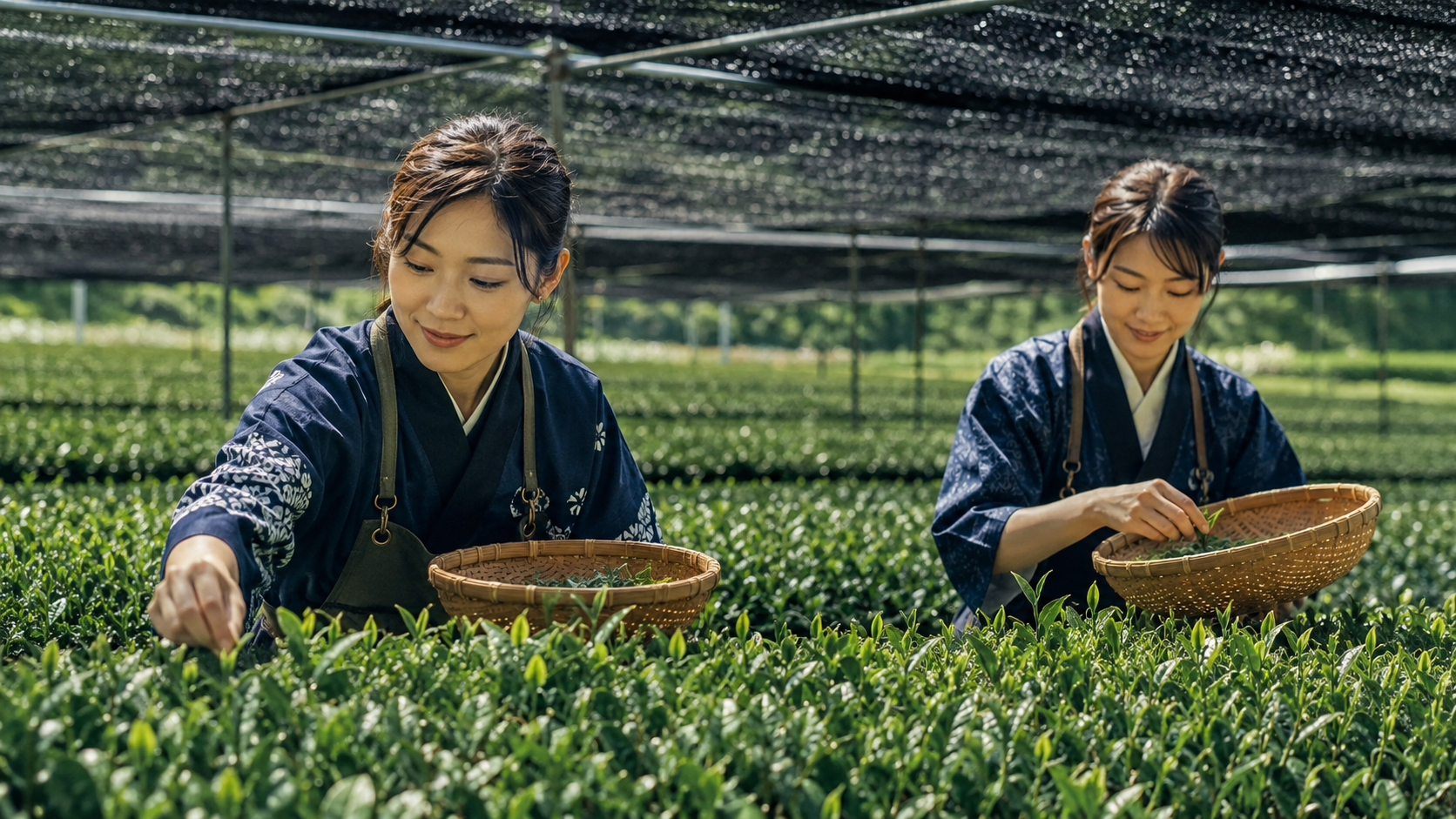


First harvest leaves from shade-grown plants are where the ceremonial grade story begins, and it’s the detail that accounts for most of what follows.
Walk into any health food shop or scroll through an online tea retailer and the word ceremonial appears on more matcha tins than the actual production volumes from Japan’s first harvest could possibly justify. The grade has become a marketing term as much as a technical one, which creates a problem for anyone trying to understand what they’re actually buying and whether the price difference between a ceremonial and culinary matcha green tea is real or performed. The differences are real. They’re specific enough to be observable before the first sip and significant enough to change whether the matcha is drinkable without additions.
Where the Leaf Comes From and When It Was Picked
First harvest leaves from shade-grown plants are where the ceremonial grade story begins, and it’s the detail that accounts for most of what follows. The shade covering applied in the final weeks before picking forces the plant to produce more chlorophyll in response to reduced sunlight, increases L-theanine concentration, and slows the development of the catechins responsible for bitterness. A young first-flush leaf from a shaded plant has a fundamentally different chemical composition from an older leaf from the same plant picked three months later under full sun.
Culinary grade draws from later harvests, older leaves, and sometimes parts of the plant that wouldn’t reach drinking grade selection. The shade period is shorter or absent. The leaf carries more catechins, less L-theanine, and the amino acid profile that produces sweetness and umami in a bowl of ceremonial matcha is reduced. None of that matters in a brownie where sugar and butter are doing most of the flavour work. In a plain bowl of whisked matcha it’s the difference between a drink and an ordeal.
What the Colour Is Telling You
The specific green of a high-grade matcha, vivid enough to look almost artificial against a white bowl, comes directly from the chlorophyll levels developed during shade growing. It’s not a processing characteristic. It’s a consequence of the plant’s biochemical response to reduced light, which means it’s an honest indicator of how the leaf was grown.
Culinary grade powder reads yellower and more muted because the chlorophyll levels aren’t there. The colour shift is visible without specialist knowledge, provided the comparison happens in natural light. Product photography can be adjusted to make almost anything look vibrant. The actual powder in the tin is harder to misrepresent when both grades are sitting side by side.
Whether It’s Drinkable Without Help
This is the test that separates the grades most honestly. Ceremonial matcha prepared simply and whisked with water at around 75 degrees produces a bowl with genuine umami quality and a bitterness level that sits in the background. People who have only ever encountered matcha in lattes and baked goods are surprised by how pleasant it is to drink this way.
Culinary grade prepared identically is unpleasant for most people. The bitterness dominates, and the umami that defines good ceremonial matcha is barely traceable. That’s not a failure, but it’s more of the product performing exactly as it was intended to, in applications where other ingredients provide the sweetness and the matcha’s intensity contributes depth. Using ceremonial grade in those applications wastes the quality entirely.
How It Behaves When Whisked
High-grade matcha produces a fine, stable foam with small uniform bubbles that hold their structure. The particle size achieved through slow stone grinding integrates with water smoothly and without grittiness on the palate.
Culinary grade ground to a coarser particle size or milled at higher speeds produces a foam that’s less stable and a texture that occasionally feels slightly gritty at the bottom of the bowl. In a blended latte, the texture difference disappears. In a traditional preparation it’s immediately apparent.
The Price Gap and What Drives It
Genuine first-harvest shade-grown matcha involves production costs that make very low price points impossible while maintaining grade integrity. The labour involved in shade installation, selective hand picking, and slow stone milling doesn’t compress to the price point of commodity food ingredient production. A ceremonial grade matcha priced comparably to culinary grade is almost certainly mislabelled, and approaching that category of product with appropriate scepticism before purchase produces better buying decisions than taking the grade designation at face value.
