

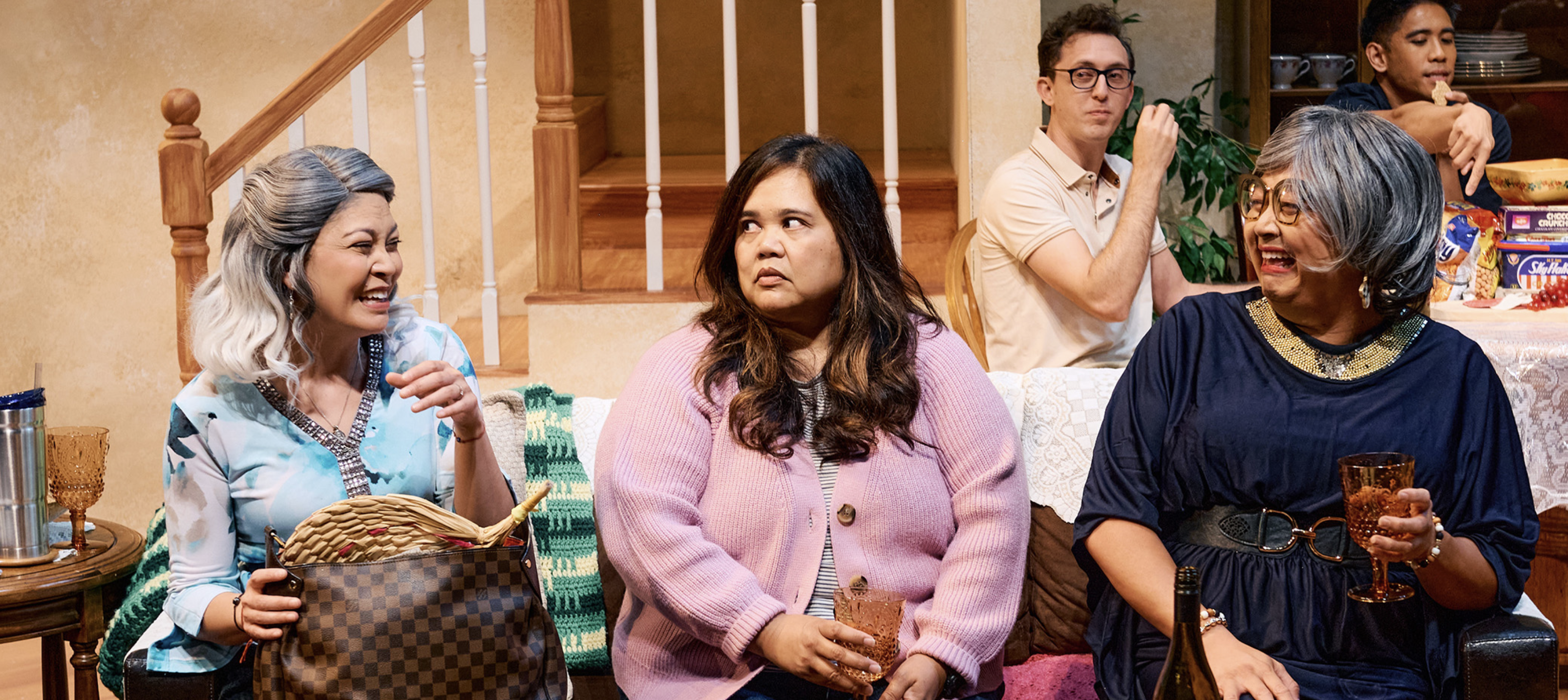

Front and center in God Will Do the Rest, and what sets it apart from typical fare on the American stage and screen, is its accent on Filipino culture.
GOD WILL DO THE REST: Theater Review
Nicholas Pilapil’s God Will Do the Rest has a sensibility that is somewhere in-between TV sitcoms and Eugene O’Neill tragedies. (Call it a “situation drama” or “sitdrama”?) For theatergoers in the USA, the uniqueness of this one-act play set in Cerritos, California is its Filipino milieu, the framework through which Rest’s family dynamic plays out. This cultural aspect is convincingly dramatized and served up by playwright Pilapil and director Fran de Leon, who are both of Filipino heritage.
The action takes place entirely in the living room and kitchen of the multi-generational de Dios household, which is exactingly, elaborately designed and decorated by Leah Ramillano, who has a keen eye for detail informed by her Filipina-American background. Ferdie (Reggie Lee, whose credits include Broadway and recurring roles on CBS’ All Rise and NBC’s Grimm) and Maggie (Rinabeth Apostol) are the 60-something immigrant couple who preside over their domain, which their 38-year-old business-minded daughter Fritzie (Josette Canilao) claims to have made financially possible for them. Fritzie is living with her Caucasian Jewish boyfriend Nate (Josh Odsess-Rubin), who is eager to please and curry favor with her family, although not to the point that he’ll abandon his own religion in the face of the de Dios’ brand of Catholicism (which includes something that’s arguably akin to idol worship).
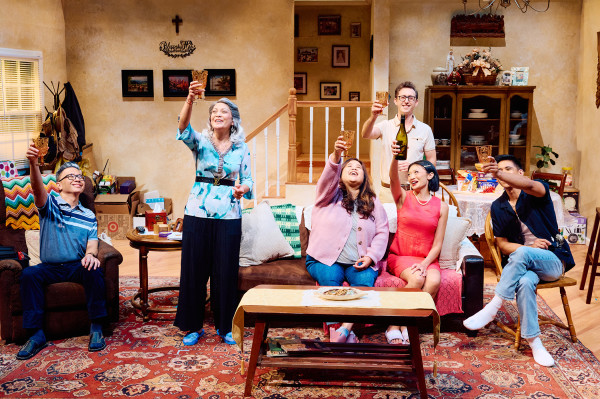 Reggie Lee, Rinabeth Apostol, Ellen D. Williams,Josh Odsess-Rubin, Josette Canilao, Ryan Nebreja
(Interestingly, last June another rare Philippines-centered production at LATC, the Latino Theater Company and Playwrights’ Arena production of Mix-Mix, The Filipino Adventures of a German Jewish Boy, also featured characters who were Jews. See: .)
Fritzie’s older angsty sister Connie (Ellen D. Williams of CBS’ How I Met Your Mother), who is undergoing a divorce, has “temporarily” alighted back at the family home. An overweight cosmetics saleswoman, Connie has an ongoing competition with her younger, prettier, more successful sister. This sibling rivalry mirrors the ongoing jousting between their mother Maggie and her own sister, Babette (a scene-stealing Jason Rogel portraying a female character), who loves to hit the sauce and amusingly pleads “jet lag” upon arriving at Cerritos from Los Angeles (a distance of only about 20 miles).
The final character is Tanner, (Ryan Nebreja), Connie’s openly gay son born out of wedlock who aspires to become a chef (even though he doesn’t know how to cook rice properly) and to learn about his Filipino roots. Maggie and Ferdie, a hard-working nurse who barely survived the pandemic, try to rule over the family, insisting upon and imposing their version of Catholicism. Connie bristles under their hegemony, but surprisingly, the apparently goody two-shoes Fritzie does so even more.
Ms. Canilao delivers the ensemble’s standout performance—it turns out that this businesswoman is not just a lapsed Catholic, but an avowed atheist. Fritzie’s romantic relationship with a Jew may be part of her rebellion against and rejection of her parents’ religiosity. (Although Fritzie’s interaction with Judaism doesn’t ring completely true, because it seems to contradict her adamant atheism. But maybe Fritzie’s one of those nonbelievers who thanks god she’s an atheist?) Whether delivering zingers or a rant, Ms. Canilao’s captivating performance creatively covers the spectrum, from the comedic to the dramatic. To behold Josette Canilao ping-ponging back and forth, alternately anxiously and exuberantly while watching a Lakers game on TV, is truly one of the joys of this year’s theater season. It’s almost enough to raise Kobe from the dead.
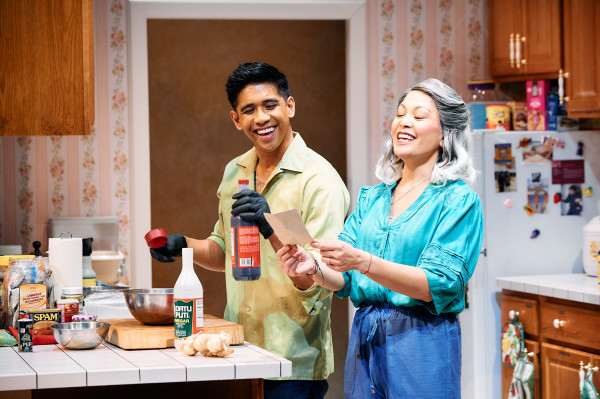 Ryan Nebreja and Rinabeth ApostolPhoto by M Palma Photography
Front and center in God Will Do the Rest, and what sets it apart from typical fare on the American stage and screen, is its accent on Filipino culture. This ranges from the adobo and lumpia dishes to the obsession with domestic appearances and tidiness when company is expected to the concept of “utang,” a transactional form of interpersonal indebtedness and obligations.
But above all else, as Connie laments and rails against, what may be the most Filipino thing about God is its zooming in on secrecy. Most of the characters have their secrets—including, as loose-lips-sink-ships Babette reveals, even Maggie and Ferdie. In one scene the longtime married couple have, at long last, the de Dios household to themselves, and they dim the lights, apparently to get their freak on. Their appearance as squares—for instance, Ferdie has an awful haircut—can be very deceiving. The ultra-religious Maggie’s deep dark past is quite a rocking revelation that I never saw coming.
However, when discussing the couple’s life back in the motherland, the playwright misses an opportunity. It is only mentioned in passing that the dictatorship of Ferdinand and Imelda Marcos played a major role in their decision to leave the martial law of the Philippines and move to America. Pilapil could have raised some political consciousness by expanding on the role the tyrannical Marcos regime played in the lives of his dramatis personae, but alas, this crucial fact is only mentioned in passing.
However, this plot point does provide an opening for the older characters to wax poetic about what it’s like to be an immigrant to a racist country, where the degrees earned at Third World universities are devalued and discounted in “developed” America, the land that had colonized the Philippines for about 50 years. And instead of politicizing his story Pilapil does heighten the drama by introducing another dire element—namely mortality.
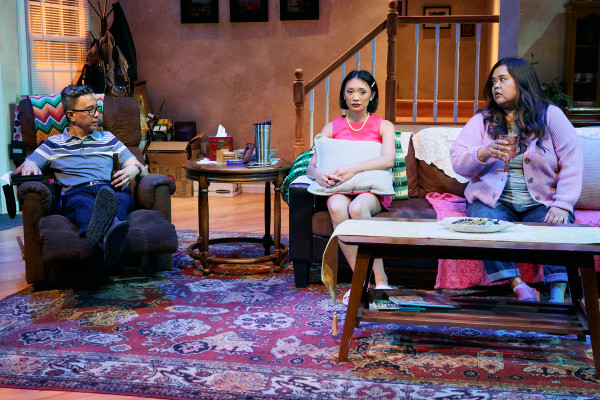 Reggie Lee, Josette Canilao,and Ellen D. WilliamsPhoto by M Palma Photography
De Leon directs the de Dios family adroitly, and there’s some clever mise-en-scène, that cleverly ties into a carving hanging at the rear of the house set: A rendering of Leonardo da Vinci’s The Last Supper, displayed courtesy of scenic designer Ramillano and/or properties designer Rye Mandel. At one point during the action the de Dios family is gathered for a feast around a dinner table and the blocking is such that the table tableau is reminiscent of Leonardo’s masterpiece—Fritzie even lightheartedly refers to herself as “Jesus.” Although it goes unmentioned, the subtext to this scene, which includes the Jewish Nate, is the fact that what da Vinci painted was actually a Passover Seder.
Before the proverbial curtain lifted, the Artistic Director of LATC, with its multiple theater complex ensconced inside of a former bank, Jose Luis Valenzuela—who, as far as this reviewer knows is the single individual most responsible for the perpetuation of this great cultural repository and venue for Angelenos—introduced the world premiere of God and welcomed the packed, enthusiastic, boisterous audience to the inaugural play of the Latino Theater Company’s Fall season. Three Producing Artistic Leaders from Artists At Play—which is co-presenting God with the Latino Theater Co., and “produces theatrical programming that explores the Asian American experience” according to Artists at Play—also welcomed the sold out crowd. They were Stefanie Lau, Marie-Reine Velez and Julia Cho, who portrayed CioCio in the outstanding This is Not a True Story almost a year ago in another AAP and LTC co-production.
God Will Do the Rest is almost two-hours, which is long for a one-act play. There’s a lot to take in as this is a sort of cross-cultural immersion that veers between comedy and tragedy, so the playwright might want to consider actually breaking the piece up into two acts. Be that as it may, the large audience seemed to enjoy the show, as did I, and it is recommended for theatergoers who enjoy Asian-American-themed works, family dramas, LGBTQ subjects, tight ensemble acting, and cuisine. Despite some minor quibbles, this God works—and works in mysterious as well as mirthful ways.
God Will Do the Rest runs through September 29 on Thursdays, Fridays and Saturdays at 8:00 p.m. and Sundays at 4:00 p.m. at the Los Angeles Theatre Center, 514 S. Spring Street, Los Angeles, CA 90013. For info and tickets: (213)489-0994; LA Theatre Center.
