

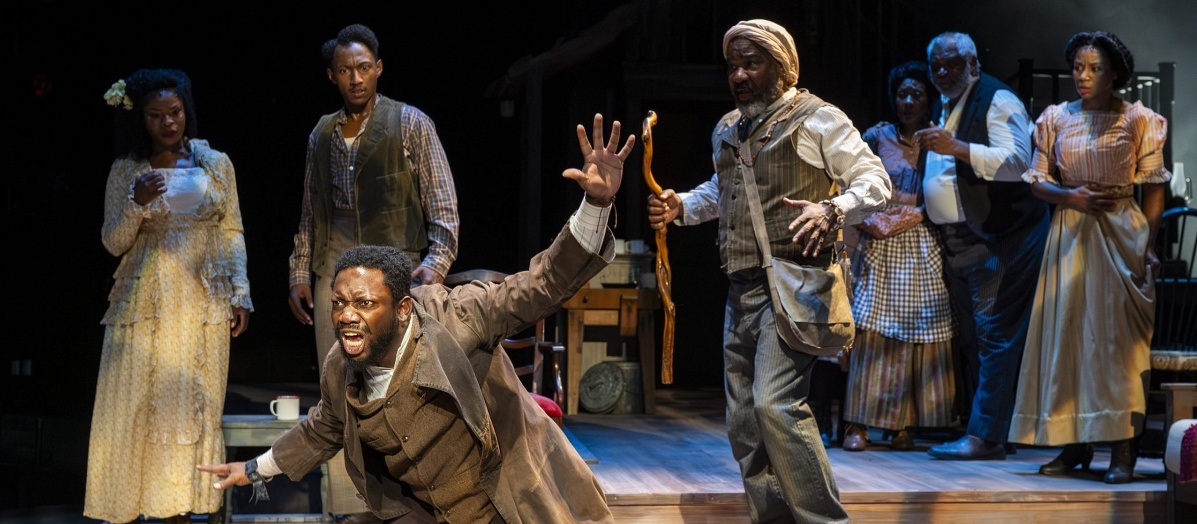


Joe Turner’s Come and Gone is for serious theatergoers who are interested in Black themes and history; lovers of stellar acting and storytelling; and fans who enjoy spooky plots and stage effects
JOE TURNER’S COME AND GONE Theater Review
A Noise Within’s powerful production of Joe Turner’s Come and Gone is quite cleverly timed, as due to supernatural subject matter, it is ideal for Halloween. Like most of August Wilson’s 10 “American Century Cycle” plays, the story is set in Pittsburgh, taking place in 1911. As the proverbial curtain lifts, director Gregg T. Daniel ingeniously and literally sets the scene – and sensibility – for Joe Turner’s Come and Gone, as members of his ensemble walk down the aisles of the mid-sized theater to mount the thrust stage. For this is a post-Civil War saga that follows African Americans moving up (literally and figuratively) from the South to America’s northern urban centers, in order to find more liberty and opportunity than permitted by their Jim Crow existence under Dixie’s American apartheid. They are part of “The Great Migration” of about 6 million Blacks, and Mr. Daniel has found a way to rather simply but effectively dramatize this mass movement through mise-en-scène. My hat is off to you, Mr. Daniel.
Well, all of these migrants need some place to stay, and the onstage action centers around a boardinghouse in Pittsburgh’s Hill District. The set is exquisitely, intricately rendered onstage by scenic designer Tesshi Nakagawa and scenic apprentice Angelene Storey. The rooming house is presided over by the hulking Seth (the redoubtable Alex Morris, a five-time NAACP Theater Award winner and an ANW Resident Artist whose credits there include two other Wilson plays, The Piano Lesson and Radio Golf). A formidable presence, Seth insists that his house is a respectable place, and although he insists on decorum, the owner respects his guests’ privacy. They are free to pursue their amorous activities under his roof, as long they don’t disrupt the status quo – and, but of course, pay their weekly fees for room and board. Seth’s wife, Bertha (Veralyn Jones, also an ANW Resident Artist, whose appearances at the South Pasadena theater likewise include a Wilson play, King Hedley II), is in charge of the boardinghouse’s cooking and cleaning, and provides a calming influence to counter her husband’s imperiousness, although she is also capable of flights of whimsy.
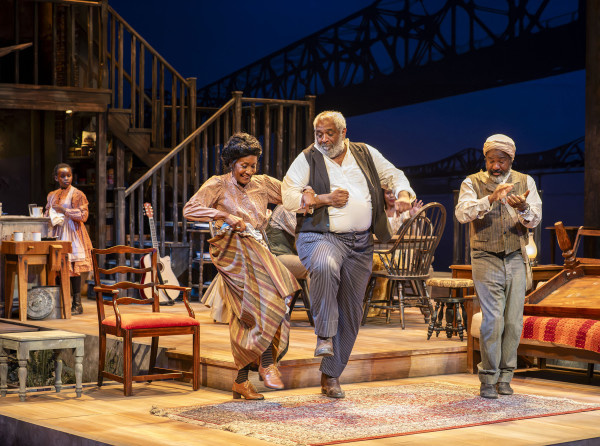 Jessica Williams, Veralyn Jones, Alex Morris and Gerald C. Rivers
One of the boarders is the young man Jeremy Furlow (Brandon Gill), a laborer eager to explore what the world has to offer. Still experiencing what Henry Miller called “crazy cock” days, the guitar strumming Jeremy woos the lovely, lonely Mattie Campbell (movingly depicted by Briana James), and lures her to move in with him. That is, until the sexy, free-spirited Molly Cunningham (Julliard-trained Nija Okoro) checks into Seth’s heartbreak hotel. Molly informs her innkeeper that she’ll have some gentlemen callers visit her at her room, which Seth okays, as long as she’s not a prostitute – and, but of course, pays her fee for room and board. Full of cunning, Ms. Cunningham is appropriately monikered, while her first name may be a reference to James Joyce’s sensuous Molly Bloom, and well-played by a zesty, scheming Ms. Okoro.
Amidst the shifting amorous alliances, the wild card at the rooming house is the brooding Kai A. Ealy’s intense Harald Loomis, an also aptly named looming presence. He and his little daughter Zonia (Jessica Williams) are searching for his long, lost wife, Martha (Tori Danner). To a great extent, their separation provides Wilson’s raison d’être for Joe Turner’s Come and Gone, which is nothing less than a loophole in the 13th Amendment of the U.S. Constitution. Passed in 1865 shortly after the Civil War, the 13th Amendment stated: “Neither slavery nor involuntary servitude, except as a punishment for crime whereof the party shall have been duly convicted, shall exist within the United States, or any place subject to their jurisdiction.” After the Emancipation Proclamation and liberation of the enslaved masses, this Amendment enabled unscrupulous racists to maintain a system of forced labor for those convicted of committing crimes. (Ava DuVernay’s 2016 documentary 13th also exposed and explored this constitutional escape clause, which has turbocharged the prison-industrial-complex and the school-to-prison pipeline.)
Hence, Wilson’s title for Joe Turner’s Come and Gone. According to Dissent Magazine: “Joe Turner” was a ‘mancatcher,’ who, in the first decade of the twentieth century, rounded up poor black sharecroppers who fell afoul of the law and sold them into slavery as ‘punishment for a crime,’ as the Thirteenth Amendment says”. (As for me, I prefer NAT Turner to Joe Turner, and would love to see another dramatization of that heroic freedom fighter, which would be more timely than ever.)
Briana James and Gerald C. Rivers (left) • Kai A. Ealy and Jessica Williams (right)
Convicted of a crime way down yonder in the land of cotton (and Jim Crow), Harald Loomis was imprisoned for seven years of hard labor. This led to the enforced separation from his wife, who, now that he’s no longer behind bars, he’s trying to track down on his trek up north. As for their fate, I won’t reveal a plot spoiler, but suffice it to say the denouement came as big surprise to this critic that I didn’t see coming.
The lynchpin for this colorful cast of characters is Bynum, a so-called “conjure man” who it is believed practices the mystical “hoodoo.” Bynum is vividly portrayed by the same actor who played a similar character last year in ANW’s production of Wilson’s King Hedley II named Stool Pigeon, who I described as “a scripture-spouting character cut in the cloth of the griot and ‘magical Negro’ archetypes, prone to exclaiming profundities such as: ‘God is a motherfucker!’ This dreadlocked soothsayer is slyly, whimsically played by Gerald C. Rivers”.
The ensemble’s token white character, Rutherford Selig (Bert Emmett), is the “People Finder,” who excels at hunting humans. Significantly and rather portentously, his ancestors include a man who sailed aboard ships that carried enslaved Africans to America during the Middle Passage, followed by another forebear, who tracked down fugitive slaves. Ironically, now he seeks to reunite individuals lost to one another.
 Jared Bennett and Jessica Williams
As a sort of “medicine man” or “voodoo priest,” Bynum plays a pivotal role by injecting a supernatural note into the play, that makes its staging around Halloween all the more timely. But as with the ghosts in Toni Morrison’s Beloved, the hocus pocus mumbo jumbo witchcraft type stuff is symbolic of humans being haunted by the past, the legacy of slavery and Jim Crow, which like Morrison, August Wilson evokes to great effect.
Gregg T. Daniel elicits outstanding performances from his gifted ensemble, although for my money the multi-talented Gerald C. Rivers is the first among equals here. In addition to co-starring in other ANW Wilsonian productions, King Hedley II plus as Wining Boy in The Piano Lesson, the prolific Rivers is a mainstay at Will Geer’s Theatricum Botanicum, yet may be best known for his uncanny reenactments of Reverend Martin Luther King.
Since 2019, A Noise Within has rather admirably presented six productions of August Wilson’s 10 plays also known as the “Pittsburgh Cycle.” Each of the 10 productions occur in a different decade of the 20th century mostly at that Pennsylvania city, the most famous of them being Fences, which takes place in 1957, and Ma Rainey’s Black Bottom, set in Chicago during the Roaring Twenties. Joe Turner’s Come and Gone is, chronologically, the second in Wilson’s wide sweeping decalogue of dramas about African Americans. It is arguably to theater what Wagner’s Ring Cycle is to opera.
Joe Turner’s Come and Gone is for serious theatergoers who are interested in Black themes and history; lovers of stellar acting and storytelling; and fans who enjoy spooky plots and stage effects (Karyn Lawrence is the lighting designer). As for me, I’m looking forward to ANW’s next four productions of August Wilson’s classic chronicles of African American life across the 20th century.
Joe Turner’s Come and Gone is being mounted through Nov. 9 on Thursdays, Fridays and Saturdays at 7:30 p.m.; Saturdays and Sundays at 2:00 p.m. The performance on Saturday, Oct. 25 is “Black Out Night,” an opportunity for an audience self-identifying as Black to experience the performance together; tickets include a post-show reception; non-Black-identifying patrons are welcome to attend, or to select a different performance. Post-performance conversations with the artists take place every Friday and on Sunday, Oct. 26. A Noise Within is at 3352 E. Foothill Blvd., Pasadena, CA 91107. For info: 626.356.3100 or www.anoisewithin.org.
