

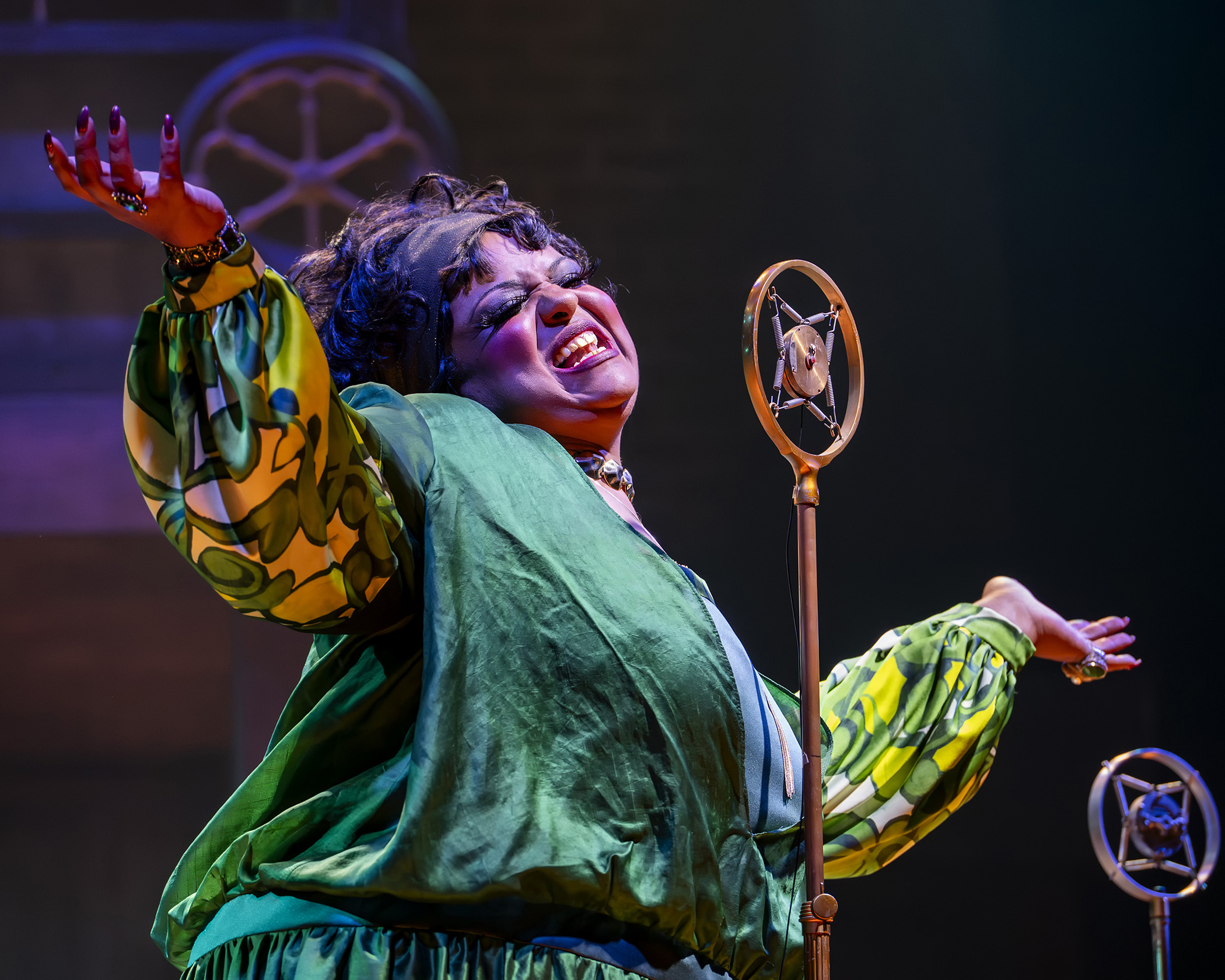

A Noise Within delivers a muscular staging of August Wilson’s classic, anchored by a commanding Ma Rainey and a tormented young trumpeter.
A Noise Within’s production of Ma Rainey’s Black Bottom is ANW’s seventh mounting since 2019 of August Wilson’s 10 “American Century Cycle” plays, directed by Gregg T. Daniel, and in my humble opinion, it is the best one I’ve seen so far. Wilson’s wide ranging decalogue of dramas about African Americans are also known as the “Pittsburgh Cycle” because each of the 10 productions occur in a different decade of the 20th century, mostly at that Pennsylvania city. However, Ma Rainey’s Black Bottom is set in Chicago in 1927.
Wilson’s two-act play essentially conforms to the Aristotelian unities of time, place and action, as it all happens within a few hours inside of a recording studio (scenic designer Tesshi Nakagawa and assistant scenic designer Angelene Story have rendered ANW’s stage unrecognizable, transforming it into a multi-level set). Costume designer Christine Cover Ferro’s fashion sense enhances the sense of the era that this period piece is set in.
In Ma Rainey’s Black Bottom, four Black musicians gather at the white music producer Mr. Sturdyvant’s (Matt Foyer) facility to record songs, including the eponymous number, to be crooned by the titular character, based on the actual historical figure of Gertrude “Ma” Rainey (Amber Liekhus), who has a larger-than-life presence, talent and ego. In real life – like onstage – she was nicknamed “The Mother of the Blues.” While Ma Rainey did indeed record discs in a Chicago studio circa 1927, Wilson uses this factoid as a launching pad with which to weave his fable that dramatizes the situation and struggle of African Americans during the Roaring Twenties.
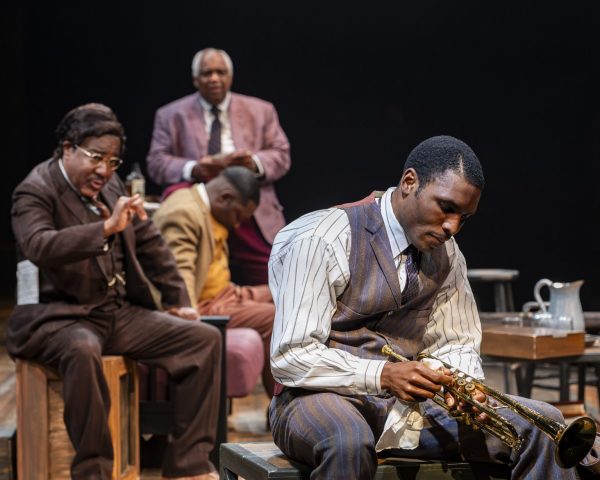 Gerald C. Rivers, Kai A Ealy, Alex Morris and Jamar Gilbert Photo by Craig Schwartz
 The prolific Gerald C. Rivers portrays Toledo, who is not only the piano player but an intellectual in the Harlem Renaissance mode who pontificates about Negritude and the plight of Blacks during that time period in the racist USA. Alex Morris (a five-time NAACP Theater Award winner and an ANW Resident Artist whose credits there include three other Wilson plays, The Piano Lesson, Radio Golf and Joe Turner’s Come and Gone) depicts the bass player Slow Drag. His longtime friend and musical and reefer smoking partner, the no nonsense trombonist Cutler (Kai A. Ealy), relates a droll tale regarding the derivation of Slow Drag’s moniker.
The band’s most youthful member, angsty trumpet-player Levee (Jamar Gilbert) is a proverbial young man with a horn, in a rush to get where he believes he’s going. Levee, who writes as well as plays music, is working a deal with Sturdyvant to record his own new-fangled music, which he insists is different and far more daring than what he derides as the “jug band” sound of his contemporaries, asserting this is what audiences really want to hear. The ambitious trumpeter is also planning to form his own group with simpatico musicians. Given to moody outbursts, Levee reveals a hair raising back story of racist oppression from his childhood that has left him with the festering wound of PTSD. Literally – if Nobel Prizes were awarded for scars, Levee’s would win, hands down (Sheila Dorn is the make-up designer).
The quartet kibbitz, rehearse and cool their heels (Levee has purchased a stylish pair of shoes, which he repeatedly spiffs up with a rag and is an important plot point) as the musicians wait for Ma Rainey to show up. She eventually does, accompanied by a Caucasian copper (James Nardini), and Ma’s manager, the much put upon Mr. Irvin (Bert Emmett, who also played a pivotal white character in Joe Turner’s Come and Gone), a schmoozer and people pleaser, has to bail Ma out of a yet another jam.
CJ Obilom and Amber Liekhus (left) • Jamar Gilbert and CJ Obilom (right)
The imperious, oversized Ma’s entourage also includes her lover, the much younger, opportunistic Dussie Mae (Nigerian-American CJ Obilom), and Ma’s youthful nephew, Sylvester (Francis C. Edemobi), who the egocentric singer is surprisingly solicitous of. Sylvester’s stutter is a source of mirth in this play originally produced back in 1984 on Broadway, when theatergoers were presumably less politically correct and sensitive about laughing at disabilities.
Having said that, Sylvester’s bit is indeed quite humorous (so shoot me!) and it should be said that on opening night, the final “character” in Ma Rainey’s Black Bottom was offstage: ANW’s audience. It was delightful to be part of a near capacity crowd that was in on the laugh, thoroughly enjoying itself as this pageant of Black lives mattered and unspooled in an extremely entertaining way across the stage. Cutler’s refrain when he began to play a song – “One, two, You know what to do” – was picked up by members of the aud who enjoyed repeating it out loud along with Ealy. In addition to the laughter, ovations were bestowed upon Liekhus when she sang. Really, if the LA Drama Critics Circle awarded prizes for “Best Audience,” I’d vote for Saturday night’s ticket buyers. It’s really great to see the peanuts gallery go nuts and have so much fun at an alive live theater.
But as uproariously funny as may be at times, Ma Rainey’s Black Bottom is also a tragedy. Not only does the troubled Levee spar with the other band members, but he clashes with the majestic Ma, a Black woman who insists that she – not her white producer or manager or her “underling” musicians – is the queen running the show. To make matters worse, Levee he is pursuing Ma’s gal, the mercenary Dussie Mae. This is all compounded by Sturdyvant’s attempt to manipulate and exploit the simmering Levee, who nears the boiling point.
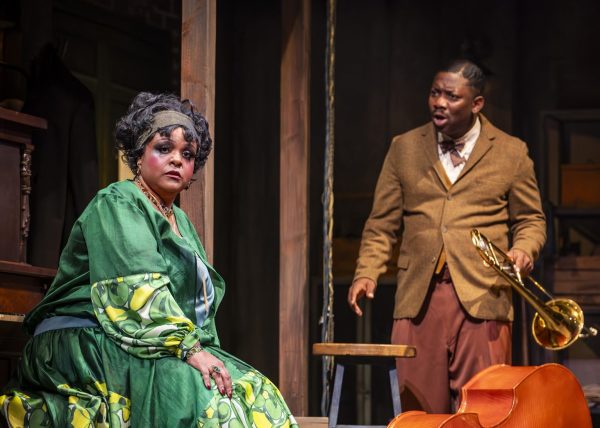 Amber Liekhus and Kai A. Ealy Photo by Craig Schwartz
I hate plot spoilers, so in terms of what happens next, let’s just say it reminded me of something that Frantz Fanon wrote about Algeria. According to the revolutionary psychiatrist, Arab-on-Arab crime was widespread in the casbah – until the Algerian war for independence from France got underway. Then the crime rate dropped and the Arabs stopped killing and hurting each other: Instead, they were channeling their rage and internalized aggression against the source of their misery. The Algerian freedom fighters were too busy killing their oppressors, the French colonizers, to harm one another…
Jamar Gilbert conveys Levee’s rising sense of disquiet and unease, and in doing so, evokes the despair and agony that oppression instills in the victims of an unjust history. Amber Liekus brings down the house with her sonorous voice that gives listeners an inkling why her character was known as the Mother of the Blues. And holy Toledo! Even with his trademark dreadlocks hidden beneath a wig, Gerald C. Rivers continues to impress with his range and breadth as a thesp. The versatile Rivers has graced Will Geer’s Theatricum Botanicum’s amphitheater for years as well as ANW’s stage, co-starring in other Wilsonian productions, Joe Turner’s Come and Gone, King Hedley II and as Wining Boy in The Piano Lesson. How fitting that Rivers, probably best known for his remarkable reenactments of Reverend Martin Luther King, portrays a Harlem Renaissance type artiste in Ma Rainey’s.
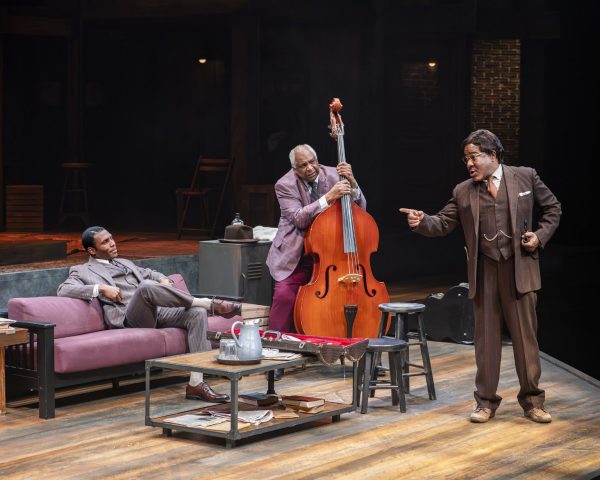 Lamar Gilbert, Alex Morris, Gerald C. Rivers Photo by Craig Schwartz
Once again, Gregg T. Daniel coaxes and captures soulful, haunting, haughty and mirthful performances from his ensemble with yet another stellar rendition of one of 10 of August Wilson’s “American Century Cycle” works. What will Daniel and ANW do once all 10 of Wilson’s decalogue have been mounted on this magnificent midsized theater’s boards? I don’t know, but I have a sneaking suspicion that the Producing Artistic Directors Julia Rodriguez-Elliott and Geoff Elliott and their ANW coterie have something to amaze, inspire and delight us with up their innovative sleeves. Until then, lovers of the live stage can enjoy ANW’s other fare and what’s left of Wilson’s 10-part cycle, which is, as I’ve written before, arguably to theater what Wagner’s Ring Cycle is to opera.
Don’t miss Ma Rainey’s Black Bottom, which is being mounted through Sept. 20 on Thursdays, Fridays and Saturdays at 7:30 p.m.; Saturdays and Sundays at 2:00 p.m. The performance on Saturday, Sept. 12 is “Black Out Night,” an opportunity for an audience self-identifying as Black to experience the performance together; tickets include a post-show reception; non-Black-identifying patrons are welcome to attend, or to select a different performance. Post-performance conversations with the artists take place every Friday and on Sunday (except Sept. 6). A Noise Within is at 3352 E. Foothill Blvd., Pasadena, CA 91107. For info: (626) 356-3100.
The fourth book co-authored by Ed Rampell and Luis Reyes about filmmaking in Hawaii is available here.
